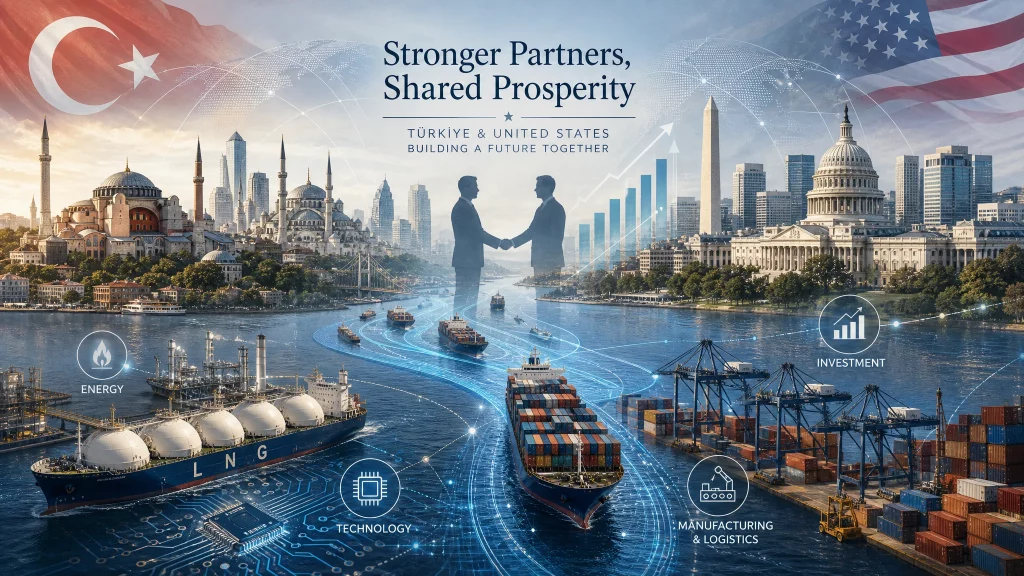
The $100 Billion Goal: How Energy and Tech Are Redrawing the U.S.-Türkiye Map
A long-discussed ambition in U.S.-Türkiye relations — lifting bilateral trade to $100 billion — is again being presented not as diplomatic slogan, but as a plausible economic goal, helped by rising business interest, expanding investment ties and a widening search for strategic cooperation in sectors from energy to artificial intelligence.
At a reception during the SelectUSA Investment Summit 2026, Michael Lally, the U.S. consul general in Istanbul, said the two countries were making “really good progress” toward that target in both trade and investment. The event brought together Turkish executives, American officials and business groups at a moment when Ankara and Washington are trying to give their relationship a more durable commercial foundation.
For Turkish Americans watching the relationship from afar, the message was striking: even when politics remain complicated, business ties are quietly deepening.
Turkish officials and American representatives have increasingly argued that commerce may be one of the most reliable ways to stabilize the broader partnership. Sedat Önal, Türkiye’s ambassador in Washington, said there was political will at the presidential level to widen cooperation across multiple fields, and he linked economic engagement to a larger strategic picture stretching from Ukraine to the Middle East and the Caucasus.
The numbers suggest momentum, though they also show how far the two sides still have to go.
Lally said trade volume and mutual investments together were nearing $48 billion, and that companies from both countries had held hundreds of meetings to explore partnerships. Earlier this year, Turkish Vice President Cevdet Yılmazsaid bilateral trade alone reached $39 billion in 2025, with $10.4 billion recorded in the first quarter of 2026 — figures that, if sustained, would point to continued growth but also underscore the gap between current commerce and the $100 billion aspiration.
The SelectUSA Investment Summit, organized by the U.S. Department of Commerce, has become a useful stage for this effort. This year’s gathering drew more than 5,500 attendees from over 100 countries and 55 U.S. states and territories, according to summit organizers. Lally said 33 Turkish companies joined the Turkish delegation, using the forum to explore opportunities across the American market, state by state.
That state-level focus matters. For many Turkish firms, the United States is no longer viewed only as a destination for exports, but as a place to build, acquire and invest. Önal urged Turkish businesses to look beyond Washington and consider the economic logic of individual states, where incentives, labor pools and industrial clusters can vary sharply.
American business already has a substantial footprint in Türkiye. Lally said 2,400 American companies operate there, creating networks that increasingly encourage Turkish partners to think in both directions: selling into the U.S. market while also planting roots in it.
Several sectors appear especially central to the next phase of the relationship. Lally pointed to artificial intelligence, robotics, information technology, construction, engineering and energy as promising areas for growth. Energy, in particular, has emerged as one of the clearest pillars of the commercial relationship. In separate remarks last year, Lally described energy cooperation — especially around LNG and infrastructure — as a practical route toward the $100 billion goal.
That reflects a broader shift in how the relationship is being framed. Rather than relying solely on traditional trade categories, both governments are increasingly emphasizing strategic industries, resilient supply chains and long-term investment. Türkiye’s geographic position, industrial base and regional logistics role give it appeal to American firms looking for diversified partnerships. The United States, in turn, remains an enormous capital market and consumer economy for Turkish companies looking to scale.
Still, optimism should be measured. A $100 billion trade target is ambitious by any standard, and U.S.-Türkiye ties have often been vulnerable to political shocks, sanctions debates and regional disputes. Trade can expand while mistrust persists elsewhere. Yet the persistence of business engagement — and the growing density of institutional and corporate links — suggests that both sides see value in building an economic relationship sturdy enough to survive political turbulence.
For Turkish-American professionals, investors and business leaders, that may be the most important takeaway. The story is no longer only about two governments trying to repair a difficult alliance. It is also about two markets, and two business communities, discovering that their interests may be more aligned than their politics sometimes suggest.
If the $100 billion target remains distant, it is at least no longer abstract. It is being pursued through boardrooms, summits, state-level outreach and sector-by-sector deals — the slower, less dramatic work through which durable economic relationships are usually made.
Sources
Reporting and context based on: