
Türkiye Steps Into the Hormuz Crisis — And Shows Why Washington Cannot Ignore Ankara
As the Strait of Hormuz crisis threatens global energy markets, Türkiye is positioning itself where serious powers must stand: in favor of open sea lanes, regional stability, and diplomatic de-escalation.
Turkish Foreign Minister Hakan Fidan said Türkiye supports efforts to reopen the Strait of Hormuz and warned that the waterway should not be used as a “weapon.” Speaking alongside Qatar’s prime minister and foreign minister, Fidan emphasized safe passage, diplomacy, and preventing the crisis from recurring
This is not a small issue. The Strait of Hormuz is one of the world’s most important energy chokepoints. The U.S. Energy Information Administration says about 20 million barrels per day moved through the strait in 2024 — roughly 20% of global petroleum liquids consumption. The same route also carried about one-fifth of global liquefied natural gas trade, much of it from Qatar.
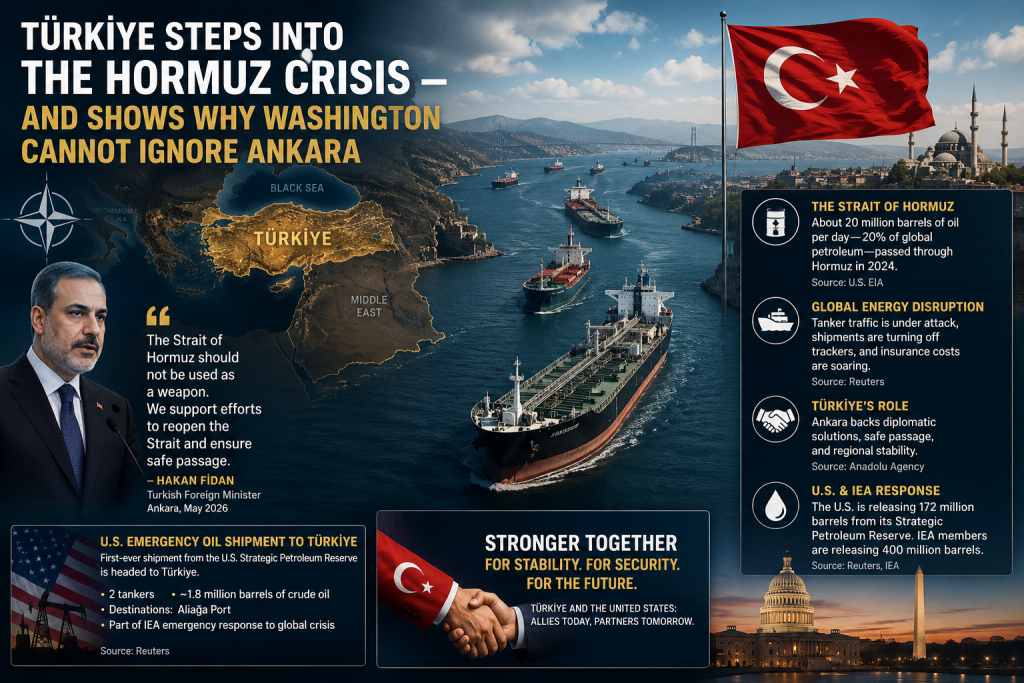
That is why Türkiye’s statement matters. The crisis has already become more than a regional confrontation. Reuters reported that shipping through Hormuz has been severely disrupted, with tankers attempting risky passages and some vessels turning off tracking systems to avoid attacks. Three crude tankers recently exited the strait under those conditions, carrying millions of barrels of crude.
Energy agencies are now warning that the impact could be severe. Reuters reported that the EIA assumes the strait may remain effectively closed through the end of May, with millions of barrels per day of Middle East oil production affected and oil prices remaining elevated.
For Turkish Americans, the lesson is clear: Türkiye is not a bystander in global security. It is a NATO ally, a regional power, and a country whose geography places it at the crossroads of the Black Sea, the Middle East, Europe, the Caucasus, and the Eastern Mediterranean.
At a time when some voices in Washington try to reduce Türkiye to a political talking point, the Hormuz crisis reminds policymakers of a harder truth: when energy routes are threatened, when regional war risks spreading, and when diplomacy is needed, Türkiye becomes indispensable.
The United States itself is already responding to the crisis by releasing oil from its Strategic Petroleum Reserve, including shipments headed to Türkiye as part of a broader International Energy Agency effort to calm markets. Reuters reported that the U.S. is releasing 172 million barrels from the SPR, while IEA members coordinate a record 400 million-barrel emergency release. ()
Türkiye’s message on Hormuz is measured but firm: the world’s critical waterways cannot become tools of blackmail. Safe passage must be restored. Diplomacy must work. And regional stability must be protected before the crisis spreads further into the global economy.
For TCUSAPAC readers, this is exactly why Turkish American civic engagement matters. Policymakers in Washington must understand Türkiye not through outdated stereotypes, but through strategic reality. Türkiye is not “the next Iran.” Türkiye is one of the countries trying to prevent a wider regional disaster. And in this crisis, Ankara’s role is not symbolic. It is strategic.