
A Small Opening on the Türkiye–Armenia Border — and a Bigger Fight Over What America Teaches
When Türkiye and Armenia take even a modest step toward normalizing ties, the ripple travels far beyond the Caucasus. It reaches American classrooms, state capitols, and diaspora communities for whom the region’s unresolved history is not an abstraction but a lived identity.
In February, Al-Monitor reported that direct land trade between Türkiye and Armenia is poised to begin, an incremental economic move that, in practice, would reduce the friction and indirect routing that has long shaped commerce between the neighbors. Other regional reporting points in the same direction, emphasizing practical mechanisms and cost reductions even as full normalization remains constrained by broader geopolitics. (Caspian Post; Turkiye Today)
For policymakers, this can be filed under “confidence-building.” For communities in the United States—particularly Armenian Americans and Turkish Americans—it can reopen an older, more emotionally freighted question: What should Americans be taught about the past, and who gets to define it?
The American arena: legislation, identity, and the curriculum
In 2026, the debate is not only about borders in the Caucasus. It is also about boundaries of memory in American civic life—especially in public education.
The American arena: legislation, identity, and the curriculum
In 2026, the debate is not only about borders in the Caucasus. It is also about boundaries of memory in American civic life—especially in public education.
In New York, proposed legislation would require instruction on the Holocaust and genocide and explicitly includes an additional unit that lists “the Armenian Genocide” among other historical atrocities. The bill’s stated rationale is to combat ignorance and hate and to reaffirm “never again.” (NY Senate S8191)
In New Hampshire, lawmakers are moving to extend the life and reporting deadline of a commission on Holocaust and genocide studies, a reminder that “genocide education” is increasingly treated not as a one-off lesson but as an ongoing state responsibility—with monitoring and recommendations built into the structure. (LegiScan NH HB1162)
And in New Jersey, a measure introduced in 2026 recognizes the Armenian Genocide and encourages education and awareness—an approach that may not mandate classroom instruction directly, but nonetheless signals how state government can shape public narrative and civic emphasis. (LegiScan NJ ACR33 text)
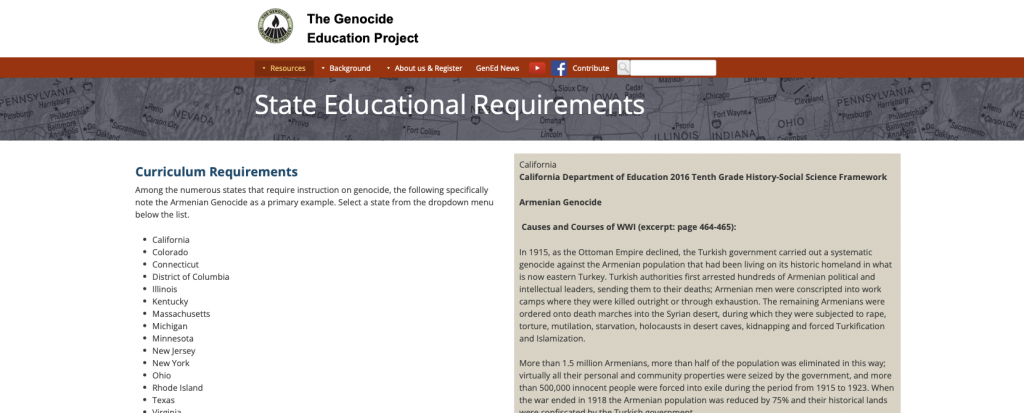
These bills sit inside a wider national pattern. Some states already have Holocaust/genocide education requirements, and advocacy groups continue to press for Armenian Genocide content to be included explicitly. (Context: Genocide Education Project — state requirements overview)
For many Armenian Americans, genocide education is framed as recognition, remembrance, and prevention—a safeguard against denial and a means of honoring family history.
For many Turkish Americans, the same push can feel like state-sponsored judgment that collapses complex history into a single mandated storyline, with downstream effects on how Turkish identity is perceived in schools and public institutions—particularly for children navigating belonging and stigma.
The result is a familiar American dynamic: a foreign-policy dispute that becomes a domestic cultural conflict, where legislation intended to teach tolerance can also be experienced—depending on one’s community—as marginalizing or accusatory.
t is possible for trade to move forward between governments even while diaspora tensions remain sharp. In fact, incremental normalization can sometimes intensify U.S.-based activism: each step becomes evidence for one side that “history is finally being acknowledged,” and for the other that “pressure campaigns are working.”
That is why the most consequential question for Turkish American civic organizations and readers may not be whether a trade corridor opens next month—but whether American institutions can hold two democratic commitments at once:
- the commitment to teach about mass atrocity and human rights with rigor, and
- the commitment to ensure that students are not turned into proxies for geopolitical disputes.
A technical trade step between Türkiye and Armenia may help reduce economic isolation and build trust in the region. But in the United States, the deeper test is whether education policy can inform without inflaming—and whether civic life can make space for disagreement without dehumanization.
When we talk about what these developments mean for Turkish Americans and what they can do, we are looking at the intersection of civic rights, education policy, and community advocacy.
The introduction of bills like New York S8191 and New Jersey ACR33 represents a shift where historical narratives are being codified into state law and school curricula. For Turkish Americans, this is often experienced as a “civil rights” issue—the concern that their children may face a one-sided or hostile environment in the classroom if the curriculum does not reflect the complexity of their heritage or if it encourages stigma.
Here is a breakdown of what this means in practice and the actionable steps Turkish Americans often take:
What This Means for the Community
- Educational Impact: If a state mandates a specific unit on the Armenian Genocide (as in the New York bill), it means that every public school student in that state will be taught a specific narrative. For Turkish American parents, this raises concerns about whether the instruction will be balanced or if it will lead to bullying and alienation of Turkish students.
- Political Precedent: Resolutions like NJ ACR33, even if non-binding, create a “political fact.” They signal to local politicians and school boards that there is a consensus on this issue, which can make it harder for Turkish American perspectives to be heard in future policy discussions.
- Identity and Representation: It means that the “cost of invisibility” (which we discussed regarding the ATAA webinar) is real. If the community is not counted or recognized as a distinct stakeholder, policies that affect their image and history are made without their input.
What Turkish Americans Can Do (Actionable Steps)
Based on the strategies discussed by organizations like the ATAA and the Turkish Coalition of America (TCA), here are the ways the community typically engages:
1. Civic Engagement and “Being Counted”
- Participate in the Census: Ensuring that Turkish Americans are accurately counted as a distinct group helps provide the data needed to demand representation.
- Voter Registration: Politicians respond to voting blocs. Increasing the number of registered Turkish American voters in key districts (like those in NY and NJ) ensures that representatives take the community’s concerns seriously.
2. Direct Legislative Advocacy
- Contact State Representatives: For bills like NY S8191, residents can write to their State Senators and Assemblymembers. The goal is often to ask for “inclusive” language that recognizes the suffering of all inhabitants of the Ottoman Empire during that period, rather than a single-sided mandate.
- Public Comments: Many state legislatures allow for public testimony or written comments on active bills. Providing a Turkish American perspective for the record is a critical step in the democratic process.
3. School Board Involvement
- Attend Local Meetings: Since school boards often have the final say on how a state mandate is implemented (the “unit of instruction”), Turkish American parents can engage with their local boards to ensure that the materials used are historically rigorous and do not promote animosity toward Turkish students.
- Review Curricula: Parents have the right to review the materials being taught to their children. If a curriculum is found to be biased or inaccurate, they can formally challenge it through the school district’s grievance process.
4. Coalition Building
- Work with Other Groups: Turkish Americans often find common ground with other Turkic communities (Azerbaijani, Uzbek, Kazakh) or other groups concerned about curriculum mandates.
- Support Advocacy Organizations: Groups like the ATAA and TCUSAPAC provide the legal and political infrastructure to fight these battles at a national level. Supporting them with time or resources helps scale the community’s voice.
5. Cultural Diplomacy
- Share the “Other Side” of the Story: Hosting cultural events, webinars (like the one you shared), and open houses helps humanize the community and provides a counter-narrative to the “terrorist sympathizer” or “denialist” labels that are sometimes used in political rhetoric.