
A Quiet Deal in Washington, a Loud Warning for Turkish Americans
The United States government is preparing to let a major state-owned bank from Türkiye walk away from one of the largest Iran sanctions-busting schemes in modern history with a slap on the wrist. For Turkish Americans who have spent years arguing that Türkiye can and should be a responsible, law-abiding ally, the message from Washington is as unsettling as it is clear: when politics intrudes, even terrorism financing can become negotiable.
At the center of the controversy is Halkbank, the Ankara-controlled lender that U.S. prosecutors say helped Iran move billions of dollars through the international financial system in violation of American sanctions. According to court filings and Treasury findings, the bank converted Iranian oil revenues trapped in accounts in Türkiye into Turkish lira, then gold, and ultimately cash that was hand-carried back to Tehran — a complex operation that routed an estimated $13–20 billionin transactions between 2012 and 2013, money that U.S. officials believe helped sustain Iran’s network of proxy militias across the Middle East, from Hezbollah in Lebanon to the Assad regime in Syria.
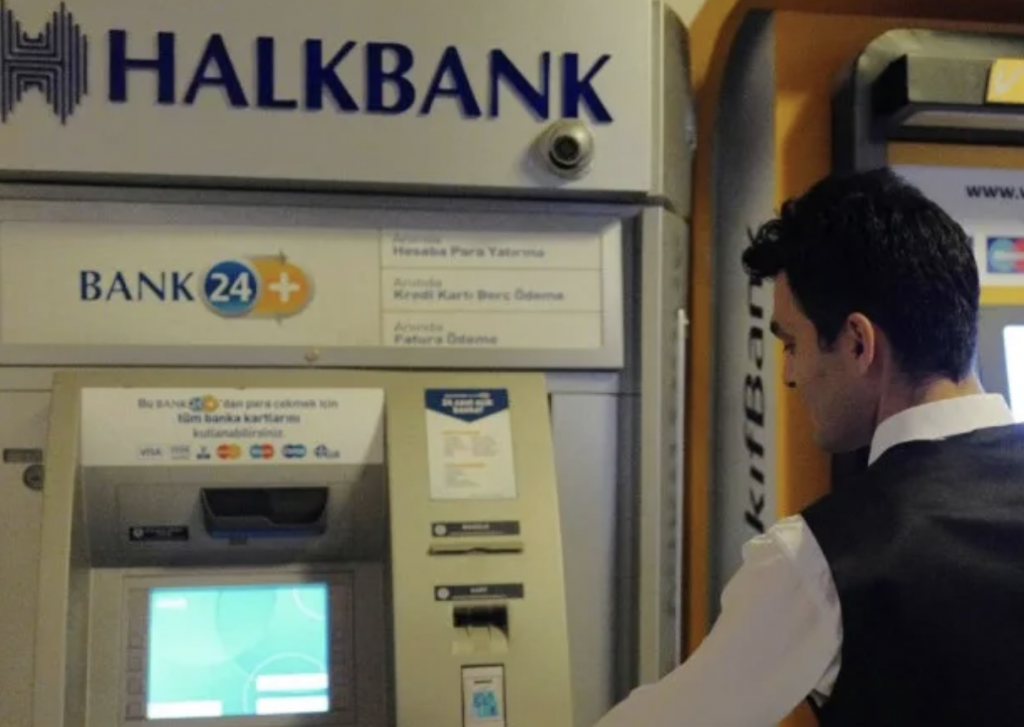
These accusations are not new. U.S. authorities indicted Halkbank in 2019. Two insiders — the Iranian-Turkish gold trader Reza Zarrab and Halkbank executive Mehmet Hakan Atilla — have already been convicted. What is new is Washington’s response. Rather than pursue the kind of multibillion-dollar penalties levied against European banks such as BNP Paribas and Standard Chartered for comparable conduct, the Trump administration has agreed to a deferred prosecution agreement, according to reporting in The Hill and summarized by Yahoo News. If approved by a federal judge, the deal would allow Halkbank to avoid a criminal conviction, pay a comparatively modest settlement and continue to access the U.S. dollar system — all without an independent compliance monitor to verify that it has truly changed its ways.
Why is Washington going soft now, after years of insisting that the integrity of its sanctions regime is non-negotiable?
Analysts point to geopolitics. President Recep Tayyip Erdoğan has methodically positioned Türkiye as an indispensable broker on a range of U.S. priorities: cease-fire talks in Gaza, de-confliction in northern Syria, and occasional shuttle diplomacy between Russia and Ukraine. In the wake of the October 2025 cease-fire between Israel and Hamas, President Trump publicly praised Erdoğan’s “strong leadership” in hostage negotiations — praise that officials in Türkiye have eagerly highlighted at home.
Behind closed doors, that diplomatic leverage appears to have been converted into leniency for Halkbank. For Mr. Erdoğan, the stakes are personal and political. A full trial, with the risk of multibillion-dollar fines, could expose the involvement of senior aides and even members of his family, while threatening a bank deeply embedded in the fragile economy of Türkiye, which is already weakened by inflation and capital flight. Shielding Halkbank from the harshest consequences means shielding the president himself and insulating the financial sector of Türkiye from further shock.
But the cost of that bargain is borne elsewhere — in U.S. credibility, in the deterrent power of sanctions, and in the trust of communities, including Turkish Americans, who expect both Ankara and Washington to uphold the rule of law.
A pattern, not an exception
Halkbank is not an isolated case. Another bank from Türkiye, Kuveyt Türk, is currently the subject of civil litigation in federal court in New York. Plaintiffs allege that the bank routed dollar transactions for Hamas through correspondent accounts at major U.S. banks, “knowingly” facilitating transfers that helped support attacks in the West Bank between 2015 and 2018, according to filings reported by The Hill.
A lower court initially dismissed the case for lack of jurisdiction in 2023. It was reinstated in 2025 after new evidence surfaced, underscoring an uncomfortable reality: multiple institutions from Türkiye with access to New York’s financial plumbing have been accused of enabling groups that Washington itself designates as terrorist organizations.
Under Section 311 of the U.S.A. Patriot Act, the Treasury Department’s Financial Crimes Enforcement Network has the power to designate banks as “primary money-laundering concerns,” effectively cutting them off from the U.S. financial system. That fate has befallen smaller institutions in far less strategically important countries. For now, however, neither Halkbank nor Kuveyt Türk has faced such a penalty.
Instead, the administration appears to be carving out political exceptions — making Türkiye a test case for whether U.S. sanctions are applied consistently or selectively, depending on the day’s diplomatic needs.
What this means for Turkish Americans
For Turkish Americans, this moment is doubly fraught.
On one side, many in the community have long argued that Türkiye can be a vital democratic partner — a NATO ally anchored in the West, economically dynamic and strategically essential. They have urged members of Congress to distinguish between the people of Türkiye and the policies of an increasingly authoritarian government.
On the other side, the allegations against Halkbank and other institutions cannot simply be dismissed as bias against Türkiye. The evidence produced in U.S. courts documents a deliberate effort to help Iran bypass sanctions designed to curb its nuclear ambitions and limit funding for organizations that target both American interests and civilians across the Middle East.
When Washington appears willing to look away from those violations, it risks sending a dangerous message: that corruption and complicity are tolerated so long as the perpetrator is a convenient partner. For Turkish Americans working to build bridges — whether in politics, business, or civil society — that message undermines years of painstaking work.
It raises difficult questions in living rooms and community centers from New Jersey to California:
- What does it mean when a bank owned by the government of Türkiye is accused of enabling Iran-backed terror, and yet is spared the consequences faced by others?
- Can Turkish Americans credibly advocate for stronger U.S.-Türkiye ties while Ankara treats sanctions as something to be negotiated away rather than obeyed?
- And if Washington is prepared to bend the rules for Türkiye today, whose interests will it sacrifice tomorrow?
A call for principle — and for accountability
The answer is not to punish ordinary citizens of Türkiye or to sever ties with a key NATO ally. It is to insist that the same rules apply to everyone.
For policymakers in Washington, that means:
Reconsidering the Halkbank settlement
Any deferred prosecution agreement should be transparent, commensurate with the scale of the violations, and accompanied by an independent monitor with the authority to scrutinize Halkbank’s books and report directly to U.S. regulators.Using existing tools against repeat offenders
If credible evidence shows that banks from Türkiye continue to facilitate financing for sanctioned entities, Treasury should not hesitate to invoke its Section 311 authorities — regardless of the diplomatic discomfort this may cause.Engaging civil society and diaspora voices
Turkish American organizations, including advocacy groups such as TCUSAPAC, can play a crucial role in explaining to Congress that leniency toward sanctions-busting banks does not help Türkiye; it entrenches corruption and further isolates the country from responsible global finance.
For Turkish Americans, this is also a moment of choice. Speaking out against illicit finance and terror funding is not against the interests of Türkiye; it is profoundly in favor of a stronger, more respected Türkiye. A transparent, accountable banking system is essential for the long-term prosperity of Türkiye and for the safety of its citizens at home and abroad.
At a time when Iran’s proxies threaten stability from the Eastern Mediterranean to the Gulf, allowing a friendly government’s banks to operate by a different set of rules does not strengthen the alliance. It cheapens it.
In that sense, the Halkbank deal is more than a legal settlement. It is a test of whether the United States still enforces its own standards when they become politically inconvenient — and of whether Turkish Americans will accept a foreign policy that treats Türkiye not as a partner bound by shared values, but as a problem to be managed with quiet exemptions.
If Washington fails that test, the damage will not be limited to courtrooms or balance sheets. It will be felt in the erosion of trust — in U.S. institutions, in the governance of Türkiye and, ultimately, in the very idea that law can stand above politics.
Source:
- Sinan Ciddi, Tyler Stapleton and Max Meizlish, “Why is Washington going soft on the Turkish banks enabling Iran’s terrorism?” The Hill, March 11, 2026.
- “Opinion – Why is Washington going soft on the Turkish banks enabling Iran’s terrorism?” Yahoo News, March 11, 2026.