
As Syria’s Kurdish Force Recedes, a Long-Running U.S.-Turkiye Dispute Begins to Fade — and a New One Takes Shape
For nearly a decade, one issue has routinely jammed the gears of the U.S.-Turkey alliance: America’s partnership in Syria with the Kurdish-led Syrian Democratic Forces, or SDF — a group Ankara views as inseparable from the PKK insurgency it has battled for decades.
Now that irritant is diminishing fast.
In a striking shift described by analysts as the “unravelling” of the SDF’s semi-autonomous project in northeastern Syria, the Trump administration has moved to back a new Syrian government’s push to reassert central control, while signaling that Washington’s security partnership with the SDF is no longer what it once was. Turkey, long frustrated by U.S. support for the group, stands to gain strategically — and diplomatically — from the change. Middle East Eye
The story is being told in different registers depending on the outlet: for some it is the end of “Rojava,” the Kurdish name for the SDF-controlled region; for others it is a pragmatic consolidation of state authority after Syria’s years of fragmentation; and for critics it is an American abandonment of a battlefield partner that helped defeat ISIS.
But across those narratives, one fact stands out: when the SDF weakens, the U.S.-Turkey relationship becomes easier — at least on paper.
A partnership that outlived its original war
The United States began working with Kurdish fighters in Syria in 2015 as the fight against the Islamic State demanded reliable ground forces. The coalition the U.S. supported became the SDF — multi-ethnic on paper, Kurdish-led in practice, anchored by the YPG, which Turkey views as an extension of the PKK. The “caliphate” was territorially defeated in 2019, but the U.S. partnership continued in part because the SDF remained central to counter-ISIS operations and the guarding of ISIS detainees. The Indian Express
The political logic shifted after the fall of Bashar al-Assad and the emergence of a new Syrian leadership under President Ahmed al‑Sharaa. In that new reality — as Middle East Eye reports — Washington’s earlier argument for sustaining the SDF as leverage against the Assad state and its Iranian backers lost force, and a Trump administration skeptical of Syria entanglements became more willing to treat Syria as falling within Turkey’s sphere of influence. Middle East Eye
The “integration” deal: unity on Damascus’s terms
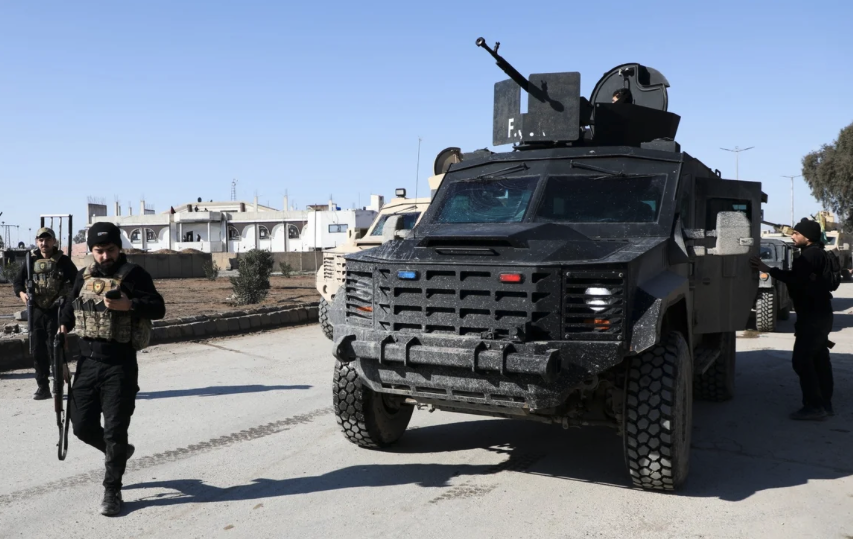
According to Middle East Eye, the SDF’s rapid territorial and political contraction culminated in a deal that compels SDF fighters to integrate into the Syrian army as individuals — not as intact Kurdish units — and rejects calls for federalism or semi-autonomy. Middle East Eye
A parallel strand of analysis from ISPI describes the same direction of travel: the SDF edging toward capitulation, with integration framed as national reunification; a fragile ceasefire under pressure; and Washington increasingly treating Damascus — not the SDF — as its primary partner on the ground. ISPI
As the SDF loses Arab-majority areas and the coalition frays, analysts cited by ISPI argue the SDF’s leverage erodes: revenue from oil-producing areas, local legitimacy among tribes, and — most consequentially — the perception that the United States would step in when the SDF was threatened. ISPI
Turkey’s win — and Washington’s tradeoff
For Turkey, the strategic logic is straightforward: if the SDF’s autonomy project collapses and the YPG’s armed footprint shrinks, Ankara’s border-security argument is vindicated, and the biggest U.S.-Turkey dispute inside Syria becomes less combustible. Middle East Eye quotes Gonul Tol of the Middle East Institute calling “Rojava” a poison pill for U.S.-Turkey relations — and argues that its unravelling removes a “main irritant.” Middle East Eye
For the United States, the benefit is also clear: aligning more closely with Turkey’s stated security priorities could reduce intra-alliance friction at a moment when Washington is juggling multiple global crises. Middle East Eye further suggests that some analysts see downstream effects — potentially giving Washington more room to ask for Turkish cooperation on files like Gaza and Ukraine. Middle East Eye
But the tradeoff is not small. It centers on the ISIS problem — not as a slogan, but as a management challenge: prisons, camps, detainee transfers, and the risk that chaos produces escapes and insurgent reconstitution. The Indian Express reports that CENTCOM ordered transfers of up to 7,000 ISIS-linked detainees from Syria to Iraq amid rising violence, and noted escapes during the fighting — a reminder that a collapsing security architecture can create the very vacuum ISIS historically exploits. The Indian Express
ISPI similarly frames the concern less as ISIS “reconquering territory” tomorrow and more as degraded custody and fragmented coordination leading to a dispersed, harder-to-contain threat. ISPI
What this means for TCUSAPAC readers — and Turkish Americans in the U.S.
For Turkish Americans, this is the kind of story that can raise visibility and scrutiny at the same time.
1) The narrative battlefield in Washington will intensify.
As U.S. policy shifts away from the SDF, Kurdish-American advocacy networks will likely frame the moment as a betrayal of an anti-ISIS partner and a humanitarian risk. Turkish-American organizations will face pressure to respond — and the biggest strategic mistake would be to respond in ethnic terms rather than national-interest terms.
2) A “good news” cycle for Ankara can still produce domestic blowback in the U.S.
If Americans perceive the shift as empowering a hardline Syrian consolidation or increasing ISIS risk, there can be congressional pushback even if the White House is aligned with Ankara on the fundamentals. Middle East Eye notes Senator Lindsey Graham’s warnings and sanctions rhetoric in response to Syrian advances. Middle East Eye
3) There is a constructive lane for Turkish-American advocacy.
A TCUSAPAC‑consistent posture that travels well in Washington is:
- emphasize Turkey’s legitimate security concerns and the need to prevent an ISIS rebound,
- support stabilization arrangements that protect civilians and reduce displacement,
- push for transparent, monitored detainee/security frameworks as control shifts from the SDF to Damascus and partners.
In other words: the strongest argument is not “Turkey wins”; it’s “the U.S. and Turkey should align on a responsible security transition that prevents ISIS from exploiting the vacuum.”
The new irritant replacing the old one
If the SDF question recedes, it will not leave a blank space. It will likely be replaced by new disputes that are harder to manage because they involve outcomes rather than partners: detainee security, human rights allegations, and the credibility of the new Syrian state as a long-term counterterrorism partner.
The U.S.-Turkey relationship may become smoother at the top line — fewer public clashes over who Washington arms in Syria — while becoming more fragile underneath, if ISIS incidents rise or if Syria’s consolidation produces new rounds of instability.
Sources (and related coverage)
- Middle East Eye — “Rapid unravelling of SDF removes ‘main irritant’ in US-Turkey ties”
- ISPI — “Syria: Al‑Sharaa’s Offensive Against the SDF Reshapes the Balance of Power”
- The Indian Express — “An expert explains: As the US moves Islamic State detainees out of Syria…”
- (Context we previously used) The Wall Street Journal — U.S. concerns about Syria operation expanding