
Historic Thaw: Türkiye and Armenia Ease Visa Restrictions in Landmark Step Toward Normalization
A diplomatic breakthrough signals new possibilities for regional cooperation and diaspora communities
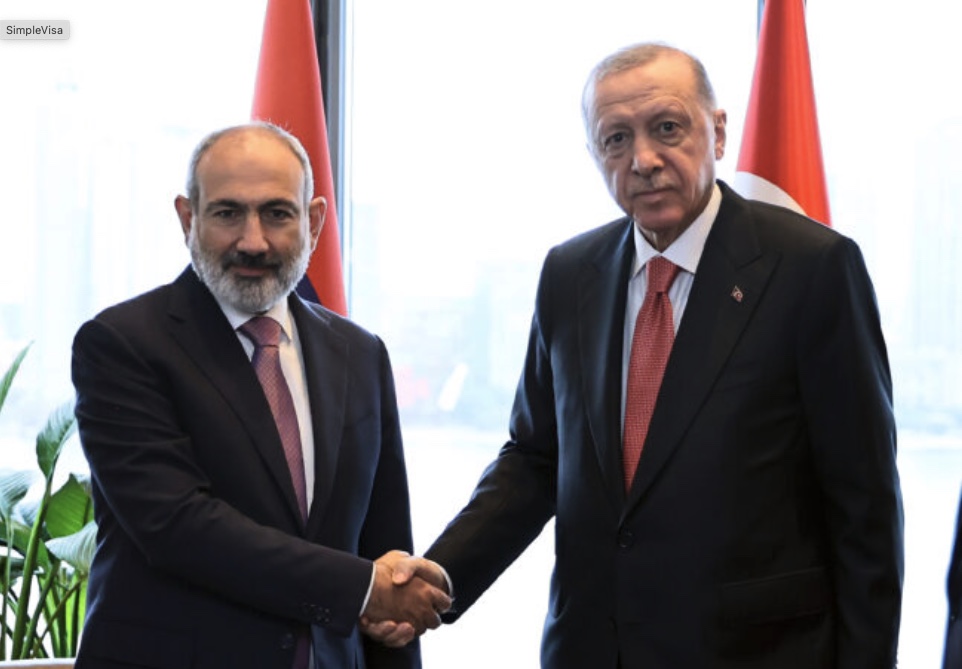
WASHINGTON — In a significant diplomatic development that could reshape relations in the South Caucasus, Türkiye and Armenia have agreed to simplify visa procedures for diplomatic and official passport holders, marking the most tangible progress in decades toward normalizing ties between the two neighbors.
Effective January 1, 2026, holders of diplomatic, service, and special passports from both countries can now obtain free electronic visas, eliminating bureaucratic hurdles that have long complicated official travel between Ankara and Yerevan. The move, announced jointly by both foreign ministries in late December, represents a carefully calibrated confidence-building measure in what both governments describe as a process aimed at “full normalization without any preconditions.”
A Border Closed for Three Decades
The visa facilitation agreement comes against the backdrop of a relationship frozen since 1993, when Türkiye closed its land border with Armenia in solidarity with Azerbaijan during the Nagorno-Karabakh conflict. The two countries have maintained no formal diplomatic relations, and their shared border has remained sealed—a physical manifestation of historical grievances that include the contentious legacy of the 1915 mass killings of Armenians in the Ottoman Empire, which Armenia and many historians characterize as genocide. Türkiye has consistently rejected that designation.
Yet recent geopolitical shifts have created new momentum for rapprochement. Following Azerbaijan’s military victories in the 2020 Karabakh war, which fundamentally altered the regional balance of power, both Ankara and Yerevan have signaled willingness to explore normalization. In 2022, the countries appointed special envoys—Turkish Ambassador Serdar Kılıç and Armenian Deputy Parliament Speaker Ruben Rubinyan—to lead talks.
The visa easing represents the most concrete outcome of those discussions to date. Turkish President Recep Tayyip Erdoğan hinted at the move in mid-December, telling Turkish ambassadors that “some symbolic steps will be taken from the beginning of next year.” Armenian Prime Minister Nikol Pashinyan welcomed the statement, saying “the time has come” for both symbolic and substantive progress.
Beyond Symbolism: Practical Implications
While the current agreement applies only to a limited category of travelers—government officials, diplomats, and holders of special passports—analysts view it as a critical foundation for broader engagement. The streamlined e-visa processeliminates both costs and paperwork, facilitating more frequent high-level exchanges on trade, security, and cultural cooperation.
Additional signs of warming relations have emerged in recent weeks. On December 22, Ambassador Kılıç announced that Turkish Airlines would launch direct Istanbul-Yerevan flights starting March 11, 2026, supplementing existing service by the low-cost carrier Pegasus. Turkish media have also reported preparations to open the Alican Border Crossing, initially for freight transport and later for passenger traffic.
Armenian officials have moved in parallel, with Prime Minister Pashinyan requesting that Russia “urgently address” the restoration of railway sections adjacent to the Turkish border—infrastructure that could eventually facilitate cross-border trade and connectivity.
Implications for Turkish Americans and Regional Diaspora Communities
For Turkish Americans and the broader diaspora communities in the United States, this diplomatic thaw carries profound significance that extends well beyond visa procedures.
The normalization process could fundamentally reshape how Turkish American organizations engage with regional issues and advocate for their community’s interests. As Türkiye and Armenia move toward establishing formal diplomatic relations, Turkish Americans may find new opportunities to serve as bridges—facilitating cultural exchanges, business partnerships, and people-to-people connections that have been impossible for three decades.
Economic and Cultural Opportunities: If the border fully reopens and visa restrictions ease for ordinary citizens, Turkish Americans with family ties or business interests in the region could benefit from enhanced mobility and trade corridors. The potential restoration of railway links and the opening of border crossings would create new economic opportunities, particularly for entrepreneurs and investors in the diaspora community who could facilitate cross-border commerce.
Advocacy and Recognition: The normalization process also has implications for how Turkish American advocacy groups position themselves on regional issues. Organizations like the Turkish American Steering Committee (TASC) and others have long worked to promote Türkiye’s interests in Washington. A successful normalization with Armenia could strengthen arguments that Türkiye is a constructive regional actor committed to peace and stability—a narrative that resonates in U.S. policy circles.
Minority Recognition and Identity: For Turkish-speaking American communities—including those who identify with the proposed Turkish Speaking Americans Minority Alliance (TSAMA) framework—the diplomatic breakthrough underscores the importance of distinct recognition separate from broader Middle Eastern and North African (MENA) categories. As Türkiye demonstrates regional leadership through normalization efforts, Turkish Americans may find renewed momentum for advocating for their community’s unique identity and contributions within the American mosaic.
U.S. Policy Considerations: The United States has long encouraged Türkiye-Armenia normalization as part of broader efforts to promote stability in the South Caucasus. For Turkish Americans engaged in policy advocacy, the current progress provides an opportunity to highlight Türkiye’s constructive role and to argue for continued U.S. support for regional integration initiatives. The normalization process could also ease some of the tensions that have complicated Turkish American relations with Armenian American communities, potentially opening space for dialogue and cooperation on shared interests.
Challenges Remain
Despite the positive momentum, significant obstacles persist. The normalization process remains closely linked to the Armenia-Azerbaijan peace negotiations, which have yet to produce a comprehensive settlement. Historical grievances, particularly regarding the events of 1915, continue to cast a long shadow. And domestic political considerations in both countries could complicate further progress.
Moreover, the current visa facilitation applies only to a narrow category of travelers. For ordinary citizens seeking to visit family, conduct business, or explore cultural heritage sites, the border remains effectively closed, and standard visa procedures—with associated fees and bureaucratic requirements—continue to apply.
A Cautious Path Forward
Regional analysts view the visa easing as part of a broader trend toward liberalized travel policies across Eurasia. Armenia recently granted visa-free entry to citizens of Gulf Cooperation Council countries, while Türkiye has introduced visa-free travel for Chinese tourists. These moves reflect growing recognition that mobility and connectivity serve as engines for economic growth and diplomatic engagement.
Whether the current momentum leads to full normalization—including the reopening of the land border, the establishment of diplomatic missions, and the resolution of historical disputes—remains uncertain. But for now, the ability of Turkish and Armenian officials to travel more easily between their capitals represents a small yet meaningful step toward overcoming decades of estrangement.
As Armenian Foreign Minister Ararat Mirzoyan noted in late December, “I believe that we will definitely have very positive progress in this direction… in the very near future, very soon.”
For a region long defined by frozen conflicts and closed borders, even cautious optimism represents progress.
Sources:
- ABC News: Turkey and Armenia agree to simplify visa procedures to normalize ties
- Turkish Minute: Turkey, Armenia to waive e-visa fees for special passport holders in 2026
- TRT World: Türkiye, Armenia agree on visa facilitation in push for full normalisation
- The Armenian Mirror-Spectator: Armenia and Turkey ‘Simplify’ Visa Procedure for Diplomats and Other Officials
- Travel And Tour World: Türkiye and Armenia Unveil Game-Changing E‑Visa System for Diplomats