
How Turkey’s Support Helped Maduro Survive — and Why It Matters Now
When U.S. forces carried out a bold raid on Venezuelan soil on Jan. 3, arresting President Nicolás Maduro and flying him to New York to face federal narcotics charges, the world took notice not only of American power but of the fragile web of international backing that had helped Mr. Maduro cling to power for years.
One of the most consequential — and least examined — strands in that web was Turkey.
Long perceived primarily as a strategic partner of the West and a NATO member with a complex diplomatic identity, Turkey under President Recep Tayyip Erdoğan quietly became one of Nicolás Maduro’s most resilient partners, offering not just rhetorical support but economic lifelines that helped Caracas evade Western pressure and sustain an embattled regime
From Solidarity to Strategic Support
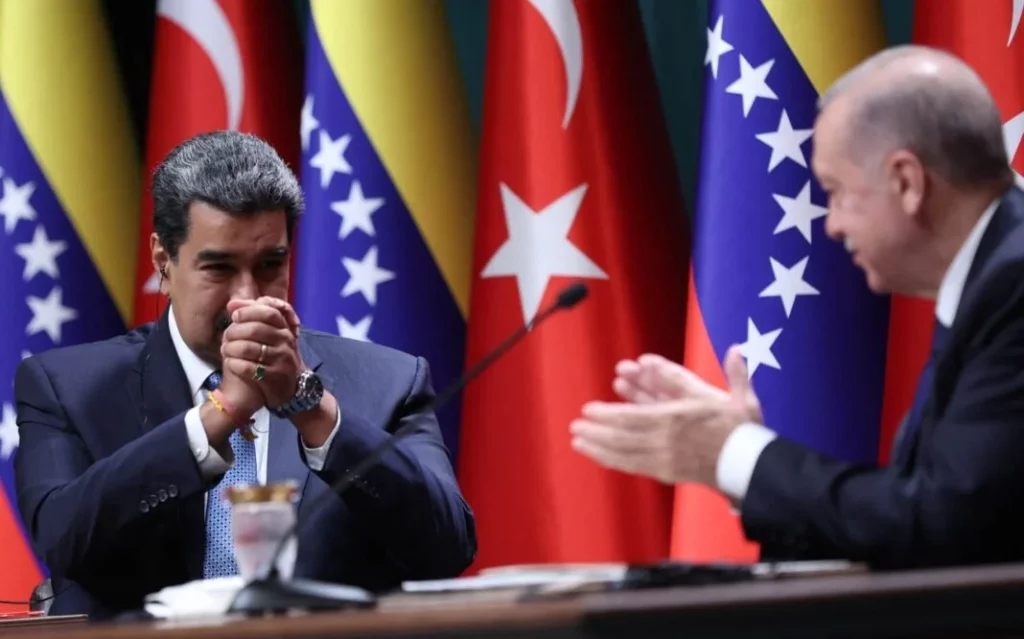
Turkey and Venezuela’s relationship predates the 2026 crisis, but it accelerated dramatically over the last decade.
Diplomatic and economic ties between Ankara and Caracas began to deepen around 2016, with regular high-level visits and a mutual interest in expanding trade and cooperation despite ideological differences. By the late 2010s, Venezuelan and Turkish officials were celebrating burgeoning commerce and political solidarity.
But analysts say that in recent years Turkey’s engagement evolved from symbolic friendliness into something far more consequential: a buffer against sanctions and isolation.
Turkish corporations invested in Venezuelan oil, gas, petrochemical, and mining projects, signing agreements worth hundreds of millions of dollars and providing Caracas with access to foreign markets and hard currency. Ankara also imported Venezuelan gold, offering a financial lifeline that helped Mr. Maduro’s government maintain liquidity in the face of U.S. sanctions.
That economic cooperation took place against a backdrop of political affinity. Turkey was among the few NATO capitals to publicly support Mr. Maduro’s resistance to calls for his removal and opposed U.S. recognition of the Venezuelan opposition in 2019. Erdoğan expressed support for Maduro at key moments, reflecting a shared antipathy to what both leaders viewed as Western interference.
Why Turkiye’s Role Is Significant
For years, Washington and its allies have sought to pressure Mr. Maduro’s government through sanctions targeting the state oil company, government officials, and the financial networks that sustained Caracas. But external partners like Turkey — along with Russia, China and Cuba — undercut that pressure.
That foreign backing, particularly economic, helped Maduro withstand a crippling downturn in oil revenue, persistent inflation and internal dissent. To critics in Washington, Ankara’s involvement was more than diplomacy: it was an intentional strategy to help a sanctioned authoritarian government endure.
A policy brief titled Turkey’s Strategic Support for the Maduro Regime Deserves Attention — released this month by the Washington think tank Foundation for Defense of Democracies — argues that Turkey’s assistance crossed a dangerous line, facilitating sanctions avoidance and prolonging an oppressive regime that has driven more than 7 million Venezuelans into exile during its years in power. The brief calls on U.S. policymakers to consider sanctions on Turkish-linked entities that abetted Caracas’s economic resilience.
A Diplomatic Tightrope After Maduro’s Capture
Even as Turkey cultivated ties with Maduro, it has been cautious in its public response to his dramatic removal.
After the U.S. operation, President Erdoğan criticized what he termed actions that “violate political legitimacy and international law,” echoing traditional Turkish calls for respect for sovereignty. But Ankara stopped short of openly condemning Washington or offering direct support to Maduro’s inner circle, now dispersed.
Some analysts suggest the muted response reflects the fine line Turkey walks: preserving working relations with Washington while maintaining its own independent foreign policy and strategic partnerships. Turkey’s diplomatic posture reflects a broader trend in Ankara’s approach — asserting autonomy from Western influence while avoiding outright confrontation that could jeopardize cooperation on issues ranging from NATO defense to trade.
Still, domestically, Erdoğan’s long support for Mr. Maduro has become a point of contention, with critics questioning whether Turkey’s engagement with Caracas ultimately served its national interest or simply tied Ankara to an increasingly isolated figure whose fall now reverberates internationally.
What Comes Next
The sudden collapse of Mr. Maduro’s grip on power has left a vacuum that Turkey and other longtime supporters must now navigate carefully.
For Ankara, the challenge is twofold: maintaining strategic autonomy in a shifting geopolitical landscape, and managing relations with Washington as the United States reshapes its presence in Venezuela and the wider region.
The broader lesson may be this: in an era of shifting alliances, where economic ties and political solidarity can extend the life of governments under pressure, traditional foreign policy assumptions are being rewired. Turkey’s role in Venezuela’s fate is a reminder that even distant partnerships can have outsized implications — for sanctions regimes, regional stability, and the future of democratic governance.
Source: