
No “Strategic Convergence” in the Greece–Turkey Dialogue — and Why It Matters in Washington
ANKARA/ATHENS — A new essay from the Middle East Forum argues that the latest Greece–Turkey “dialogue” is masking a hard reality: the two NATO allies may be talking more, but they are not moving closer on the core questions that actually drive crises in the Aegean and Eastern Mediterranean. Source:
The author’s bottom line is blunt: Greece and Turkey continue to describe the relationship as manageable through diplomacy, but their starting points remain fundamentally incompatible—especially on sovereignty, maritime zones, and how international law should apply.
What the MEF article claims is really happening
The piece frames the current moment as “process without progress”:
Athens wants a narrow, legally bounded agenda—primarily delimitation of maritime zones—grounded in international law and the law of the sea.
Ankara, in this telling, seeks a broader renegotiation of the status quo, and uses dialogue to widen the agenda beyond what Greece is willing to recognize as legitimate disputes.
The author points to Turkey’s navigation advisories and continuing “grey zone” arguments as evidence that the conversation is not converging toward a shared legal framework.
It’s an argument written from a clearly pro-Greek, hard-line lens on Ankara—but it captures a real, recurring pattern: whenever tensions cool, the disputes don’t disappear; they merely go dormant.
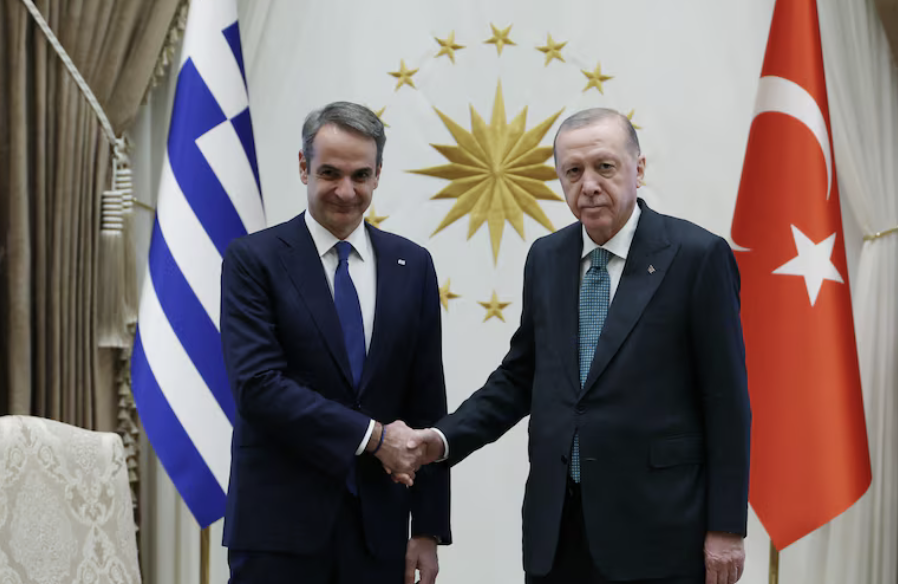
In the past two days (Feb. 11–12, 2026), the public tone improved after a leaders’ meeting in Ankara. Both President Recep Tayyip Erdoğan and Prime Minister Kyriakos Mitsotakis spoke in favor of dialogue and cooperation, while acknowledging the disputes are complex.
But the flashpoints remain the same—and they’re the reason analysts keep warning about “no convergence”:
Maritime boundaries and rights in the Aegean/Eastern Med (also tied to energy and military posture).
Greece’s sovereign right (under its view of international law) to extend territorial waters, versus Turkey’s long-standing casus belli stance if Greece does so in certain areas—raised again publicly by Mitsotakis.
Cyprus and the wider security architecture in the Eastern Mediterranean.
So: the “dialogue” is active, but the settlement logic is still stuck.
Why this matters to Turkish Americans in the United States
This isn’t just a distant Aegean quarrel. It shapes U.S. policy choices that directly affect Turkish Americans’ advocacy environment—especially on Capitol Hill.
1) Congress and the “who is destabilizing” narrative
When Greece–Turkey tensions flare, Washington conversations often compress into simple storylines. Those storylines influence:
congressional letters,
defense authorization language,
sanctions pressure,
arms sales politics (and the conditions attached to them).
For Turkish Americans engaged in civic advocacy, this is the arena where reputational framing becomes policy gravity—hard to reverse once it sets.
2) U.S. defense cooperation and procurement decisions
Greece is deepening defense ties with partners; Turkey seeks its own defense priorities. When Athens–Ankara disputes rise, U.S. policymakers face louder calls to “choose” or to condition defense cooperation. That can spill into debates around U.S.–Türkiye defense trade, interoperability in NATO, and restrictions/strings attached to cooperation—all of which Turkish Americans hear about from family, business networks, and community organizations.
3) Energy corridors and Eastern Mediterranean alignment
Energy and infrastructure projects (gas corridors, electricity interconnections, regional investment) are increasingly wrapped into geopolitical blocs. When the region is framed as “alliance vs. spoiler,” diaspora communities often get pulled into a messy messaging fight that affects public opinion, think-tank ecosystems, and media narratives in the U.S.
4) Community relations at home
Greek-American and Turkish-American organizations both engage Washington. When bilateral tensions spike, it can harden domestic polarization—making it harder to advocate on issues where there is overlap (trade, disaster cooperation, people-to-people ties, and stability in NATO’s southeast flank).
What TC-USA PAC readers should watch next
Any concrete move (or refusal) on the casus belli / territorial waters issue.
Whether the “positive agenda” (trade, disaster response, science) produces durable habits of cooperation—or just photo-ops.
U.S. signals: whether Washington leans into mediation, strategic ambiguity, or quiet alignment with one side’s legal framing (the MEF article explicitly urges the U.S. to back Greece more firmly).