The Fracture: How the Collapse of Türkiye-Israel Relations Is Reshaping the Middle East — and Why Turkish Americans Cannot Afford to Look Away
A 77-year alliance unravels in real time. For the diaspora caught in the middle, the stakes have never been higher.
On a chilly evening in December 2025, Israeli Prime Minister Benjamin Netanyahu stood before cameras and delivered a warning aimed squarely at Ankara. Türkiye, he cautioned, “should not even think about” restoring Ottoman imperial ambitions in the region. Thousands of miles away, Turkish television pundits fired back with bravado, claiming their military could seize Israel’s capital within 72 hours.
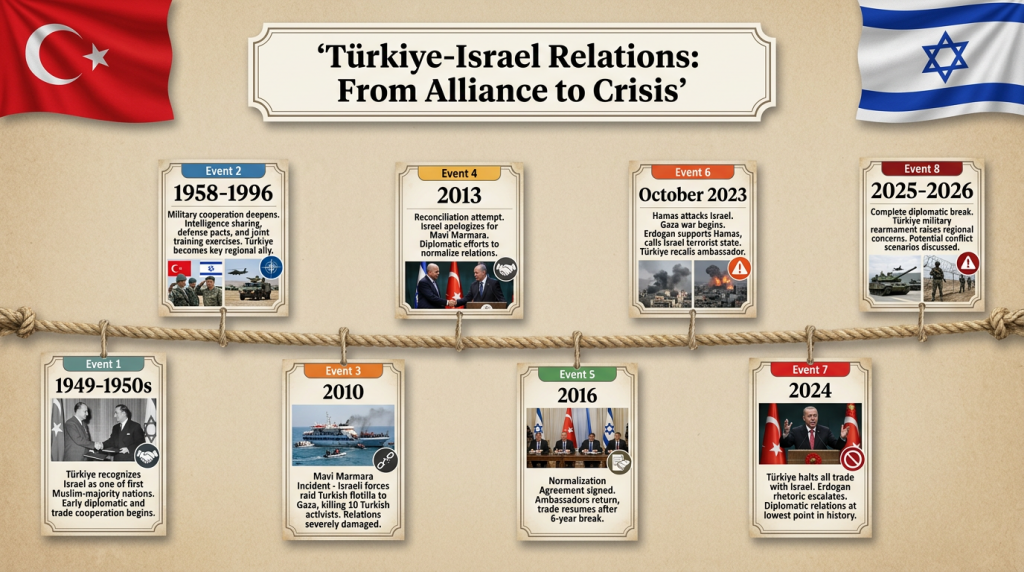
This was not the rhetoric of fringe voices. It was the new normal between two nations that, barely three years earlier, had announced the full restoration of diplomatic ties. That détente, forged in August 2022 with promises of natural gas pipelines and economic cooperation, now lies in ruins — shattered by the catastrophic fallout of October 7, 2023, and the devastating war in Gaza that followed.
As of May 2026, the relationship has deteriorated to its lowest point since Ankara first recognized the Jewish state in 1949. Trade has been severed. Ambassadors recalled. Legal proceedings filed. And in both capitals, military planners are quietly contemplating scenarios unthinkable a decade ago: direct armed confrontation between two of America’s most important allies.
For the estimated 500,000 Turkish Americans living in the United States, this is not an abstract geopolitical puzzle. It is personal. It shapes how their heritage country is perceived in Washington, how their advocacy organizations operate on Capitol Hill, and ultimately, how they are seen by their neighbors, colleagues, and elected officials. The fracture between Ankara and Jerusalem reverberates through their lives in ways both visible and invisible — and the choices this community makes in the months ahead could influence the trajectory of one of the most consequential rivalries in the modern Middle East.
From Allies to Adversaries: A Partnership That Once Anchored the Region
To understand the depth of the current crisis, you have to understand what was lost. The Türkiye-Israel relationship was never a casual friendship. It was a strategic pillar — one that the United States relied upon to maintain stability across a volatile region.
The partnership blossomed in the 1990s, when two non-Arab, democratic-leaning powers found common cause. Türkiye offered Israel geographic proximity to Iran and a crucial intelligence vantage point. Israel offered Türkiye something equally valuable: influence in Washington. Pro-Israel advocacy groups on Capitol Hill frequently supported Ankara’s interests, creating a virtuous cycle of mutual benefit that served both nations and their American patron. For Turkish Americans, this era represented a kind of golden age — their heritage country was broadly viewed in Washington as a reliable NATO ally and a bridge between East and West.
The cracks began to appear in the 2000s, widened under the pressure of the Arab Spring, and finally ruptured over the question of Palestine. The 2010 Mavi Marmara incident — in which Israeli commandos killed ten Turkish citizens aboard a humanitarian flotilla bound for Gaza — marked the first major break. Relations were downgraded again in 2018, when Israeli forces killed dozens of Palestinian protesters during demonstrations against the relocation of the U.S. Embassy to Jerusalem, prompting Ankara to expel the Israeli ambassador.
The 2022 Reset: A Brief Window of Hope
Then came the surprise. In August 2022, Türkiye and Israel announced a full normalization of diplomatic ties. President Recep Tayyip Erdoğan, facing a struggling economy and approaching pivotal elections, calculated that de-escalation could attract foreign investment, generate goodwill in Washington, and strengthen Ankara’s hand in the energy-rich Eastern Mediterranean. For Israel, the prospect of routing its offshore natural gas to Europe through Turkish pipelines was an irresistible economic incentive.
This was the first key turning point in the modern timeline of relations — a moment when it seemed the cycle of crisis and reconciliation might finally stabilize. Diplomats exchanged ambassadors. Business delegations crossed borders. Analysts spoke cautiously of a “new chapter.”
It lasted barely fourteen months.
October 7 and the Collapse
The Hamas attack on Israel on October 7, 2023, and Israel’s subsequent military campaign in Gaza, detonated whatever goodwill had been rebuilt. This was the second decisive turning point — the event that transformed the relationship from strained to openly hostile. President Erdoğan publicly defended Hamas as a “resistance” movement rather than a terrorist organization, a position that placed him at direct odds with both Israel and the United States. Diplomatic relations were downgraded once more. And in May 2024, Ankara imposed a near-total ban on approximately $7 billion in annual bilateral trade, conditioning its resumption on a permanent ceasefire.
The escalation did not stop there. By August 2025, Turkish authorities had blocked all ships carrying military equipment, radioactive materials, or explosives destined for Israel from using Turkish ports. Ship operators were required to declare they had no connections to Israel, with false statements punishable by fines and expulsion from Turkish waters. In April 2026, Türkiye filed formal indictments against Netanyahu and other senior Israeli officials for alleged war crimes.
The hopeful reset of 2022 was not merely over. It had been replaced by something far more dangerous.
Three Flashpoints That Could Ignite a Wider Conflict
The Türkiye-Israel rivalry is not confined to angry speeches and trade embargoes. It is playing out across three distinct theaters, each carrying the potential for catastrophic miscalculation.
Gaza: The Diplomatic Minefield
Despite the hostility, Washington has pushed for Türkiye to play a stabilizing role in post-war Gaza. Under a U.S.-initiated peace plan endorsed by the UN Security Council in late 2025, Ankara agreed to participate in a multinational task force to monitor a ceasefire and train Palestinian security forces. Turkish Foreign Minister Hakan Fidan was even appointed to the Gaza Executive Board of the Trump administration’s newly created “Board of Peace.”
Israel has rejected this arrangement outright. Israeli officials argue that Erdoğan’s defense of Hamas disqualifies Türkiye from any role in Gaza’s future. The result is a diplomatic standoff with the United States caught in the middle — trying to leverage Ankara’s genuine influence over Hamas while reassuring Israel that its security concerns will be honored.
Syria: The Most Dangerous Front
If Gaza is a diplomatic minefield, Syria is a potential shooting war. The fall of the Assad regime in December 2024 — the third critical turning point on the timeline — created a power vacuum that both Türkiye and Israel are racing to fill. Ankara has moved aggressively to expand its influence, backing Sunni Arab forces to counter Kurdish groups it considers terrorists. Israel views this Turkish expansion with alarm, fearing that a permanent military presence on its northern border would constrain the Israeli Air Force’s freedom of action.
This is not hypothetical. In early 2025, an Israeli airstrike hit a prospective Turkish airbase near Palmyra, Syria — a stark reminder of how quickly competition for influence could become kinetic. An Israeli think tank warned in January 2026 that a “Sunni-Turkish axis” was replacing Iranian influence in Damascus and that Israel must prepare for rapid escalation.
The Eastern Mediterranean: Energy, Territory, and Naval Rivalry
The third front is the sea. During the years of Türkiye-Israel estrangement, Israel forged a powerful trilateral partnership with Greece and Cyprus — a grouping Ankara views as an “anti-Türkiye axis” designed to box in its maritime ambitions and cut it off from vast offshore natural gas reserves. In December 2025, the leaders of Israel, Greece, and Cyprus met to deepen their defense collaboration. Cyprus has acquired Israel’s Barak MX air defense system. Joint military exercises have become routine.
For Türkiye, these developments represent an encirclement strategy — a coordinated effort to deny it the energy resources and strategic position it believes it deserves. The result is a slow-motion naval arms race in one of the world’s busiest shipping corridors.
The Arms Buildup: Strength or Provocation?
Underpinning Ankara’s increasingly assertive posture is a decades-long effort to build an indigenous defense industry. The results have been impressive. Turkish-made Bayraktar drones proved their worth on the battlefields of Ukraine, Libya, and the Caucasus. New warships, armored vehicles, and missile systems are rolling off production lines and finding eager buyers across Africa and Asia.
President Erdoğan has explicitly linked this military buildup to the Israeli challenge. “We must be very strong so that Israel cannot do these things to Palestine,” he declared in 2024. “There is nothing stopping us from doing so. We just need to be strong enough to take these steps.”
Türkiye’s 2026 defense budget reflects this ambition: a record 2.155 trillion lira (approximately $51.4 billion), a nearly 34 percent increase from the previous year, supporting 49 modernization projects. These include the Kaan fifth-generation fighter jet, the Kizilelma jet-powered drone, new ballistic missiles, and the “Steel Dome” air defense system — an indigenous answer to Israel’s Iron Dome.
But a closer look reveals significant gaps. The celebrated Altay main battle tank has reportedly only three units in service. The aging F-16 fleet still awaits upgrades hampered by U.S. restrictions. The Steel Dome remains in development. And perhaps most revealing, when Iran launched missiles that traversed Turkish airspace in March 2026, it was NATO — not indigenous systems — that intercepted them.
The most provocative signal came this May, when Ankara unveiled the Yildirimhan, a purported intercontinental ballistic missile with a 6,000-kilometer range. A promotional video depicted the weapon striking targets on the American eastern seaboard — a gesture that left analysts questioning whether this was strategic deterrence or reckless posturing.
This is the central paradox: while intended to establish deterrence, the rapid expansion of missile and drone capabilities will almost certainly be interpreted by Israel as preparation for war — potentially triggering precisely the preemptive response Ankara seeks to prevent.
Why This Matters to Turkish Americans
For Turkish Americans, these developments are not foreign dispatches to scan over morning coffee. They carry direct, tangible consequences for the community’s standing, influence, and identity in the United States.
The Perception Problem
Every escalation between Ankara and Jerusalem makes Turkish Americans’ advocacy work harder. When Türkiye is framed as an adversary of Israel — America’s closest Middle Eastern ally — it colors how members of Congress, media commentators, and ordinary Americans view both the country and its diaspora. Turkish Americans find themselves in an increasingly defensive posture, forced to explain and contextualize rather than advocate proactively.
The Turkish Coalition USA PAC (TC-USA PAC), founded in 2007 to strengthen U.S.-Türkiye ties, has warned of a “new campaign against Türkiye” gaining traction in policymaking circles. Its messaging emphasizes the urgent need for Turkish Americans to make their voices heard as Congress debates the future of the bilateral relationship. Other organizations, such as the Turkish Coalition of America (TCA), focus on public education, congressional outreach, and cultural understanding — slower work, but essential for shifting long-term perceptions. The Assembly of Turkish American Associations (ATAA) builds the community infrastructure through cultural events, youth leadership programs, and civic engagement that creates the foundation for political action.
The Policy Stakes
The policy implications are profound and immediate. Congress is debating arms sales to Türkiye — including the contentious question of whether Ankara should regain access to the F-35 fighter jet program, from which it was expelled after purchasing Russia’s S-400 missile defense system. These debates do not occur in a vacuum. Every headline about Turkish-Israeli tensions becomes ammunition for those in Washington who view Ankara as an unreliable partner.
Meanwhile, the broader Middle East policy landscape has been consumed by the U.S.-Israeli military confrontation with Iran, with Congress debating massive supplemental funding and new sanctions. In this environment, the Türkiye-Israel rivalry risks being seen as a dangerous distraction — or worse, as evidence that Ankara is on the wrong side of American interests.
The Identity Question
At the deepest level, the crisis forces Turkish Americans to navigate competing loyalties and complex identities. Many feel genuine anguish over the humanitarian catastrophe in Gaza and take pride in Türkiye’s willingness to speak out. Others worry that Ankara’s confrontational posture is isolating the country and, by extension, its diaspora. Still others simply want to be seen as Americans who happen to have Turkish heritage — not as proxies for a foreign government’s foreign policy.
This is the lived reality of diaspora politics: the constant negotiation between who you are, where you come from, and where you live.
What Turkish Americans Can Do: A Practical Guide for Civic Action
The good news is that Turkish Americans are not passive observers. The American political system offers powerful tools for communities willing to organize, show up, and speak up. Here is what individuals and organizations can do right now.
For Individuals
1. Contact Your Elected Officials — Regularly.
Call and write your representatives in Congress. You do not need to be a policy expert. A simple, personal message — “As a Turkish American constituent, I urge you to support balanced U.S. policy toward Türkiye and prioritize diplomacy over escalation” — carries more weight than you might think. Target members who sit on the Foreign Affairs, Armed Services, and Appropriations committees.
2. Register to Vote and Get Others Registered.
Political influence starts at the ballot box. Organize voter registration drives in your community, mosque, or cultural center. Politicians pay attention to demographics that vote.
3. Attend Town Halls and Congressional Meetings.
Show up in person with informed questions about U.S.-Türkiye relations, NATO’s future, and balanced Middle East policy. Visibility matters.
4. Write Letters to the Editor and Op-Eds.
Local newspapers remain influential, especially in swing districts. Explain the Turkish American perspective in clear, human terms. Counter negative narratives with facts and lived experience.
5. Engage on Social Media — Strategically.
Amplify credible voices and fact-based analysis. Push back on misinformation calmly and with evidence. Avoid inflammatory rhetoric that reinforces negative stereotypes.
6. Support Turkish American Advocacy Organizations.
Whether it is TC-USA PAC, TCA, ATAA, or local community groups, these organizations need financial support, volunteer time, and active participation.
For Turkish American PACs and Advocacy Organizations
1. Build Bipartisan Coalitions.
Do not put all eggs in one partisan basket. The Türkiye relationship has historically enjoyed support across the aisle. Invest in relationships with both Republican and Democratic members, particularly those who understand NATO’s strategic value and the importance of a stable Eastern Mediterranean.
2. Reframe the Narrative.
Move beyond reactive defense. Proactively tell the story of Türkiye as a NATO ally, a trading partner, a counterterrorism collaborator, and a bridge between civilizations. Commission polling, fund think tank research, and sponsor educational events that provide policymakers with nuanced analysis rather than headlines.
3. Leverage the NATO Summit.
The upcoming NATO summit in Türkiye in July 2026 is a golden opportunity. Organize advocacy events timed to the summit. Brief congressional staffers on Türkiye’s role as NATO’s “historical backbone.” Use the moment to demonstrate that supporting the bilateral relationship is in America’s strategic interest.
4. Engage With Other Diaspora Communities.
Build bridges — not walls — with other communities, including Arab Americans, Greek Americans, and Jewish Americans. Look for areas of common interest: regional stability, humanitarian concerns, democratic values, and the rule of law. Coalition politics is the currency of influence in Washington.
5. Invest in the Next Generation.
Fund internship programs, scholarship opportunities, and leadership development for young Turkish Americans interested in policy, law, and public service. The TCA’s internship programs are a model worth expanding. Today’s interns are tomorrow’s staffers, policy analysts, and elected officials.
6. Monitor and Respond to Legislation.
Maintain a dedicated legislative tracking operation. When bills affecting Türkiye come to the floor — whether arms sales, sanctions, or foreign aid provisions — mobilize quickly with informed talking points, constituent pressure, and direct engagement with key committee members.
The Balanced View: Weighing the Policy Options
Honest advocacy requires honest analysis. Turkish Americans should understand the legitimate arguments on multiple sides of this debate.
The Case for Türkiye’s Assertive Posture:
Ankara’s supporters argue that Türkiye has a moral obligation to speak out against civilian casualties in Gaza, that its military buildup is a legitimate exercise of sovereignty, and that a stronger Türkiye serves as a necessary counterbalance to unchecked Israeli military action in the region. They point to Türkiye’s role as a guarantor in the Gaza peace process as evidence that assertiveness can translate into constructive influence.
The Case for Restraint and Diplomacy:
Critics counter that Erdoğan’s confrontational rhetoric alienates Washington at precisely the moment Ankara needs American support — for F-35s, for economic investment, for leverage in Syria. They argue that the military buildup, while impressive on paper, risks provoking an arms race that Türkiye cannot win and that severing trade ties hurts Turkish businesses more than Israeli ones. The provocative ICBM video, they say, undermines Ankara’s credibility as a responsible NATO member.
The Case for Strategic Engagement:
A middle path emphasizes that Türkiye’s greatest leverage lies not in military threats but in its unique position as a NATO ally with genuine influence over Hamas and deep connections across the Muslim world. Constructive engagement in Gaza, a pragmatic partnership with Washington in Syria, and quiet diplomacy in the Eastern Mediterranean could yield more durable gains than saber-rattling — while preserving the relationships Turkish Americans depend upon for effective advocacy.
Turkish American organizations would be wise to advocate for this third path: firm on principles, pragmatic on tactics, and always oriented toward outcomes rather than rhetoric.
May 2026: Where Things Stand and What Comes Next
As of this writing, the situation remains volatile but not yet irreversible. Several developments in the coming months will be critical:
The NATO Summit (July 2026): Hosted by Türkiye, this gathering offers Ankara a chance to reassert its commitment to the Western alliance and engage directly with allies — including the United States — on the terms of the relationship going forward. For Turkish Americans, it is the single most important advocacy window of the year.
The Syria Stabilization Process: How Ankara and Jerusalem manage their competing interests in post-Assad Syria will determine whether the most dangerous flashpoint escalates or stabilizes. Early signs of U.S.-brokered coordination offer cautious hope, but the risk of miscalculation remains acute.
Congressional Debates on Arms Sales: The question of whether Türkiye regains access to the F-35 program — and whether new arms packages are approved — will serve as a barometer of the bilateral relationship’s health. Turkish American advocacy will be tested here.
Türkiye’s Domestic Politics: With a presidential election scheduled for 2028 and Erdoğan constitutionally barred from running, the internal dynamics of Turkish politics will shape how aggressively Ankara pursues its rivalry with Israel. A leadership transition could open new possibilities — or close them.
Looking Forward: The Weight of This Moment
The fracture between Türkiye and Israel is not merely a bilateral dispute. It is a stress test for the entire architecture of American alliances in the Middle East — a system built on the assumption that Washington’s partners would, at minimum, avoid war with each other.
That assumption can no longer be taken for granted.
For Turkish Americans, this reality carries a special burden and a special opportunity. The burden is the constant work of explaining, advocating, and navigating a political environment that grows more challenging with each escalation. The opportunity is the chance to shape the narrative — to insist that complexity is not the enemy of understanding, that Türkiye’s role in the world cannot be reduced to a single rivalry, and that the interests of Turkish Americans are, fundamentally, American interests: stability, diplomacy, the rule of law, and a foreign policy rooted in strategic wisdom rather than reactive emotion.
The next twelve months will test whether that message can break through. The organizations are in place. The community is mobilizing. The question is whether Turkish Americans will seize this moment with the urgency, sophistication, and sustained commitment it demands.
History, as the timeline of Türkiye-Israel relations so vividly demonstrates, does not wait for those who hesitate.
A Critical Intervention: Countering the “Next Iran” Narrative
Perhaps the most urgent task facing Turkish Americans today is confronting a particularly dangerous strain of rhetoric gaining traction in certain political and media circles: the claim that “Türkiye is becoming the next Iran.” This framing is not merely inaccurate — it is profoundly irresponsible and carries serious implications for U.S. national security and NATO cohesion.
The comparison is misleading on every substantive level. Türkiye is a founding member of NATO with the alliance’s second-largest military, a democratic system with competitive elections and peaceful transfers of power, a market economy deeply integrated with the West, and a critical partner in counterterrorism, refugee management, energy transit, and regional diplomacy. Iran, by contrast, is a theocratic authoritarian state sanctioned by much of the international community and locked in confrontation with the United States and its allies.
Yet the false equivalence persists — repeated in op-eds, amplified on cable news, and increasingly cited in congressional debates. Left unchallenged, this narrative risks becoming conventional wisdom, shaping policy decisions that could undermine decades of strategic partnership and isolate a NATO ally at the precise moment when alliance unity is most needed.
This is where the Turkish American community must act with clarity and conviction. Letters to members of Congress and senators are not symbolic gestures — they are a direct line of influence that elected officials monitor closely. Turkish Americans should urge their representatives to support policies that soften rather than inflame the Türkiye-Israel relationship, to resist oversimplified narratives that distort Ankara’s complex role in the region, and to prioritize diplomacy and de-escalation over reactive rhetoric.
The message to Washington should be clear: Türkiye is not Iran. It is a longtime ally facing internal and external pressures, navigating a turbulent region, and deserving of the same patient, strategic engagement the United States extends to other imperfect but indispensable partners. Ankara’s current tensions with Israel, however genuine, do not erase 75 years of cooperation with the West — and American policy should not treat them as if they do.
Sources and References
“Ankara’s Crossroads: Rearmament, Risk, and the Prospect of War with Israel.” War on the Rocks.warontherocks.com
“Türkiye: Background and U.S. Relations.” Congressional Research Service. congress.gov
“Turkey Blocks Israel-Linked Ships from Using Its Ports: What to Know.” Al-Monitor. al-monitor.com
“How Israel and Turkey Benefit From Restoring Relations.” Council on Foreign Relations. cfr.org
“The U.S. and Israeli-Iranian ’12 Day War’ Against Iran: Issues for Congress.” Congressional Research Service.congress.gov
“The Future of NATO’s Southern Flank.” Center for Strategic and International Studies. csis.org
“Türkiye: Background and U.S. Relations.” Congressional Research Service. congress.gov
“Türkiye at the Threshold: Foreign Policy Tests in 2026.” Daily Sabah. dailysabah.com
“Ankara and Washington Can Build on Recent Groundwork to Improve Relations and Stability.” Atlantic Council.atlanticcouncil.org
“Turkey and Israel: Deepening Rivalry Between Right-Wing Regimes in Ankara and Tel Aviv.” World Socialist Web Site. wsws.org
“Türkiye Increases Defence Expenditure to 2 Trillion Lira.” TurDef. turdef.com
“The Broader Middle East and North Africa: U.S. Policy and Key Issues for the 119th Congress.” Congressional Research Service. congress.gov
“US Unveils Key Gaza Panel With Prominent Roles Given to Israel Critics Qatar, Turkey.” The Times of Israel.timesofisrael.com
“From Bystander to Player: What Is Turkey’s Role in the Gaza Peace Plan?” Deutsche Welle. dw.com
“Israel’s Top Diplomat Says Turkish Troops Will Have No Role in Gaza Force.” PBS NewsHour. pbs.org
Turkish Coalition USA PAC. tcusapac.org
“Turkish Coalition USA PAC.” OpenSecrets. opensecrets.org
Assembly of Turkish American Associations. ataa.org
Turkish Coalition of America. tc-america.org