
Trump Calls Erdoğan Conversation “Very Good,” Offering Few Details — but Sending a Familiar Signal
President Trump said he had a “very good call” with Turkey’s president, Recep Tayyip Erdoğan, offering little public detail about the substance of the conversation even as the timing underscored how central Turkey remains to several of Washington’s most delicate files in the Middle East.
Speaking Tuesday evening as he departed the White House for the World Economic Forum in Switzerland, Mr. Trump confirmed the conversation and characterized it positively, without elaborating. Earlier the same day, he had told reporters he was going to have “a very important call” with Mr. Erdoğan. Al‑Monitor (reprinting Reuters)
The brevity of the public readout was itself a kind of message. Mr. Trump has often preferred leader-to-leader diplomacy with Mr. Erdoğan — a channel that can produce quick alignment, but that can also bypass the slow, stabilizing machinery of bureaucracies and alliances. On Syria, counterterrorism and regional crises, that style has real consequences: it can speed coordination, or it can heighten uncertainty for partners watching for policy made by phone.
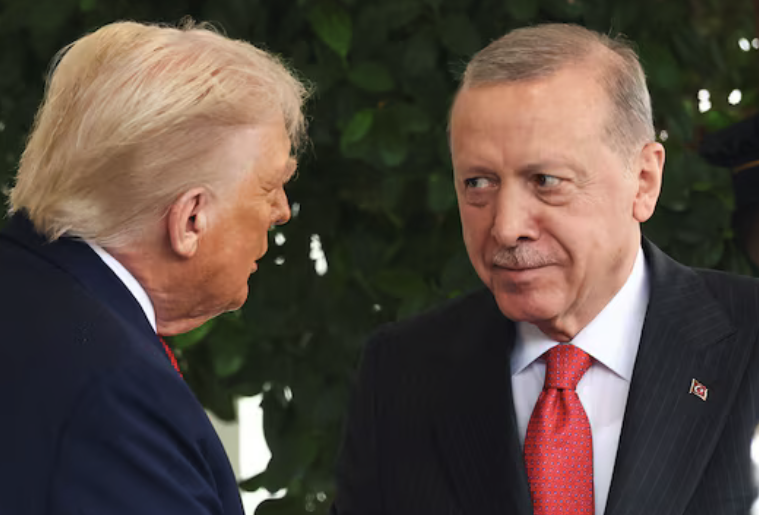
Newsmax, citing wire reporting and Turkish accounts, said Turkish officials described the call as touching on Syria, Gaza and broader regional stability, while noting neither side announced specific agreements. Newsmax
Why a short call matters: Turkey sits at the hinge of multiple U.S. priorities
To American officials, Turkey is rarely just one issue. It is a NATO ally with veto points inside the alliance, a major actor on refugee flows, a Black Sea and Middle East power, and a country whose security concerns collide directly with the U.S. partnership with Kurdish-led forces in Syria.
That collision has been sharpened by renewed tensions in northern Syria, where Turkey has long viewed the Syrian Democratic Forces (SDF) — especially elements linked to the YPG — as tied to the PKK, a group designated as terrorist by Turkey and the United States. Washington, meanwhile, has relied on the SDF as a key partner against ISIS. Fox News
The same week that Mr. Trump described his call with Mr. Erdoğan as “very good,” reporting in the American press described a fragile situation in Syria — and the fear in Washington that fighting could unravel counter-ISIS gains or destabilize detention sites holding ISIS-linked prisoners. The Wall Street Journal
That is the context in which a president’s terse characterization can carry weight: allies and partners often interpret the temperature of U.S.-Turkey relations through tone as much as through text.
Trump’s signal to Ankara — and to Washington
Mr. Trump’s choice to publicly praise the call, while withholding details, puts emphasis on relationship and process: the notion that the channel is open, direct, and productive.
For Ankara, that kind of affirmation has value on its own. Turkey’s officials frequently argue that U.S. policy in Syria must account for Turkey’s border security and counterterror concerns. A “very good call” does not imply policy concessions — but it can suggest access and influence, especially in an administration that often prizes personal rapport.
For Washington, the same approach can cut both ways. A warm relationship may help manage crises quickly, but it can also intensify anxieties on Capitol Hill, among NATO partners, and among U.S. partners in Syria who worry that decisions affecting them may be made in private and announced later as faits accomplis.
What this means for U.S. interests
For the United States, the immediate stakes of U.S.-Turkey leader diplomacy typically converge on three questions:
Counter-ISIS continuity.
U.S. officials and analysts have warned that instability in Syria can create openings for ISIS to regenerate. Turkey is essential in any serious regional architecture against ISIS — but U.S. coordination with Kurdish-led forces has also been central. Managing both at once is the continuing U.S. balancing act. Fox NewsAlliance management inside NATO.
Even when Washington and Ankara disagree, Turkey’s role in NATO gives it leverage — from defense procurement choices to regional basing and operational cooperation. A positive presidential channel can reduce the risk of sudden rupture, even if it does not resolve underlying disputes.Crisis containment.
When the White House emphasizes a “good call,” it often aims to project stability: that tensions can be handled through direct engagement rather than escalation by press statement and proxy conflict.
What this means for Turkish Americans — and TCUSAPAC readers
For Turkish Americans, the call’s significance is less about any single line of policy and more about the political climate it shapes in Washington.
A public confirmation of constructive leader dialogue tends to do two things at once:
Raises visibility of Turkey in U.S. politics.
Increased visibility can be an opportunity — but it can also bring sharper scrutiny, particularly when Turkey is linked in U.S. coverage to contentious issues like Syria-Kurd dynamics, NATO friction, or Gaza diplomacy. The Wall Street JournalIncreases the premium on “U.S.-interest” framing.
For TCUSAPAC readers engaging policymakers, the most effective posture is typically not identity defense, but interest alignment: emphasizing anti-ISIS stability, alliance cohesion, protection of civilians, and rules-based cooperation. That framing travels better across administrations and helps avoid diaspora debates collapsing into ethnic polarization.
In practical terms: a “very good call” can reduce immediate anxiety about a breakdown in U.S.-Turkey communications — but it may also intensify demands from multiple communities for clarity on where U.S. policy is actually headed.
What to watch next
Because Mr. Trump offered no detail, the most important signals will come from follow-on actions and secondary readouts:
- Any official U.S. or Turkish summaries that specify agenda items (Syria, counter-ISIS, Gaza, sanctions, defense cooperation).
- Moves on the Syria file — especially anything affecting U.S. coordination with Kurdish-led forces and the stability of areas where U.S. troops operate. Fox News
- Congressional reactions — which often serve as an early indicator of whether a diplomatic warm moment is likely to translate into policy space, or into backlash.
Sources
- Reuters link (may be paywalled/blocked)
- Al‑Monitor (reprinting Reuters dispatch with full text snippet)
- Newsmax (wire write-up and Turkish-side characterization)
- Fox News (context on Syria/SDF tensions during the same period)
- The Wall Street Journal (context on U.S. concerns about Syria operation expanding)