
Trump Can Open the Door. Can Türkiye Get Its F-35s Through Congress?
A new balance of power in Washington puts a familiar dispute back in focus—and offers Turkish Americans a reminder that lasting alliances need more than friendship between presidents.
News Analysis | November 15, 2026
The fighter jets are American. The missile system is Russian. And the argument between two NATO allies has lasted seven years. Now, Türkiye’s effort to obtain F-35 fighter aircraft and escape U.S. defense sanctions faces another test: a changing Congress. President Donald Trump has expressed willingness to consider selling the aircraft and lifting sanctions. President Recep Tayyip Erdoğan has kept the relationship with Washington open through direct diplomacy. Yet the central obstacle remains where it has been for years: Türkiye’s possession of Russia’s S-400 air-defense system. Democrats’ midterm victories, which will give them control of both chambers in January, add political uncertainty to an already complicated negotiation. But framing the dispute as simply “Trump versus Democrats” misses the deeper story.
Presidential support can begin a deal. It cannot, by itself, deliver the aircraft. For Turkish Americans watching the relationship between their country of citizenship and their ancestral homeland, the stakes extend beyond a military purchase. This is a test of whether Washington and Ankara can turn warmer diplomacy into a partnership that survives elections, disagreements and changes in leadership. [1][2]
A Fighter Jet—and a Falling-Out
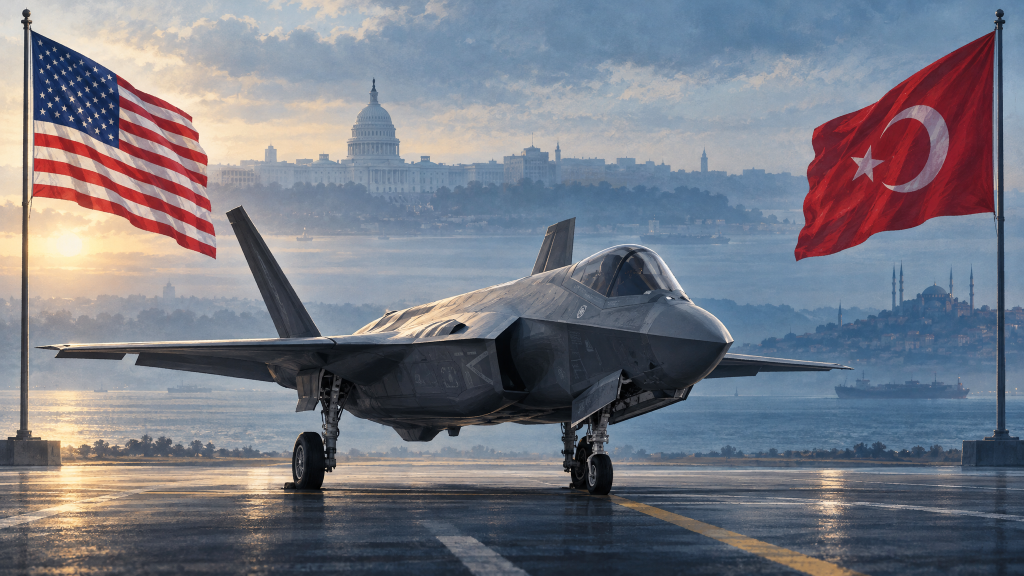
The F-35 is more than a fast aircraft carrying advanced weapons. Built by Lockheed Martin, it combines a design intended to make it difficult to detect with sophisticated sensors and the ability to share battlefield information.Its value lies partly in what its pilot can see—and what an opponent may struggle to see. Türkiye originally belonged inside that enterprise. It helped develop and manufacture the aircraft, and Turkish companies produced components for the multinational program. That changed in 2019, when Ankara received the Russian S-400. American defense officials argued that the Russian system could collect sensitive information about the F-35’s stealth capabilities. Washington removed Türkiye from the program, and Congress enacted restrictions on transferring the jets. The economic consequences went beyond the aircraft themselves. At the time, the Pentagon estimated that Turkish suppliers stood to lose more than $9 billion in projected work after their removal from producing more than 900 aircraft parts. Those were forecasts, not a tally of realized losses, but they showed the industrial relationship at stake. In December 2020, the first Trump administration imposed separate sanctions on Türkiye’s defense procurement agency and associated officials under the Countering America’s Adversaries Through Sanctions Act, known as CAATSA. [2] The result was an unusual rupture: a NATO ally that had helped build an American fighter was barred from receiving it.
Two Obstacles, Not One
Much of the public debate bundles the F-35 restrictions and sanctions together. They arise from the same dispute, but they operate under different laws. The first obstacle concerns the aircraft. Under Section 1245 of the fiscal 2020 National Defense Authorization Act, the existing route to waiving the transfer prohibition requires certification that Türkiye no longer possesses the S-400 and associated items, along with additional assurances and security conditions. The process also includes a 90-day waiting period.
The second obstacle concerns the sanctions. The president has certain powers to waive or terminate CAATSA sanctions, but those powers come with legal requirements. Some routes involve congressional review; another modified waiver authority has its own national-security conditions. In plain English: lifting sanctions would not automatically authorize F-35 deliveries. Clearing the aircraft restriction would not automatically remove the sanctions. Nor would purchasing aircraft necessarily restore Türkiye’s former position in the program’s development and manufacturing network. [2][3] These distinctions are not fine print. They are the difference between a diplomatic announcement and an executable agreement.
Can Democrats Stop Trump?
Democratic control will give the incoming Congress greater influence over hearings, legislation and the committees that examine arms transfers. Committee leaders can also delay a proposed sale during the informal review process before it reaches a public decision. But a Democratic majority does not automatically kill a deal. Formally blocking an arms sale through legislation can require overcoming a presidential veto. More fundamentally, lawmakers’ positions on Türkiye do not fall neatly along party lines. The Congressional Research Service has documented both bipartisan concern about the S-400 and conditional bipartisan support for Turkish access to F-35s if the security problem is resolved. The history itself challenges a simple partisan explanation: Türkiye’s removal from the program and the imposition of sanctions both occurred during Trump’s first administration. The decisive question is not whether a lawmaker is a Democrat or Republican. It is whether a proposed agreement answers the legal and security objections that created the dispute. [2][3]
Ankara’s Dilemma: Give Up the S-400—and Then What?
From Washington’s perspective, the Russian system presents a technology-security problem. From Ankara’s perspective, resolving that problem creates another question: what assurance would Türkiye receive that giving up the S-400 would actually produce the aircraft and sanctions relief it seeks? That concern helps explain why a breakthrough would likely require an agreed sequence of steps rather than a broad promise. One possibility discussed in recent commentary is transferring the S-400 to Russia or another country, followed by U.S. certifications and moves toward sanctions relief and aircraft delivery. But that is a proposed route, not a publicly confirmed agreement. A transfer could require Russian approval and could generate additional American security concerns, depending on the recipient and terms. The Congressional Research Service identifies both complications.
A November 13 commentary by Barın Kayaoğlu argues that the outgoing Congress offers a limited opportunity to establish a roadmap before control changes in January. That is an argument for action—not evidence that the governments have settled the issue. [2][4] The distinction matters. A plan discussed in public is not yet a deal negotiated in private.
Why Neither Side Can Easily Walk Away
Türkiye’s importance to Washington does not begin or end with one aircraft. It controls access between the Mediterranean and Black Sea, hosts important U.S. and NATO facilities, and occupies a central position near several regions vital to allied security. For Ankara, NATO provides security guarantees, military cooperation and access to capabilities that are difficult to replace. At the same time, Türkiye has pursued alternatives, including Eurofighter Typhoons and its domestically developed KAAN fighter. Those efforts give Ankara more options, but they do not eliminate foreign dependencies: KAAN’s early development relies on American-made engines. The broader relationship therefore contains both leverage and limits on each side. Washington has reasons to protect sensitive technology. It also has reasons to keep a major ally closely connected to Western defense systems. Ankara wants greater independence, but also seeks the military and industrial benefits of cooperation with the United States. [2] A workable agreement would have to recognize all of those interests—not pretend that one side has none.
What This Means for Turkish Americans
For Turkish Americans, the most important lesson is political rather than technical: a durable U.S.–Türkiye relationship cannot depend on access to one president. The White House matters. So do Congress, the Pentagon, the State Department and relationships across both political parties. For community organizations and readers following the debate, that means looking beyond personal chemistry and partisan headlines. A lawmaker’s objection to a particular weapons transfer should be examined on its merits, rather than automatically treated as hostility toward Turkish Americans. Presidential praise, likewise, should not be confused with a completed policy change. For those working in aerospace, engineering and manufacturing, a settlement could improve the environment for defense cooperation. But potential opportunities remain just that: potential. No diplomatic opening guarantees contracts, jobs or the return of former supplier roles. The dispute is also specifically about defense transfers and targeted sanctions—not a new measure against Turkish Americans as a community. Its significance lies in the direction of the bilateral relationship and whether institutions on both sides can rebuild confidence.
Watch the Paperwork, Not Just the Handshakes
The next breakthrough may arrive in language less dramatic than a presidential speech. Readers should watch for:
A confirmed S-400 arrangement: What happens to the system, who controls it and how security concerns are addressed.
Formal U.S. certifications: Evidence that the administration has determined the legal conditions are met.
Specific sanctions action: Which restrictions are being waived or terminated, and under what authority.
Concrete aircraft arrangements: Approvals, training, support and delivery terms—not merely statements of interest.
Those developments would show whether diplomacy is becoming policy. For now, the F-35 remains both an aircraft Türkiye wants and a measure of trust the two allies have yet to rebuild. Trump may be able to open the door. Getting through it will require an agreement that Ankara can accept, Washington can legally implement—and both sides can trust after the next election.
Al-Monitor — Barın Kayaoğlu’s November 8 analysis of Türkiye’s F-35 negotiations, sanctions and congressional obstacles. Accessible opening and summary; the remainder is subscriber-only.
Congressional Research Service — U.S.–Türkiye relations, updated August 20, 2026. Primary congressional research supporting the historical, legal, industrial and strategic background.
EDAM — “After the Midterms: What Changes for Türkiye’s Defence Industry,” November 2026. Policy analysis explaining the separate aircraft, sanctions and engine-export processes.
Türkiye Today — “Congress has weeks to unstick Türkiye’s F-35 and S-400 standoff,” November 13, 2026. Commentary proposing a roadmap; not an announcement of an agreement.