
Trump Signals Possible Reset on Türkiye’s F-35 Access, but Congress and the S-400 Issue Still Stand in the Way
President Donald Trump’s recent comments on Türkiye’s defense relationship with the United States have raised the prospect of the most consequential U.S.-Türkiye military reset in years. But despite public optimism surrounding the NATO summit in Ankara, Türkiye’s possible return to the F-35 fighter-jet program remains uncertain—and would require more than presidential goodwill. At the center of the discussion is a long-running dispute: Türkiye’s purchase of the Russian-made S-400 air-defense system, Washington’s decision to remove Türkiye from the F-35 program, and U.S. sanctions imposed on Türkiye’s defense procurement agency under the Countering America’s Adversaries Through Sanctions Act, known as CAATSA.
Before the July NATO summit, Trump suggested that a breakthrough might be possible. Speaking alongside NATO Secretary-General Mark Rutte, Trump praised President Recep Tayyip Erdoğan as a strong NATO partner and said he would “probably do something” that would make him “very happy.” Vice President JD Vance said the Pentagon was examining whether Türkiye met the legal criteria for access to the F-35. At the summit, Trump went further, saying the United States would lift CAATSA sanctions on Türkiye and that an F-35 sale was something Washington would consider. Yet “consider” is not the same as a completed agreement. No new F-35 delivery contract, formal restoration of Türkiye’s role in the F-35 program, or publicly detailed S-400 arrangement has been announced.
For Turkish Americans, these developments are important—but they should be understood as a possible opening, not a final resolution.
The Long Road to the Current Moment
Türkiye was once a major participant in the multinational F-35 program and had planned to purchase the advanced U.S.-made fighter. Turkish companies were also part of the aircraft’s supply chain.
The relationship changed after Ankara decided to acquire the Russian S-400 air-defense system in 2017. The first components of the system arrived in Türkiye in 2019. Washington argued that operating the Russian system alongside the F-35 could create security risks, including possible exposure of sensitive information about the aircraft. The United States removed Türkiye from the F-35 program in 2019. In December 2020, the U.S. imposed CAATSA sanctions on Türkiye’s Presidency of Defense Industries, known by its Turkish acronym SSB. The sanctions created additional obstacles to defense transactions and export licenses. The dispute has repeatedly appeared close to resolution, only to stall:
Ankara has argued that it needs an advanced air-defense capability and that it was not offered acceptable alternatives at the time it acquired the S-400.
The United States has maintained that Türkiye cannot possess the S-400 and receive F-35 aircraft.
Turkish officials have sought a formula that protects Türkiye’s defense interests without appearing to surrender national sovereignty.
Members of Congress have remained skeptical of restoring high-end defense cooperation without a clear, verifiable resolution of the S-400 issue.
The result has been years of negotiations, public signals, and incomplete progress.
The KAAN Engine Sale: A More Immediate Test
The more immediate issue may be the proposed U.S. sale of approximately $700 million in General Electric F110 engines for Türkiye’s indigenous KAAN fighter aircraft program.
The F110 engine is important because the KAAN program is intended to reduce long-term dependence on foreign combat aircraft. Early versions of the KAAN are expected to rely on U.S.-made engines while Türkiye continues developing a domestic engine.
The Trump administration’s move toward the engine sale signals a willingness to re-engage with Türkiye on defense-industrial cooperation. However, it has also triggered congressional criticism. Critics argue that the administration should not bypass or minimize congressional review while CAATSA-related questions remain unresolved.
Best-Case and Worst-Case Scenarios
Best-Case Scenario: The U.S. and Türkiye reach a transparent agreement on the S-400s. The Trump administration formally lifts CAATSA sanctions, Congress allows the F110 engine sale to proceed, and the two allies rebuild defense cooperation. This would keep the KAAN program on track and stabilize the relationship within NATO.
Worst-Case Scenario: Negotiations fail if neither side can agree on the S-400’s status or if Congress blocks the deals. In this outcome, Türkiye could accelerate its search for non-U.S. defense alternatives, and the strategic relationship would remain transactional and fragile.
What This Means for Turkish Americans
For Turkish Americans, this issue is a measure of whether the United States and Türkiye can manage serious disagreements while maintaining a productive alliance. A sustained improvement in relations can create more opportunities for trade, education, and investment. Turkish Americans can encourage a more accurate discussion that recognizes both U.S. security concerns and Türkiye’s security priorities. Staying engaged with elected representatives and supporting fact-based advocacy is essential during this transition period.
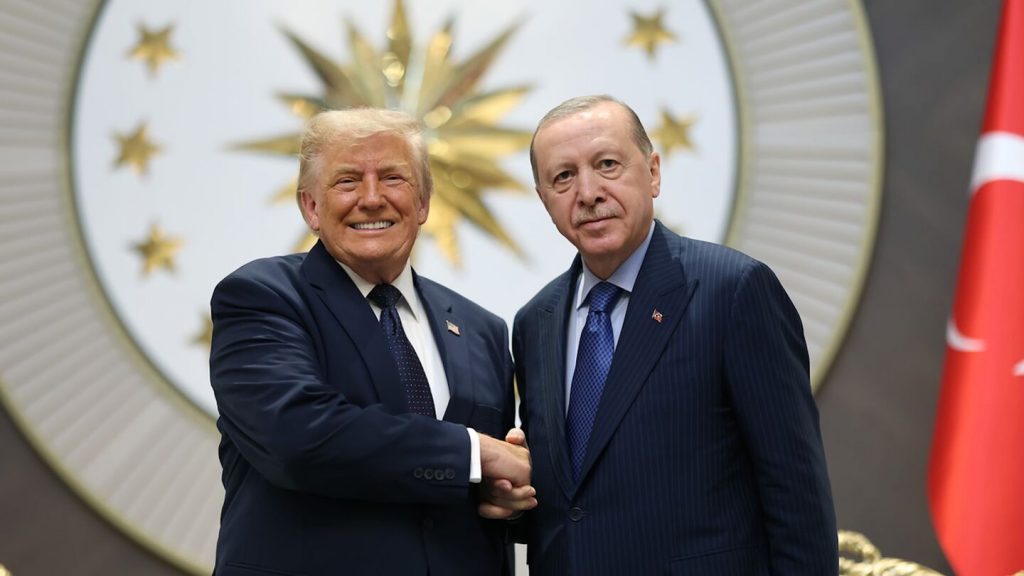
For reporting on President Trump’s comments ahead of the NATO summit, the potential F-35 pathway, CAATSA restrictions, the S-400 issue, and the proposed General Electric F110 engine sale for Türkiye’s KAAN program, see Al-Monitor’s June 25, 2026 report, “Trump hints at F-35 breakthrough with Turkey ahead of NATO summit”.
For coverage of Trump’s reported readiness to restore Türkiye’s access to the F-35 program, see Reuters’ July 7, 2026 report.
For post-summit reporting on Trump’s statements regarding CAATSA sanctions and the possibility of an F-35 sale to Türkiye, see Al-Monitor’s report, “Trump says U.S. will lift CAATSA sanctions on Turkey, consider F-35 sale”.
For background on the proposed F110 turbofan-engine transfer and its importance to Türkiye’s KAAN fighter program, see The War Zone’s report on the planned F110 engine sale.
For additional reporting on Türkiye’s interest in F110 engines and the broader defense discussions surrounding the NATO meeting, see France 24’s coverage.
For reporting on congressional scrutiny and likely political resistance to an F-35-related policy shift, see The Hill’s coverage.