
Türkiye's Diplomatic Tightrope: Ankara Tightens Israel Trade Restrictions While Sitting on Gaza Ceasefire Board
Turkish-American Community Watches as Ankara Balances Peace Mediation with Economic Pressure on Israel
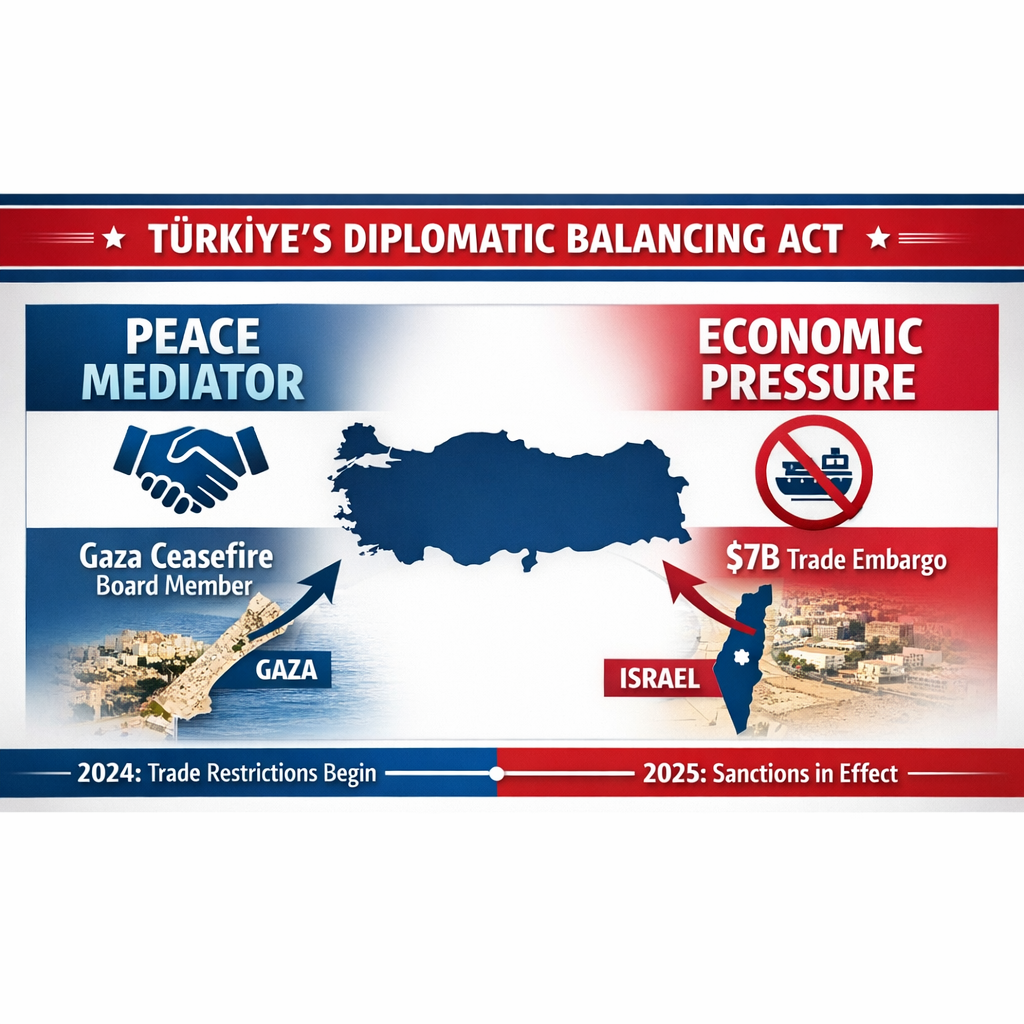
WASHINGTON, D.C. — In a move that has drawn both praise and criticism from the international community, Türkiye has implemented new measures to further restrict trade with Israel, even as it maintains a seat on the international board overseeing the fragile Gaza ceasefire—a paradox that highlights Ankara’s complex balancing act in Middle Eastern diplomacy.
The Turkish government announced in late February 2026 that it would refuse to allow Israeli cargo ships to dock at Turkish ports, adding another layer to the comprehensive trade embargo that began in May 2024. The decision comes as Türkiye simultaneously participates in ceasefire monitoring efforts following the January 2026 Gaza truce agreement between Israel and Hamas.
For Turkish-Americans watching from the United States, the developments underscore Türkiye’s increasingly assertive foreign policy under President Recep Tayyip Erdoğan and raise questions about Ankara’s role as both mediator and partisan in one of the world’s most intractable conflicts.
From Trade Partner to Trade Embargo
The relationship between Türkiye and Israel has undergone a dramatic transformation over the past two years. In 2023, bilateral trade between the two countries stood at approximately $7 billion annually, with Türkiye serving as Israel’s fifth-largest source of imports. Turkish exports to Israel included steel, cement, construction materials, vehicles, plastics, and electrical devices—critical supplies for Israel’s economy and infrastructure.
That relationship began to fracture after Hamas’s October 7, 2023, attack on Israel, which killed approximately 1,200 people and resulted in the abduction of about 250 hostages. Israel’s subsequent military campaign in Gaza, which Gazan health officials say has killed more than 34,000 people, prompted increasingly strident criticism from Ankara.
Initially, President Erdoğan walked a careful diplomatic line, directing his harshest rhetoric at Israeli Prime Minister Benjamin Netanyahu personally rather than at Israel as a state. In November 2023, Erdoğan called Netanyahu “the butcher of Gaza,” while the Turkish Foreign Ministry accused him of “entering the dark pages of history with the oppression and massacres committed against the Palestinian people.”
But words soon gave way to action. In April 2024, Türkiye imposed export restrictions on 54 product categories, including iron, steel, cement, fertilizer, construction equipment, and aviation fuel. The Turkish Trade Ministry said the measures would remain in place “until Israel, under its obligations emanating from international law, urgently declares a ceasefire in Gaza and allows the unhindered flow of sufficient humanitarian aid into the Gaza Strip.”
One month later, on May 2, 2024, Türkiye escalated to a complete trade embargo, halting all imports and exports with Israel. Turkish Trade Minister Omer Bolat cited Israel’s “uncompromising attitude” toward a ceasefire and the worsening humanitarian situation in Gaza’s Rafah region.
“Türkiye has suspended all export and import with Israel until a permanent ceasefire is established and the aid into Gaza is allowed without any interruption,” Bolat announced.
Domestic Political Pressures
The trade restrictions did not emerge in a vacuum. Erdoğan faced mounting domestic pressure to take concrete action against Israel, particularly after his Justice and Development Party (AKP) suffered its worst electoral defeat in two decades in local elections on March 31, 2024.
The far-right, Islamist New Welfare Party (Yeniden Refah, or YRP) made significant gains in those elections, winning nearly 7 percent of the national vote by campaigning on a hardline anti-Israel platform. The YRP accused Erdoğan of hypocrisy, pointing to continued Turkish-Israeli trade despite Ankara’s pro-Palestinian rhetoric. “We support Palestine in words, but Israel in reality,” one Turkish journalist tweeted before the elections, a sentiment that resonated with many conservative voters.
The electoral setback forced Erdoğan’s hand. To prevent further defection of his right-wing base to the YRP, the Turkish president hardened his stance on Israel. In addition to the trade embargo, Türkiye announced it would join South Africa’s genocide case against Israel at the International Court of Justice.
“Türkiye could not remain idle in the face of Israeli bombardment of defenceless Palestinians,” Erdoğan said in May 2024, speaking to supporters after Friday prayers.
The Ceasefire Paradox
The January 2026 Gaza ceasefire agreement, brokered by Qatar, Egypt, and the United States, created an unexpected diplomatic opening for Türkiye. As part of the complex, multi-phase deal, an international monitoring board was established to oversee implementation, ensure humanitarian aid delivery, and mediate disputes between Israel and Hamas.
Türkiye secured a seat on this board, positioning itself as a key player in Gaza’s future—a long-standing ambition of Erdoğan’s government. Ankara has consistently sought to play a mediating role in the Israeli-Palestinian conflict and to participate in Gaza’s eventual reconstruction, viewing such involvement as essential to Türkiye’s status as a regional power.
However, Türkiye’s participation on the ceasefire board while simultaneously maintaining a trade embargo against Israel has drawn criticism from multiple quarters. Israeli Foreign Minister Israel Katz accused Erdoğan of “acting like a dictator” and “disregarding the interests of the Turkish people and businessmen, and ignoring international trade agreements.”
Katz instructed Israel’s Foreign Ministry to develop alternatives to Turkish trade, focusing on local production and imports from other countries. Israel also threatened to impose its own restrictions on Turkish products and to reduce economic connections with the Palestinian Authority and Gaza—a move that could complicate Türkiye’s reconstruction ambitions.
Critics, particularly at conservative think tanks like the Foundation for Defense of Democracies, have characterized Türkiye as “Hamas’s most vocal cheerleader on the international stage,” arguing that Ankara’s trade restrictions undermine the peace process it claims to support.
Türkiye’s Strategic Calculations
Despite the criticism, Turkish officials defend their approach as both principled and pragmatic. They argue that economic pressure on Israel is necessary to ensure compliance with international humanitarian law and to prevent future violations in Gaza.
“This decision will remain in place until Israel allows an uninterrupted and sufficient flow of humanitarian aid into Gaza,” the Turkish Trade Ministry stated in February 2026, announcing the latest port restrictions.
Soner Cagaptay, director of the Turkish Research Program at the Washington Institute for Near East Policy, notes that Türkiye’s position reflects a careful calculation. “Ankara is eager to participate in reconstructing the Strip, sorting out Palestinian politics, and mediating a long-term solution to the Israeli-Palestinian conflict,” Cagaptay wrote in May 2024. “This suggests that it will shy away from another full 2010-style rupture”—a reference to the 2010 Mavi Marmara incident, when Israeli commandos raided a Turkish-led flotilla attempting to break the Gaza blockade, killing 10 Turkish activists and severing diplomatic ties for years.
Indeed, despite the trade embargo, Türkiye has not completely severed relations with Israel. Diplomatic channels remain open, and Turkish intelligence chief Hakan Fidan has maintained contact with Israeli counterparts on security matters, particularly regarding Hamas operations in Türkiye.
Moreover, the trade embargo has proven somewhat porous. News reports indicate that Türkiye continues to provide Israel with Azerbaijani oil, sent by pipeline from the Caspian Sea to the Mediterranean port of Ceyhan and from there to Israel. This suggests that Ankara’s restrictions are calibrated to apply maximum political pressure while preserving some economic and strategic flexibility.
Economic Impact and Business Backlash
The trade embargo has had significant economic consequences for both countries. Turkish exports to Israel, which totaled $5.4 billion in 2023, represented nearly 6 percent of all Israeli imports. Key Turkish exports included construction materials like cement—critical for Israel’s building sector—as well as steel, iron, and motor vehicles.
For Israel, the loss of Turkish supplies has meant higher costs as it seeks alternative suppliers from more distant markets. Ron Tomer, president of the Manufacturers’ Association of Israel, noted that approximately 50 percent of Israel’s cement, steel, and marble imports came from Türkiye. “Maybe now the government will wake up and break away from Turkish dependence,” Tomer said.
For Türkiye, the embargo has also carried costs. The Turkish Exporters Assembly warned that the country would need to trim its year-end export targets by $7 billion unless trade with Israel resumed. Four Turkish exporters told Reuters that the embargo “blindsided them” and left those with firm orders scrambling to find ways to send goods to Israel via third countries.
Nail Olpak, head of the Turkish Foreign Economic Relations Board (DEIK), indicated in early 2026 that Türkiye could restart trade with Israel “if peace is permanent,” suggesting that Turkish business leaders are eager to resume commercial ties once the political situation stabilizes.
Historical Context: A Complicated Relationship
The current tensions represent the latest chapter in a complex and often troubled relationship between Türkiye and Israel. In 1949, Türkiye became the first Muslim-majority country to recognize the State of Israel, less than a year after Israeli independence. For decades, the two countries maintained close diplomatic, military, and economic ties, viewing each other as valuable partners in a volatile region.
In the 1990s, Türkiye and Israel developed a robust strategic partnership. The New York Times reported in 1999 that the relationship had the potential to alter Middle East politics: Trade and tourism were booming, the Israeli Air Force practiced maneuvers in Turkish airspace, and Israeli technicians were modernizing Turkish combat jets.
However, the relationship began to deteriorate in the 2000s, particularly after Erdoğan’s Justice and Development Party came to power in 2002. While Erdoğan initially maintained cordial relations with Israel—visiting in 2005 and laying a wreath at Yad Vashem, Israel’s Holocaust memorial—tensions escalated over Israeli military operations in Gaza.
The 2010 Mavi Marmara incident marked a turning point. Türkiye broke off diplomatic ties with Israel and began openly providing diplomatic support and shelter to Hamas. Relations were not fully restored until December 2022, when the two countries reinstated their ambassadors after more than a decade of estrangement.
That rapprochement proved short-lived. The October 7, 2023, Hamas attacks and Israel’s subsequent Gaza campaign reignited tensions, leading to the current trade embargo and war of words between Ankara and Jerusalem.
Implications for Turkish-Americans
For the estimated 3.5 million Turkish-Americans, Türkiye’s stance on the Israeli-Palestinian conflict presents both opportunities and challenges. Many Turkish-Americans have family and business ties to both Türkiye and the broader Middle East, and they watch developments in the region with keen interest.
Turkish-American political organizations, including the Turkish Coalition of America and TC-USAPAC (Turkish American Political Action Committee), have sought to educate American policymakers about Türkiye’s perspective on regional issues, including the Gaza conflict. These groups emphasize Türkiye’s role as a NATO ally and its potential as a mediator in Middle Eastern disputes.
At the same time, Turkish-Americans must navigate the complex politics of the Israeli-Palestinian conflict in the United States, where support for Israel remains strong across both major political parties. Some Turkish-Americans worry that Ankara’s hardline stance on Israel could complicate Türkiye’s relationship with Washington and undermine Turkish-American advocacy efforts.
“We want to see Türkiye play a constructive role in bringing peace to the region,” said one Turkish-American community leader who requested anonymity to speak candidly. “But we also recognize that the situation is incredibly complex, and there are no easy answers.”
The Road Ahead
As the Gaza ceasefire enters its third month, questions remain about Türkiye’s long-term strategy. Will Ankara maintain its trade embargo indefinitely, or will it seek a face-saving way to resume commercial ties with Israel? Will Türkiye’s participation on the ceasefire board prove effective, or will its partisan stance undermine its credibility as a mediator?
Much depends on the durability of the ceasefire itself. The January 2026 agreement is a multi-phase deal that calls for the gradual release of hostages, the withdrawal of Israeli forces from populated areas of Gaza, and eventually, negotiations on Gaza’s long-term governance. If the ceasefire holds and leads to a more permanent resolution, Türkiye may find opportunities to play a constructive role in Gaza’s reconstruction.
However, if the ceasefire collapses and fighting resumes, Türkiye’s position could become even more complicated. Erdoğan has staked significant political capital on his pro-Palestinian stance, and any perception that he has failed to deliver results could further erode his domestic support.
For now, Türkiye appears committed to maintaining pressure on Israel while positioning itself as an indispensable player in any long-term solution. Whether that strategy succeeds will depend on factors largely beyond Ankara’s control, including the actions of Israel, Hamas, and the United States.
What is clear is that Türkiye’s approach to the Israeli-Palestinian conflict reflects broader shifts in its foreign policy under Erdoğan—a more assertive, independent stance that sometimes puts Ankara at odds with its traditional Western allies. For Turkish-Americans, understanding and explaining these shifts to their fellow Americans will be an ongoing challenge in the years ahead.