
Washington Opens Syria’s Door—and Hands Türkiye a Strategic Opportunity
For nearly half a century, Syria occupied one of Washington’s most isolating diplomatic categories. The United States placed the country on its list of state sponsors of terrorism in 1979, making Syria the longest continuously designated member of the original list. The label survived wars, failed negotiations, regional realignments and the long rule of Bashar al-Assad.

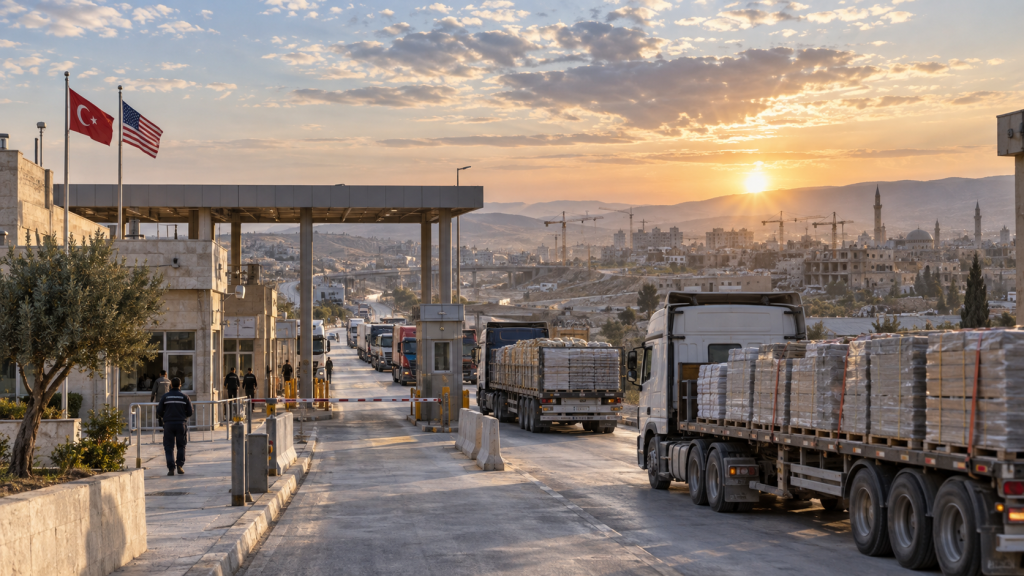
On August 24, 2026, that era formally ended.
After a required 45-day congressional review, the Trump administration rescinded Syria’s designation. Secretary of State Marco Rubio said the decision recognized “positive actions” and additional commitments by President Ahmed al-Sharaa’s government to distance Syria from international terrorism. The Treasury Department simultaneously removed restrictions associated with the designation and completed related changes involving Hay’at Tahrir al-Sham, the former insurgent organization that led the campaign that toppled Assad in December 2024. The decision does not certify that Syria is democratic, stable or free of extremist threats. It is a strategic wager: that engagement, investment and conditional reintegration now offer the United States more leverage than preserving an Assad-era architecture of isolation.
For Türkiye, which shares a 911-kilometer border with Syria and has carried a disproportionate share of the war’s human, economic and security consequences, the decision is more than a diplomatic victory. It creates an opportunity to transform years of crisis management into regional reconstruction—but also assigns Ankara greater responsibility for what comes next.
For Turkish Americans, the moment calls for advocacy that is more sophisticated than simply celebrating the removal of sanctions. The United States now needs policies that turn legal relief into functioning banks, reliable electricity, accountable investment, voluntary refugee return, minority protection and durable security. Without those results, delisting will remain a headline rather than a recovery strategy.
What Washington actually changed
The state-sponsor designation was not a rhetorical label. It activated restrictions across U.S. foreign assistance, defense exports, dual-use technology, finance and other transactions. Even after Washington lifted most comprehensive Syria sanctions in 2025 and Congress repealed the Caesar Syria Civilian Protection Act later that year, the terrorism designation continued to create legal exposure and uncertainty for banks, technology companies, energy firms and investors.
President Donald Trump formally notified Congress on July 8, 2026, of his intention to rescind the designation. Federal law required a 45-day review period. When that period expired, the removal took effect on August 24.
According to the Treasury Department, Syria is no longer subject to prohibitions under the Terrorism List Governments Sanctions Regulations or the associated statutory restriction covering certain agricultural assistance. The State Department also revoked the terrorism designation of al-Nusrah Front—also known as Hay’at Tahrir al-Sham—and Treasury removed HTS from its Specially Designated Nationals list.
The cumulative legal changes matter because sanctions can continue influencing behavior long after formal prohibitions disappear. Banks and multinational companies commonly avoid transactions that are technically permitted if the compliance risk is unclear. This “overcompliance” can prevent humanitarian organizations, small businesses and legitimate investors from transferring money or obtaining insurance.
The first commercial effects appeared quickly. Visa and Mastercard conducted international card transactions in Syria after the delisting, assisted by regional financial institutions. These initial payments were limited, but they demonstrated how legal normalization could begin reconnecting Syrians with ordinary financial services.
The change may also allow energy, telecommunications, transportation and construction projects to move more easily. But removing a barrier is not the same as creating a reliable market. Syria still needs capable regulators, transparent procurement, credible courts, modern banking supervision, cybersecurity and effective controls against money laundering and terrorist financing.
What the decision did not do
The delisting did not erase Syria’s violent history or protect every Syrian person and organization from sanctions.
U.S. measures remain available against Bashar al-Assad and his associates, individuals responsible for human-rights abuses, ISIS and other terrorist organizations, Iranian and Russian networks, Captagon traffickers and other designated actors. American firms must still screen counterparties and comply with export-control, anti-money-laundering and counterterrorism rules. Other countries and international institutions may maintain different restrictions or risk assessments.
Nor did Washington give Syria’s new government an unconditional endorsement.
The American policy framework continues to focus on whether Damascus is:
taking verifiable action against ISIS, al-Qaeda and other terrorist organizations;
removing foreign fighters from senior government and security positions;
protecting religious and ethnic minorities;
integrating the Syrian Democratic Forces through a political and security arrangement;
preventing money laundering, terrorism financing and weapons proliferation;
prosecuting serious abuses committed after Assad’s fall;
combating Captagon production and trafficking; and
avoiding unprovoked military action against neighboring countries.
These benchmarks reflect real concerns. Syria’s transition has been marked by sectarian violence, disputed authority, fragile institutions and unresolved questions about armed groups. International investment cannot substitute for political inclusion or justice. If reconstruction becomes a system of patronage, dispossession or corruption, sanctions relief could strengthen new power networks without building a stable country.
The correct interpretation is therefore neither “Syria has been cleared” nor “Washington abandoned accountability.” The United States replaced a broad national designation with a more conditional framework that can target specific threats while allowing ordinary economic activity to resume.
Türkiye’s long campaign for sanctions relief
Türkiye had advocated for this shift well before the August announcement. President Recep Tayyip Erdoğan told al-Sharaa in April 2025 that Ankara would intensify efforts to secure the removal of international sanctions and revive bilateral trade. Turkish officials argued that a government deprived of electricity, investment, banking and basic administrative capacity could not stabilize the country or prevent extremist resurgence.
That argument gained ground in Washington, Europe and the Gulf after Assad’s removal. Türkiye’s position was straightforward: sanctions written to weaken the former regime should not indefinitely obstruct the government that replaced it.
On August 25, the Turkish Foreign Ministry welcomed the U.S. decision and praised both the administration and Congress. It described the designation as a major obstacle to Syria’s economic recovery and called on the international community to support a prosperous and stable Syria.
Ankara has strong reasons to want that outcome. More than two million Syrians remained under temporary protection in Türkiye in 2026, even after hundreds of thousands returned following Assad’s fall. UNHCR reporting has consistently shown that security, housing, services and employment—not political declarations alone—determine whether refugees believe return is viable.
A functioning Syrian economy would also expand lawful trade, reduce smuggling, improve border security and create opportunities for Turkish contractors, manufacturers, banks and logistics companies. Turkish businesses possess geographic proximity, regional experience and supply networks that could make them important participants in reconstruction.
But Türkiye’s advantage also creates exposure. Turkish companies will be among the first to encounter unreliable counterparties, property disputes, corruption, unexploded ordnance and overlapping sanctions lists. Ankara will need to ensure that commercial ambition does not outrun compliance, transparency or the rights of displaced property owners.
The scale of the opportunity—and the danger of exaggerating it
The reconstruction challenge is immense. The World Bank estimates that rebuilding Syria’s damaged physical assets could cost approximately $216 billion, with a plausible range from $140 billion to $345 billion. Infrastructure accounts for an estimated $82 billion, residential buildings $75 billion and nonresidential structures $59 billion. The central estimate is nearly ten times Syria’s projected 2024 gross domestic product.
Those numbers explain why sanctions relief matters. No humanitarian program can independently rebuild a national power grid, housing stock, water system, banking network and transportation infrastructure.
They also explain why triumphal claims should be resisted. Syria will not receive hundreds of billions of dollars merely because Washington removed a designation. Investors will require security, enforceable contracts, insurance, payment mechanisms and political predictability. Donors will demand safeguards. Families will not return permanently if they cannot find schools, electricity, health care, housing and work.
The earliest evidence is encouraging but limited. The World Bank resumed engagement and approved a $146 million grant for emergency electricity rehabilitation in 2025. International payment networks have started returning. Turkish companies have expressed readiness to participate. These are building blocks, not proof of recovery.
Why this serves American interests
The strongest case for delisting is not charity. It is strategy.
A Syria left economically isolated would be more vulnerable to ISIS recruitment, criminal trafficking, warlordism and renewed dependence on Iran or Russia. A Syria gradually connected to Türkiye, the Gulf, Europe and the United States has more alternatives—and Washington gains more leverage over its political direction.
Türkiye is indispensable to that strategy. It controls Syria’s most important northern commercial routes, maintains extensive political and security relationships inside the country and has the capacity to support reconstruction at scale. It is also a NATO ally capable of aligning Syrian recovery more closely with Western markets and institutions.
The United States should therefore regard cooperation with Türkiye not as an accommodation but as a force multiplier. Washington can provide financial standards, technology, development expertise and diplomatic leverage. Türkiye can provide access, logistics, construction capacity and long-term regional engagement. Gulf partners can provide capital. Syrian institutions must provide legitimacy, inclusion and accountable governance.
None can succeed alone.
What this means for Turkish Americans
Turkish Americans have an unusual opportunity to shape the next phase of U.S. policy. Many congressional offices understand Syria primarily through terrorism, humanitarian aid or Israel’s security. Those issues matter, but the picture is incomplete without Türkiye’s experience and interests.
Effective advocacy should explain five points:
Türkiye’s support for sanctions relief advanced an American objective. Preventing Syria’s economic collapse reduces the space available to ISIS, Iran, Russia and organized crime.
Reconstruction and refugee return are connected. Safe and voluntary return requires homes, schools, electricity, health care and employment—not pressure on refugees.
Targeted accountability should replace blanket isolation. Sanctions should remain available against terrorists, traffickers, human-rights abusers and corrupt networks without blocking legitimate Syrian commerce.
Türkiye should be treated as a principal implementation partner. Its border, private sector, institutions and Syrian diaspora give it capabilities Washington cannot reproduce.
Relief must remain conditional on inclusive governance. Turkish American advocacy will be more credible if it supports the rights of Kurds, Druze, Alawites, Christians and other communities alongside Syria’s unity.
Who should lead the advocacy
This subject requires specialized voices, not only political organizations:
Turkish American bankers, accountants and sanctions attorneys should help explain lawful transactions, remaining restrictions and the practical causes of financial overcompliance.
Engineers, contractors, architects and energy professionals can identify realistic reconstruction priorities and transparent procurement practices.
Physicians, educators and humanitarian professionals can connect sanctions policy to hospitals, schools, water systems and civilian life.
Syrian Turkish Americans and Syrian American organizations should have a central role in discussions about property, return, minority protection and local legitimacy.
Technology and telecommunications professionals can advocate for secure digital infrastructure, payment systems and access to civilian technology.
Veterans and national-security specialists can explain why economic stabilization supports counterterrorism and reduces regional military risk.
University faculty and students can organize policy forums, publish evidence-based analysis and build durable relationships with congressional offices.
Business leaders and chambers of commerce can encourage lawful trade while establishing anti-corruption and human-rights expectations.
A practical advocacy agenda
1. Ask Washington to issue clear implementation guidance
The administration should provide banks, insurers, exporters, nonprofits and investors with consolidated guidance explaining what is permitted, what remains prohibited and how licenses will be processed. Legal relief that private institutions cannot interpret will have limited effect.
2. Support targeted sanctions, not a return to nationwide punishment
Congress should retain the ability to sanction terrorists, traffickers, war criminals and corrupt officials. It should resist reimposing broad restrictions on the Syrian population whenever the government fails a policy test. Targeted pressure is more defensible and less damaging to civilians.
3. Build a U.S.–Türkiye reconstruction working group
Washington and Ankara should convene government agencies, development institutions, banks, compliance experts and private companies. Priority areas should include electricity, water, housing, border logistics, telecommunications, health facilities and digital payments.
4. Tie investment to transparency and property rights
Turkish American organizations should advocate for public contracting standards, beneficial-ownership disclosure, independent audits and procedures for resolving property claims. Reconstruction must not erase evidence of crimes, seize the land of displaced Syrians or reward armed networks.
5. Keep refugee return voluntary and evidence-based
Advocacy should support UNHCR monitoring and insist that return decisions remain voluntary. The number of people crossing a border is not, by itself, proof of sustainable reintegration. Safety, legal status, housing, livelihoods and access to services must be measured.
6. Support inclusive Syrian institutions
Turkish Americans should publicly support Syria’s territorial unity while also defending meaningful political representation, religious freedom and equal citizenship. This is morally necessary and strategically wise: exclusion creates the grievances on which extremist organizations depend.
7. Encourage American and Turkish universities to cooperate
Professional training will be as important as construction. Partnerships can help Syria rebuild expertise in public administration, medicine, engineering, banking compliance, agriculture, municipal government and the rule of law.
8. Use PAC activity carefully and lawfully
PACs may support candidates who favor a strong U.S.–Türkiye relationship, responsible sanctions relief, Syrian stabilization and accountable reconstruction. Electoral activity must remain separate from nonprofit educational work, and organizations should obtain qualified campaign-finance and tax counsel. Foreign nationals may not finance or participate in decisions involving U.S. election spending; lawful permanent residents are treated differently under federal rules.
A message for Congress
Turkish American advocates can deliver a concise and bipartisan request:
The removal of Syria from the State Sponsors of Terrorism list gives the United States an opportunity to replace broad isolation with targeted accountability. Congress and the administration should work with Türkiye to rebuild essential infrastructure, restore lawful banking and trade, support voluntary refugee return, protect every Syrian community and prevent renewed influence by terrorist organizations, Iran and Russia. Sanctions relief should be implemented clearly, monitored carefully and preserved so long as Syria continues moving toward stability, inclusion and peace with its neighbors.
The test begins after the designation ends
Removing Syria from the terrorism list closed a chapter written for a government that no longer rules Damascus. It did not answer the harder questions facing the government that replaced it.
Can Syria create institutions stronger than its militias? Can it protect minorities as citizens rather than bargaining chips? Can international investment reach communities instead of connected elites? Can refugee returns be safe, voluntary and sustainable? Can Türkiye, the United States and regional partners cooperate without turning Syria into another arena for competition?
The delisting gives Syria room to attempt those tasks. It gives Türkiye a chance to convert influence into stability. And it gives Washington an opportunity to replace a policy of isolation with one of conditional engagement.
That is not the end of American leverage. Properly managed, it is the beginning of more useful leverage—and a moment when Turkish Americans can help ensure that a major diplomatic decision produces something more durable than optimism.