
The Washington Gambit: Why Greece is Using the Israel Mirror to Recast Turkey
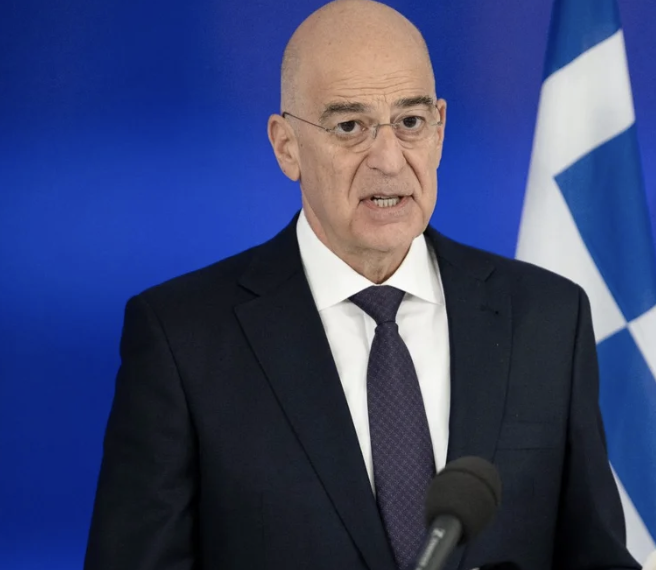
WASHINGTON — When Nikos Dendias, the Greek Defense Minister, took the stage at a high-profile forum in the American capital this month, he did not lead with a policy white paper. Instead, he offered a pointed rhetorical question designed to resonate in the halls of Congress: “Remember that 25 years ago Israel and Turkey were the best of friends. What has changed?”
It was a calculated performance. Speaking at a panel hosted by the Delphi Economic Forum and the Foundation for Defense of Democracies—a think tank with deep ties to the pro-Israel establishment—Dendias was not merely reminiscing. He was executing a strategic pivot, attempting to frame the decades-old Greece-Turkey rivalry as a modern litmus test for American values and regional security. (Middle East Eye)
By accusing Ankara of “advocating for Hamas” and highlighting its refusal to condemn the October 7 attacks in terms Washington demands, Dendias is betting that the shortest path to swaying U.S. policy is through the lens of the Israel-Palestine conflict.
The Architecture of a Rupture
Dendias’s question—what has changed?—is one that Turkish-American observers and TCUSAPAC stakeholders must answer with more than just defensive slogans. The “Golden Era” of Turkey-Israel relations in the 1990s was built on a specific foundation: a secular Turkish security establishment that viewed Israel as a vital strategic counterweight in a hostile neighborhood. (Eliamep)
The erosion of that foundation was not an overnight event, but a structural shift driven by three distinct forces:
- The Ideological Pivot: The rise of the AKP brought a foreign policy that prioritized Muslim world leadership and a vocal, often confrontational, defense of Palestinian rights. This shifted the relationship from a quiet military alliance to a public, high-stakes political drama. (Wilson Center)
- The Trauma of the Flotilla: The 2010 Mavi Marmara raid, in which Israeli forces killed Turkish activists, remains the definitive psychological break. It transformed a diplomatic disagreement into a national grievance, making any return to the “best friends” era politically toxic for any Turkish leader. (INSS)
- The Post-October 7 Reality: Today, the rift is no longer just about Gaza; it is about competing visions for the Middle East. Turkey’s hosting of Hamas leadership and its “Blue Homeland” maritime doctrine are now being successfully framed by Athens as evidence that Ankara has exited the Western orbit entirely. (Daily Sabah)
The Greek Strategy: Forcing a Binary
Dendias is playing a sophisticated game of “forced choice.” By positioning Greece as the reliable, pro-Israel, and “Western-aligned” alternative, he hopes to convince Washington that Turkey is no longer a partner to be managed, but a liability to be contained. This is evidenced by his recent rhetoric describing Turkey as Greece’s “greatest threat” and his potential snub of an upcoming Ankara summit—a move designed to preserve his hawkish credentials at home while signaling intransigence abroad. (Middle East Eye)
However, this strategy ignores a fundamental reality of American statecraft: Washington loathes being forced into a binary. Despite the friction, the U.S. continues to rely on Turkey for critical objectives—from mediating the Gaza ceasefire to balancing Russian influence in the Black Sea and managing the fallout in Syria. (Middle East Eye)
The Path Forward for the Diaspora
For the Turkish-American community, the Dendias speech is a wake-up call. When the narrative in Washington is allowed to be reduced to “Turkey vs. Israel,” Turkey loses. The challenge for civic leaders is to broaden the conversation.
The response cannot be a simple denial of the changes Dendias pointed out. Instead, it must be an insistence on strategic necessity. Turkey’s role in NATO, its unique ability to talk to all sides in the Middle East, and its indispensable position in the Eastern Mediterranean are facts that slogans cannot erase.
Dendias asked what has changed. The answer is that the world has become more complex, and Turkey’s role in it has become more independent. The task now is to ensure that Washington views this independence not as a betrayal, but as a strategic asset that requires sophisticated engagement rather than the blunt instrument of exclusion.