
Bound by NATO, Tested by Freedom: The U.S.–Türkiye Relationship at a Breaking Point
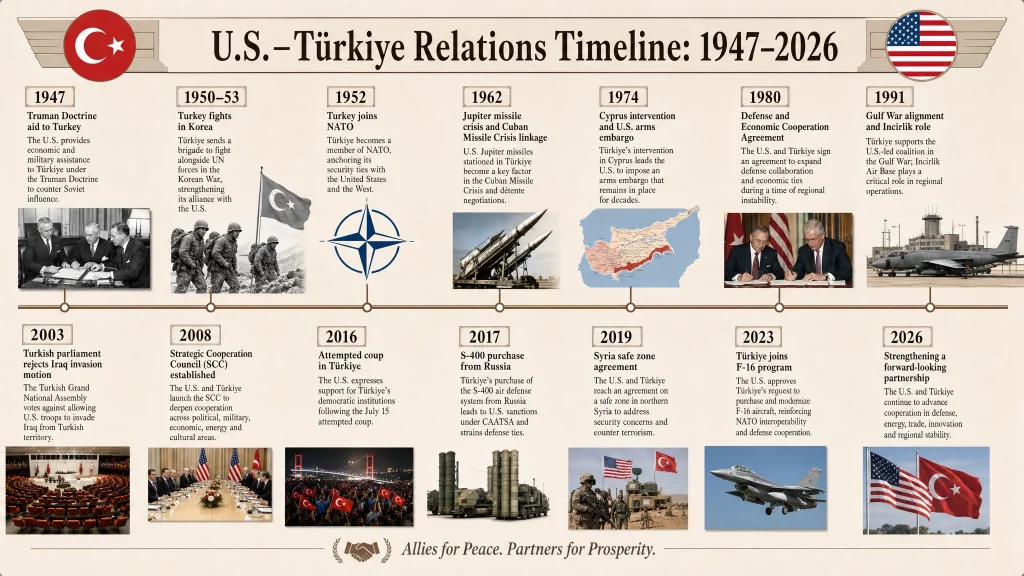
For Turkish Americans watching both Washington and Ankara, the story of U.S.–Türkiye relations has never been simple. It is a long, strategic partnership built on Cold War urgency, NATO power, military cooperation and regional security. But in 2026, it is also a relationship shadowed by a troubling question: can two countries remain indispensable allies while both face growing criticism over democratic decline?
That question is no longer abstract. The historical record shows how deep this partnership runs. In 1947, the Truman Doctrine helped place Türkiye firmly inside the American security umbrella as Washington worked to contain Soviet pressure. During the Korean War, Turkish troops fought alongside U.S. forces. In 1952, Türkiye joined NATO, cementing its role as a frontline ally. Over the decades, that alliance deepened through Incirlik Air Base, defense cooperation, Gulf War operations and joint strategic concerns stretching from the Black Sea to the Middle East. But the timeline also tells a second story: this has always been an alliance marked by friction.
In 1962, the Jupiter missile dispute tied Türkiye directly to the Cuban Missile Crisis. In 1974, Türkiye’s intervention in Cyprus triggered a U.S. arms embargo. In 2003, the Turkish Parliament refused to allow American troops to open a northern front through Türkiye during the Iraq War. In 2016, after the failed coup attempt in Türkiye, ties grew even more strained as Ankara pressed Washington over Fethullah Gülen and blasted U.S. cooperation with the YPG in Syria. In 2019, Türkiye’s purchase of the Russian S-400 system led to its suspension from the F-35 program. And yet, the alliance held. That is the part many critics miss. The U.S. and Türkiye do not have the luxury of ignoring each other. Türkiye remains one of NATO’s most strategically located members, controlling access to the Black Sea through the Turkish Straits and sitting at the crossroads of Europe, the Middle East and the Caucasus. The war between Russia and Ukraine only sharpened that reality. By 2022, Türkiye’s role as mediator, arms supplier to Kyiv and gatekeeper in a tense regional environment made it impossible for Washington or Brussels to dismiss Ankara as just another difficult ally.
By 2024, Türkiye’s approval of Sweden’s NATO accession and movement on an F-16 package showed that when pressure builds, the relationship can still produce results. But in 2026, the real tension may not be over hardware, airspace or troop access. It may be over the values both countries once claimed to defend. On one side, Türkiye faces severe international criticism over press freedom. Reporters Without Borders ranked Türkiye 163rd out of 180 countries in its 2026 World Press Freedom Index, a stark sign of how deeply restricted the media environment has become. Amnesty International has also warned about ongoing crackdowns on journalists and legal pressure on reporting. For many Turkish Americans, this is not just a headline from afar. It touches family, language, identity and trust. When the press is squeezed in Türkiye, diaspora communities often feel the effects directly through fear, polarization and shrinking space for independent voices.
On the other side, the United States is now facing its own uncomfortable scrutiny. The Academic Freedom Index and other watchdogs have warned of a meaningful drop in academic freedom and institutional autonomy in America. That may sound different from Türkiye’s media crackdown, and it is. The two systems are not the same. But the trend line is enough to raise concern: in both countries, institutions designed to challenge power, produce knowledge and protect public debate are facing stronger political pressure. That matters because alliances are not held together by missiles alone. For decades, American leaders framed NATO as more than a military pact. It was supposed to be a community of democratic states. But that language looks weaker when one ally is accused of crushing press freedom while another is increasingly criticized for politicizing higher education and public discourse. Turkish Americans see that contradiction clearly because they live inside both worlds. They watch U.S. politics up close while staying tied to events in Türkiye through family, media, business, travel and memory. So what does this mean now?
It means the U.S.–Türkiye relationship is entering a harder, more honest phase. The romance is gone. The dependency remains. Washington needs Türkiye for NATO strategy, regional deterrence, Black Sea balance and wider Middle East calculations. Ankara needs the United States for defense ties, economic credibility, Western access and geopolitical leverage. Neither side is walking away. But the old slogans are not enough anymore. If this alliance is going to mean more than transactional survival, both countries will have to confront what is weakening at home. For Türkiye, that means the steady collapse of media freedom and democratic confidence. For the United States, that means taking seriously warnings that academic and institutional independence are under pressure in ways once associated with weaker democracies, not established ones.
That is why this story matters to Turkish Americans in particular. They are not passive observers. They are the community most likely to understand the emotional, political and strategic contradiction at the heart of this alliance: two countries can be bound together by history and security, while drifting apart on the freedoms that once gave the alliance moral force.
From Truman to NATO, from Korea to Incirlik, from Iraq to the S-400 crisis, the U.S.–Türkiye relationship has survived almost every test history could throw at it. The question now is whether it can survive a loss of democratic confidence on both sides without becoming little more than a cold, necessary bargain.
Source-backed points reflected from the timeline/image
1947 Truman Doctrine aid to Türkiye
1950–53 Turkish role in the Korean War
1952 Türkiye joins NATO
1962 Jupiter missile crisis connection
1974 Cyprus intervention and U.S. embargo
1980 defense and economic cooperation
1991 Gulf War and Incirlik role
2003 Turkish Parliament rejects U.S. troop passage
2009 Obama visit
2016 coup attempt fallout
2019 S-400 and F-35 rupture
2022 Russia-Ukraine war increases Türkiye’s NATO importance
2024 Sweden NATO accession approval / F-16 movement
2025–2026 academic freedom and press freedom concerns