
A Historic Moment — or a Battle Still to Be Won? Trump, Turkey, and the F-35 Fight That Will Define the Future
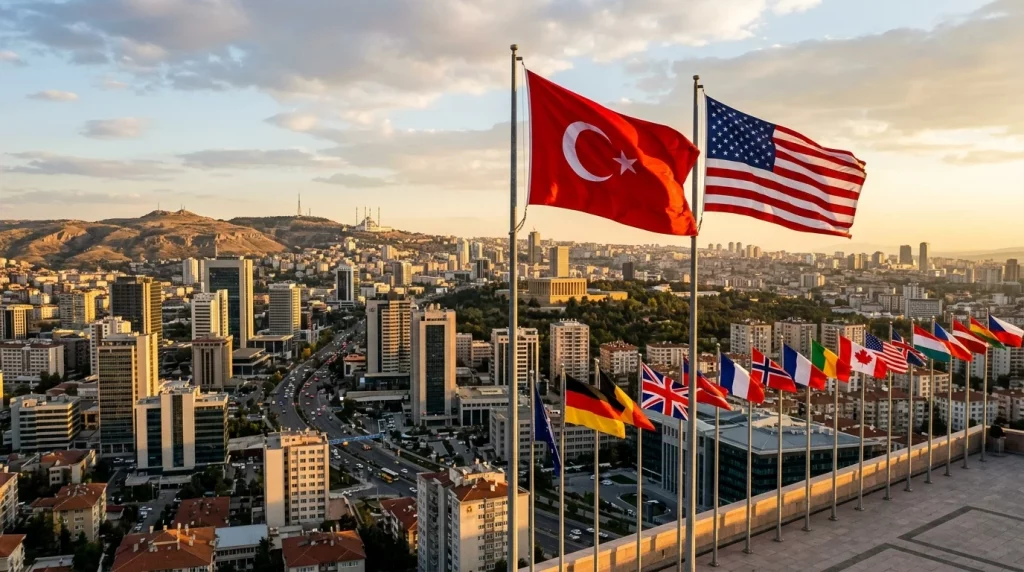
Washington, D.C. / Ankara — The flags of 32 nations lined the grand boulevards of Ankara last week. NATO leaders shook hands, made promises, and posed for cameras inside a city that was, for just two days, the most watched place on earth. For Turkey — and for the nearly four million Turkish Americans living in the United States — those two days may have changed everything. Or perhaps they changed nothing at all. The truth, as usual, lies somewhere in between.
President Donald Trump flew into Ankara on July 7 for the 36th NATO Summit, becoming only the second American president in history to attend a NATO gathering on Turkish soil. He received a warm welcome from President Recep Tayyip Erdoğan. He praised Turkey as a “loyal” ally. He lifted the CAATSA sanctions that had punished Turkey’s defense industry since 2020. And in the most stunning statement of all, he said the United States would “certainly consider” selling Turkey the F-35 stealth fighter jet — the most advanced aircraft in the world, a plane Turkey helped build before being kicked out of the program seven years ago. For Turkish Americans, it was a moment that felt, at long last, like being seen. But then came the pushback. And it was fierce.
What Happened in Ankara: The Big Moments You Need to Know
The NATO Summit in Ankara produced a long list of agreements. Alliance members pledged €70 billion in military equipment for Ukraine. NATO reaffirmed its “ironclad” commitment to collective defense under Article 5. Trump announced that the U.S. would allow Ukraine to domestically manufacture Patriot missile interceptors — a massive shift in arms policy. He also declared that the U.S.-Iran nuclear memorandum of understanding was “over” after American strikes on Iranian targets in the Strait of Hormuz. But nothing dominated the headlines quite like the question of Turkey and the F-35. In a bilateral meeting with Erdoğan on the sidelines of the summit, Trump confirmed that the United States had lifted CAATSA sanctions on Turkey’s defense procurement agency, SSTEK. These were the same sanctions that were imposed during Trump’s own first term, in December 2020, after Turkey purchased the Russian-made S-400 air defense missile system against Washington’s direct warnings. Trump went further. He said Turkey had been “treated very unfairly” and signaled a willingness to revisit the F-35 ban — a position that immediately sent shockwaves through Washington, Jerusalem, and Athens.
“Turkey is a great ally,” Trump told reporters. “We want to work with them. We’ll certainly consider it.”
Erdoğan, for his part, could barely hide his satisfaction. He told Turkish state media that the summit had been a “turning point” in U.S.-Turkey relations and that he had received personal assurances from Trump about the fighter jet issue. Also on the same day, in a bittersweet reminder of Turkey’s complicated domestic politics, Istanbul Mayor Ekrem İmamoğlu — the man many Turks hope will one day challenge Erdoğan for the presidency — was defending himself in a courtroom near Silivri prison outside Istanbul. He faces 142 charges and a potential sentence of more than 2,000 years. The European Parliament’s Turkey rapporteur called the timing “statistically improbable.” Critics called it deliberately orchestrated to suppress political opposition while world leaders celebrated Erdoğan on the international stage.
Why Turkey Was Kicked Out of the F-35 Program — and Why It Still Matters
To understand why this moment is so big, you have to go back to 2019. Turkey was not just a customer for the F-35 — it was a manufacturer. Turkish companies built critical components for the aircraft. Turkey was supposed to receive more than 100 jets and was deeply woven into the global supply chain that produces the plane. Then Erdoğan bought the S-400. Russia’s most advanced air defense system. A system designed specifically to detect, track, and shoot down aircraft like the F-35.
The United States said: you cannot have both. The S-400’s radar, if operated alongside F-35s, could give Russia invaluable intelligence about the jet’s stealth technology — its exact radar signature, its vulnerabilities. It was, from a national security standpoint, an unacceptable risk. So Turkey was expelled from the program in July 2019. Its manufacturing contracts were redistributed. The jets never came. Turkey never gave up the S-400. It never gave up hope for the F-35, either.
The Real Obstacle: Congress and the Law
Here is where things get complicated — and where many news reports leave out the most important part. Trump’s enthusiasm does not make an F-35 sale happen. Under U.S. law — specifically Section 1245 of the National Defense Authorization Act (NDAA) of 2020 — the transfer of F-35 jets to Turkey is explicitly prohibited until Turkey “no longer possesses” the S-400 system or any of its components.
That is not a policy preference. That is a federal statute. And it takes Congress to change it. So far, Congress is not cooperating. A bipartisan group of lawmakers — led by Republican Rep. Mike Lawler of New York and Democratic Rep. Brad Sherman of California — sent a letter to the White House warning against the sale. They cited Turkey’s “constant and growing anti-Israel rhetoric,” its growing ties with Iran, its occupation of northern Cyprus, and its historical tensions with fellow NATO member Greece.
Sen. John Cornyn, a powerful Republican from Texas and normally a close Trump ally, publicly disagreed with the president’s position. Senate Foreign Relations Committee Chairman Jim Risch — one of the most influential voices on U.S. arms sales — said flatly that the S-400 must go before any F-35 discussion can move forward.
Rep. Dina Titus of Nevada led a group of 18 House Democrats who pushed for a Joint Resolution of Disapproval to block even the separate $700 million sale of F-110 jet engines for Turkey’s homegrown KAAN fighter jet. That resolution did not advance in committee, and the engine sale is expected to proceed — but it shows how quickly organized opposition can mobilize.
Secretary of State Marco Rubio, in a June 2026 appearance before Congress, acknowledged that the administration remains legally bound by the existing statute. Even he could not promise what Trump seemed to be suggesting.
Who Is Against the Sale — and Why
The opposition to Turkey getting F-35s comes from several directions, and understanding each one helps you see the full picture.
The Pro-Israel Lobby
Israeli Prime Minister Benjamin Netanyahu has been the loudest foreign voice against the sale. In a phone call with Trump just before the summit and then again in a Fox News interview, Netanyahu was blunt: “I don’t think they should be given F-35s or engines for their fighter jets.” His reasoning? Turkey under Erdoğan openly supports Hamas, hosts its leadership in Istanbul, and has called for an end to Israeli “apartheid.” Israeli officials also warn that F-35s in Turkish hands would “upset the power balance in the Middle East” and undermine the principle of Israeli air superiority — a cornerstone of U.S. policy in the region for decades. The New York Post’s editorial board, echoing this position, called Turkey “an enormously problematic NATO member” and urged Trump to reimpose sanctions, not lift them.
Opponents of Erdoğan’s Governance Critics of the Turkish government — both in the U.S. and abroad — point to Erdoğan’s record at home. They say he has used Turkey’s courts and anti-terrorism laws to imprison political opponents, journalists, and Kurdish activists. The İmamoğlu case is only the most visible example. Human rights organizations have long warned that Turkey under Erdoğan is not a reliable democratic partner. The New York Post called Erdoğan a “strongman” and warned that friendship with him was “blinding” Trump to serious security risks.
Greek American and Armenian American Communities Powerful and well-organized advocacy communities — particularly Greek Americans and Armenian Americans — have lobbied Congress intensively to oppose the sale. They cite Turkey’s occupation of Northern Cyprus, its territorial disputes with Greece in the Aegean Sea, and its historical role in the Armenian Genocide. For these communities, Turkey receiving advanced U.S. weapons is not just a foreign policy concern. It is personal.
Some National Security Experts Independent defense analysts worry that even if the S-400 issue is resolved on paper, Russia’s end-user agreements for the system may prevent Turkey from actually handing it over. The legal and technical complications are enormous. Some experts also worry that advanced U.S. technology could eventually leak to adversaries if geopolitical relationships shift.
Who Supports the Sale — and Why
The case for restoring Turkey’s place in the F-35 program is also compelling — and has been made by serious people across the political spectrum.
Strategic NATO Value – Turkey commands the Bosphorus and Dardanelles Straits — the only maritime gateway between the Black Sea and the Mediterranean. It hosts the Incirlik Air Base, one of NATO’s most critical forward deployment platforms. It has NATO’s second-largest military. It has been a member of the alliance since 1952. Supporters of the F-35 sale argue that punishing Turkey indefinitely — especially while expecting it to keep hosting American troops, missiles, and aircraft — is both unfair and strategically counterproductive. A Turkey that is isolated within NATO is a Turkey that has less reason to choose the Western alliance over alternatives.
Turkey Has Been Pivoting Away From Russia – Since the NATO summit, Turkey has signaled a remarkable and potentially historic defense pivot. Reporting from Al-Monitor and Defense News indicates that Turkey is now in advanced talks to acquire the SAMP/T air defense system — a Franco-Italian system — as a potential replacement for the S-400. This would be the most concrete step yet toward resolving the legal obstacle to the F-35 sale. Russia, for its part, has confirmed that Turkey approached Moscow about the terms of transferring or returning the S-400 batteries. Whether this leads to a deal is unclear, but the direction of movement is significant.
The KAAN Connection – A $700 million sale of F-110 General Electric jet engines for Turkey’s domestically produced KAAN fighter jet has already cleared its congressional review window without being blocked. This is not the F-35 — but it is a major step in normalizing defense cooperation between the two countries. It signals that, even in Congress, some openness exists to working with Turkey on defense matters when the legal boxes are checked.
A More Stable Middle East – The Middle East Forum argues that Turkey’s growing standing in the region — combined with Israel’s declining soft power following years of conflict in Gaza — actually makes Turkey a more important partner for the U.S., not less. Turkey has played a key mediating role in the Russia-Ukraine war, in Gaza ceasefire talks, and in broader regional diplomacy. Selling Turkey the F-35 would deepen that partnership and give Ankara more reason to align with Washington.
The Imamoglu Factor: Democracy, Diplomacy, and Double Standards
It would be incomplete to discuss this NATO summit without acknowledging the elephant in the room. While Erdoğan shook hands with Trump in Ankara’s grand summit halls, his most dangerous political rival — Istanbul Mayor Ekrem İmamoğlu — was sitting in a makeshift courtroom near a prison, fighting charges that his supporters say are entirely fabricated. İmamoğlu was arrested in March 2025. His party, the CHP, immediately declared him its presidential candidate — a move designed to make his prosecution politically radioactive. The case has dragged on for months. During the NATO summit week, İmamoğlu was barred from his own court proceedings for alleged “disruptive behavior.” A prosecutor then opened a new investigation against him for “threatening a public official” — based on things he said inside the courtroom.
The European Parliament’s Turkey rapporteur publicly noted that three separate cases against İmamoğlu were all scheduled to have hearings on the same day as the NATO summit. “The timing,” he said, “is not a coincidence.” For Turkish Americans who support democratic values and a Turkey where political competition is free and fair, this is deeply troubling. Celebrating Trump’s embrace of Erdoğa without also naming the injustice being done to İmamoğlu — and to Turkish democracy itself — would be dishonest. A truly free and prosperous Turkey is one where the rights of all citizens are protected, where political opponents are not imprisoned on trumped-up charges, and where the press can report freely. Turkish Americans should hold both truths simultaneously: celebrate improved U.S.-Turkey relations while also demanding that the United States use its influence to stand up for democracy and human rights in Turkey.
What This Means for Turkish Americans
This is the part of the story that matters most to you — to us. For nearly a decade, Turkish Americans have watched their ancestral homeland be treated as something between a problem and a pariah within the American political system. The S-400 crisis froze the relationship. The CAATSA sanctions embarrassed Turkey in front of the world. Turkish American advocacy organizations, including TCUSAPAC, worked year after year to remind Washington of Turkey’s strategic value, its NATO loyalty, and the deep bonds between the two countries’ people. The Ankara summit was a turning point — not a final victory, but a turning point. Here is what this moment means for you:
1. Your voice helped make this happen. The long-term advocacy work by Turkish American organizations — meeting with senators and representatives, educating policymakers, building relationships across party lines — created the political environment in which this opening became possible. Do not underestimate that.
2. The work is not done. Trump’s words are powerful but they are not law. Until Congress changes the NDAA statute, the F-35 ban remains in place. The next fight is on Capitol Hill — and that fight needs Turkish American voices now more than ever.
3. The opposition is organized. Greek American, Armenian American, and pro-Israel lobbying groups have been working against Turkey in Washington for years. They are experienced, well-funded, and have deep relationships with members of both parties. Turkish Americans must match that level of organization and engagement. This is not a moment to sit back.
4. This is bigger than jets. The F-35 is a symbol. What it really represents is whether Turkey is treated as a full and valued partner by the United States — or as a second-tier ally to be managed and restricted. A resolution of this issue would open the door to deeper economic ties, more cultural exchanges, and stronger political representation for Turkish Americans at every level of government.
5. Bipartisan engagement is essential. The lawmakers most opposed to Turkey tend to be those with large Greek American or Armenian American constituencies. But there are also pro-Turkey voices on both sides of the aisle — including some who represent districts with significant Turkish American populations. Turkish Americans should know their own representatives and make sure those representatives know them.
What Turkish Americans Should Do Right Now
This is an urgent moment, and it requires action — not just awareness. Contact your congressional representatives. Call, write, or visit the offices of your senators and representatives. Let them know you are a constituent, that you care about U.S.-Turkey relations, and that you support a policy that treats Turkey as the trusted NATO ally it has been for more than 70 years. Be polite, be specific, and be persistent.
Support TCUSAPAC and allied organizations. Organizations like TCUSAPAC exist precisely to represent Turkish American interests in Washington. Support them financially, attend their events, and volunteer. The strength of a community’s political voice is directly related to its level of organization.
Educate your neighbors and colleagues. Many Americans know very little about Turkey beyond stereotypes and headlines. Share accurate information about Turkey’s role in NATO, its contributions to regional stability, and the rich history and culture that Turkish Americans bring to this country. Personal relationships change minds in ways that press releases never can.
Engage with the S-400 issue honestly. Turkish Americans who want the F-35 deal to happen must also acknowledge and engage with the legitimate concern about the S-400. The best argument is not to dismiss the issue but to support Turkey’s efforts to find a credible path — such as the SAMP/T acquisition — that resolves the legal obstacle. That is the path most likely to succeed.
Register to vote and vote in every election. Political influence flows from electoral power. Every Turkish American who is eligible to vote and does not vote is leaving power on the table. Local, state, and federal elections all matter.
Call on U.S. leaders to also stand up for democracy in Turkey. Improving U.S.-Turkey relations is a worthy goal. So is pushing for a Turkey where political competition is free, where İmamoğlu is released and given a fair trial, and where journalists can report without fear. These goals are not in conflict. A healthy U.S.-Turkey partnership works best when Turkey is a healthy democracy.
The Bottom Line
What happened in Ankara last week was significant — and it was complicated. Trump gave Turkey a diplomatic victory that Erdoğan will use to boost his standing at home and abroad. He lifted sanctions that had chilled the relationship for years. He opened the door, even if just a crack, to the possibility that Turkey might one day fly the F-35.
But a cracked door is not an open one. Congress still controls the keys. Lawmakers from both parties are watching closely. The S-400 problem has not been solved. And back in Istanbul, Ekrem İmamoğlu is still waiting for justice. For Turkish Americans, this moment calls for celebration — and for action. The diplomatic winds have shifted in Turkey’s favor. Now it is time to make sure that shift becomes permanent, and that it benefits not just Turkey’s government, but its people, its diaspora, and the shared democratic values that should bind the United States and Turkey together as true partners. The story is not over. In many ways, it is just beginning.
Sources
New York Post Editorial Board, “Trump Mustn’t Trust Turkey Strongman Recep Erdogan With Our F-35 Jets,” July 8, 2026
The Hill, “Trump ‘Undecided’ on Turkey’s F-35s,” July 2026
Middle East Forum / Times of Israel, “NATO Summit and Trump’s Support for F-35s Sale Boost Turkey’s Standing,” July 8, 2026
Al-Monitor, “Trump ‘Undecided’ on Turkey’s F-35s as Congress Seeks Answers on S-400,” July 2026
Reuters, “Trump Says Will Lift Turkey Sanctions, Decide on Selling F-35s,” July 7, 2026
Defense News, “US Will Lift Sanctions on Turkey, Possibly Sell F-35 Fighter Jets, Trump Says,” July 7, 2026
The Notus, “Trump Removing Sanctions, F-35 Sales to Turkey,” July 2026
Atlantic Council, “Eleven Takeaways from the NATO Summit in Ankara,” July 2026
Al Jazeera, “Five Key Takeaways from the NATO Summit in Ankara,” July 8, 2026
Washington Times, “Erdogan Hosts NATO Summit as Political Rival İmamoğlu Defends Himself in Court,” July 8, 2026
Washington Post, “Turkey: İmamoğlu, CHP, NATO, Erdoğan, Court,” July 8, 2026
Rep. Mike Lawler Press Release, Lawler.house.gov, July 2026
Washington Examiner, “Trump’s F-35 Jets to Turkey: Congress,” July 2026
Breaking Defense, “F-35 for Turkey: Trump Says ‘Certainly We’ll Consider’ Reversing Ban,” July 2026
Army Recognition, “Trump-Turkey F-35 Deal: NATO Summit,” July 2026