
A Washington Test for Turkey’s F-35 Ambitions
Trump’s pledge to lift sanctions has revived Ankara’s hopes. But in Congress, the question is less whether Turkey matters to the United States than whether the alliance’s old disputes have actually been resolved. President Trump’s promise in Ankara to lift U.S. sanctions on Turkey — and his indication that he will decide whether to allow the sale of F-35 fighter jets — has reopened one of the most consequential disputes in the U.S.-Turkey relationship. Speaking alongside President Recep Tayyip Erdoğa during the NATO summit, Mr. Trump said the United States would remove sanctions imposed after Turkey acquired Russia’s S-400 air-defense system. He also described a potential F-35 sale as something his administration would consider, while stopping short of announcing an agreement “We don’t want to sanction friends,” Mr. Trump said, according to Reuters. For Ankara, the comments were a significant diplomatic opening after years of exclusion from the F-35 program. For lawmakers in Washington, they were a reminder that the core questions surrounding Turkey’s Russian-made S-400 system, its relationship with NATO, and its strained ties with Israel and Greece have not gone away. The emerging divide is not cleanly partisan. It is instead a contest between those who see Turkey’s return to closer defense cooperation as strategically necessary and those who believe that restoring access to the F-35 before Ankara resolves longstanding disputes would undermine American security policy.
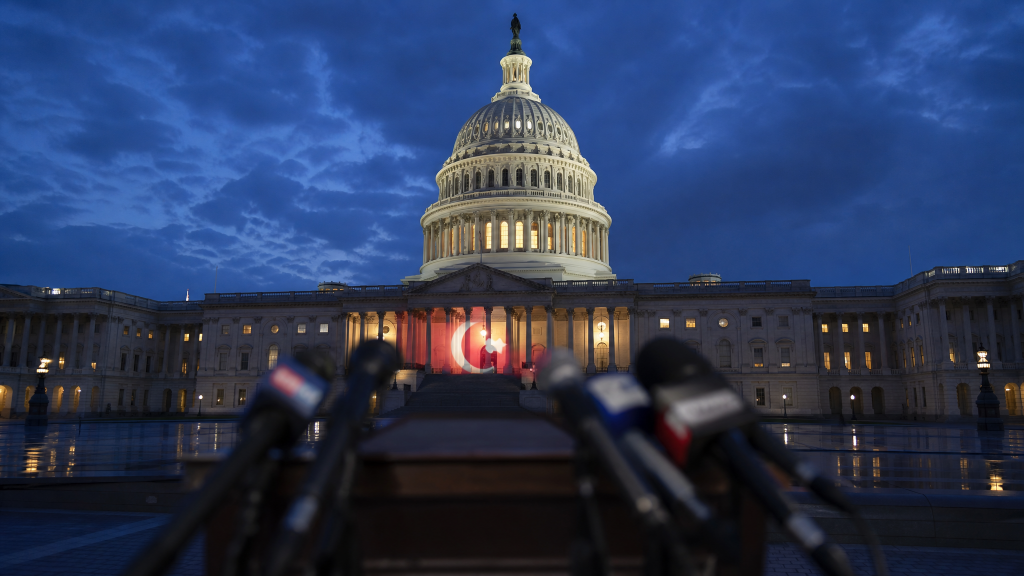
The president’s opening — and Congress’s skepticism
Mr. Trump’s announcement came after Turkey spent years seeking relief from CAATSA sanctions and a renewed route to the F-35, the advanced U.S. aircraft program from which it was removed in 2019. The original break centered on Turkey’s acquisition of the Russian S-400 system, which Washington said created an unacceptable risk to F-35 technology and NATO security. Congressional restrictions have since blocked an F-35 transfer while Turkey retains the S-400, making a presidential decision only one part of the process.
A sale would still require formal notification to Congress, where lawmakers could seek to block it or attach conditions through legislation. As Breaking Defense reported, the legislative and security barriers remain substantial even as the administration considers a policy shift.
The House response has already been organized and bipartisan. On July 2, Representatives Mike Lawler, Republican of New York, and Brad Sherman, Democrat of California, led a letter to Mr. Trump urging him not to sell F-35s to Turkey. The group argued that the S-400 remains a “major security threat” and cited disputes involving Israel, Greece, Cyprus and Iran. The letter was also signed by:
Nicole Malliotakis, Republican of New York
Gus Bilirakis, Republican of Florida
Jeff Hurd, Republican of Colorado
Max Miller, Republican of Ohio
Young Kim, Republican of California
Stephen Lynch, Democrat of Massachusetts
Gabe Amo, Democrat of Rhode Island
Jared Moskowitz, Democrat of Florida
Their position, published by Representative Lawler’s office, underscores the central political reality: opposition to the sale is not limited to one party.
Is Congress aligned with Mr. Trump?
No. Congress is not aligned behind the president’s position — at least not yet.
Mr. Trump’s remarks have created an opening for the administration, but they have not established congressional consensus. The clearest public congressional intervention so far is the Lawler-Sherman letter, which opposes a sale and includes both Republicans and Democrats. In the Senate, the available public reaction is more cautious than unified. Senator John Cornyn, Republican of Texas, who sits on the Senate Foreign Relations Committee, has raised concerns about the security implications of a potential F-35 transfer, according to reporting by Jewish Insider. At the same time, lawmakers at the NATO summit have indicated that a different outcome could be possible if Turkey addresses the S-400 issue in a credible, verifiable way. That distinction matters. There is not, at present, a visible congressional bloc committed to an unconditional F-35 sale. But there may be room for members of both parties to support a structured arrangement if it includes enforceable safeguards and a durable resolution of the S-400 dispute.
Republicans and Democrats: Where the lines are drawn The debate does not break down neatly between Republicans and Democrats.
Republican view
Some Republicans have echoed the administration’s broader argument: Turkey is a NATO ally of great strategic importance, and Washington should avoid allowing a rupture with Ankara to become permanent. They point to Turkey’s position on the Black Sea, its role in NATO’s southeastern flank, its proximity to conflicts in the Middle East and Caucasus, and the importance of military interoperability among allies. But prominent Republican House members — including Mr. Lawler, Ms. Malliotakis, Mr. Bilirakis, Mr. Hurd, Mr. Miller and Ms. Kim — have joined opposition to an F-35 sale under current conditions. Their objections focus principally on the S-400, but they also reflect wider concern about Turkey’s regional policy and the implications for U.S. partners.
Democratic view
Democrats who have spoken publicly through the House letter have also opposed an immediate sale. Mr. Sherman, Mr. Lynch, Mr. Amo and Mr. Moskowitz joined the bipartisan warning to the White House. Democratic skepticism generally emphasizes congressional oversight, the S-400’s potential access to sensitive military information, arms-transfer safeguards and human-rights or regional-stability concerns. Still, there is no evidence of a unified Democratic caucus position beyond the lawmakers who have publicly expressed opposition.
The more useful distinction: conditional engagement vs. outright resistance
The current congressional landscape is better understood through two approaches:
Conditional engagement: Members who may be willing to reconsider the relationship if Turkey resolves the S-400 issue in a clear, durable and verifiable manner, while recommitting to defense cooperation compatible with NATO security standards.
Current-condition opposition: Members who believe that an F-35 sale should not proceed while Turkey retains the S-400 and while regional disputes remain unresolved.
At present, the public record offers stronger evidence of the second position than the first. It would be premature to label a large group of House or Senate members as firmly “pro-Turkey” on the F-35 question without specific public statements from them.
Why this debate is larger than an aircraft sale
The F-35 dispute has become a proxy for a larger question: Can Washington and Ankara rebuild strategic trust after years of disagreement? Turkey argues that continued exclusion weakens NATO, reduces military coordination with a major ally and encourages Ankara to develop alternatives outside the Western defense-industrial system. Turkey was once a production partner in the F-35 program, and its removal was seen in Ankara as both a military and political setback.
Critics in Congress argue that returning Turkey to the program without resolving the S-400 problem would signal that a NATO ally can purchase significant Russian military equipment and later regain access to America’s most sensitive defense technology.
The administration will also have to weigh vocal objections from Israel. Prime Minister Benjamin Netanyahu has publicly opposed a potential sale, arguing that it could alter the regional military balance, as reported by CNN. Greece has also expressed concerns in public reporting.
What it means for Turkish Americans
For Turkish Americans, this debate is not simply about a fighter jet. It is about whether the United States and Turkey can move toward a more stable, predictable and strategically serious relationship. A stronger relationship would affect issues far beyond defense procurement:
NATO cohesion and deterrence in the Black Sea region
U.S.-Turkey cooperation on regional security and energy routes
Trade, investment and technology partnerships
Educational and cultural exchange
The standing and influence of Turkish-American civic engagement in Washington
But Turkish Americans should also recognize that the F-35 issue carries real security and legal questions in Congress. Effective advocacy should not dismiss those concerns; it should address them directly.
What Turkish Americans can do
Engage Congress consistently, not only during a crisis.
Contact House members and senators with respectful, fact-based messages. Explain why a functional U.S.-Turkey alliance serves American interests, NATO security and regional stability.Support a credible path forward.
Advocacy is more persuasive when it recognizes the S-400 issue rather than treating it as irrelevant. A viable policy outcome will likely require a transparent security arrangement acceptable to the United States and NATO.Make the strategic case in U.S. terms.
Focus on interoperability, deterrence, Black Sea security, counterterrorism, economic ties and the costs of further strategic separation between Washington and Ankara.Build broad coalitions.
Work with veterans, business leaders, foreign-policy experts, NATO-focused organizations and local civic groups. Durable influence comes from relationships built over time.Reject inflammatory rhetoric.
The Turkish-American community can support close U.S.-Turkey ties without hostility toward other communities. Serious advocacy is strengthened by a commitment to dialogue, pluralism and democratic participation.
The road ahead
Mr. Trump has made clear that he wants to reset the tone with Ankara. But his announcement has not resolved the policy dispute; it has moved it to Congress. The decisive questions remain unanswered: What will happen to the S-400 system? Can the administration satisfy congressional security concerns? And can Washington develop a framework that strengthens NATO without deepening tensions with other regional partners?
For Turkey, the prospect of sanctions relief represents an opening. For Congress, it is a test of whether strategic necessity and security safeguards can be reconciled. For Turkish Americans, it is a moment to engage with clarity, persistence and an understanding that the future of the alliance will be shaped as much on Capitol Hill as in Ankara.
Sources
Reuters: Trump says he will lift Turkey sanctions and decide on F-35 sale
Reuters: Report on Trump’s expected restoration of F-35 access
Breaking Defense: Legal and policy obstacles to a potential F-35 sale
Representative Mike Lawler’s office: Bipartisan House letter opposing F-35 sale
Jewish Insider: Congressional reactions and divisions over sanctions relief