
Türkiye’s Nuclear Pivot Toward Russia: What It Means for Washington and NATO
Erdoğan’s call for expanded nuclear cooperation with Moscow presents the United States with a strategic choice: offer Türkiye credible energy alternatives or watch Russian influence deepen inside a key NATO ally.
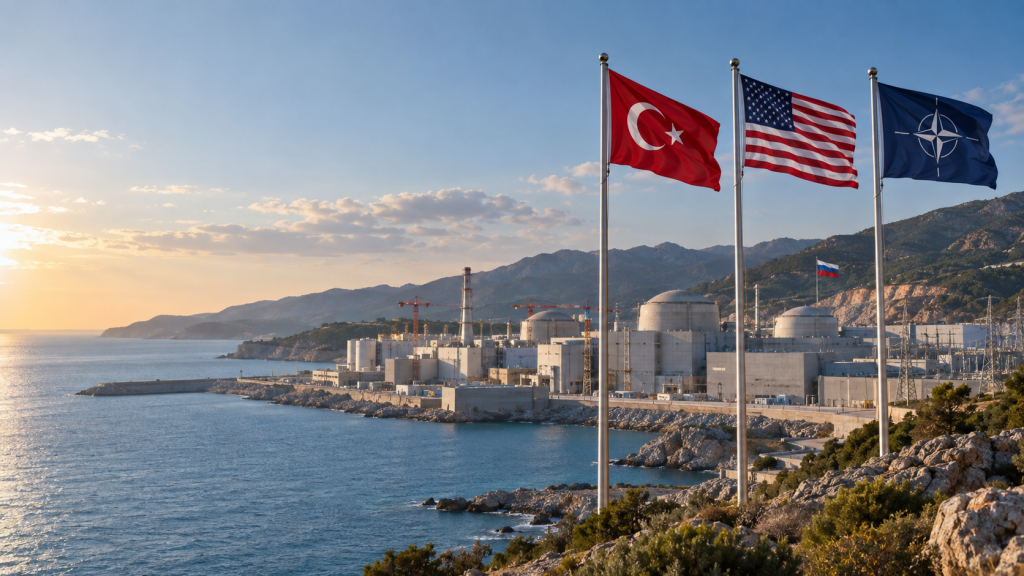
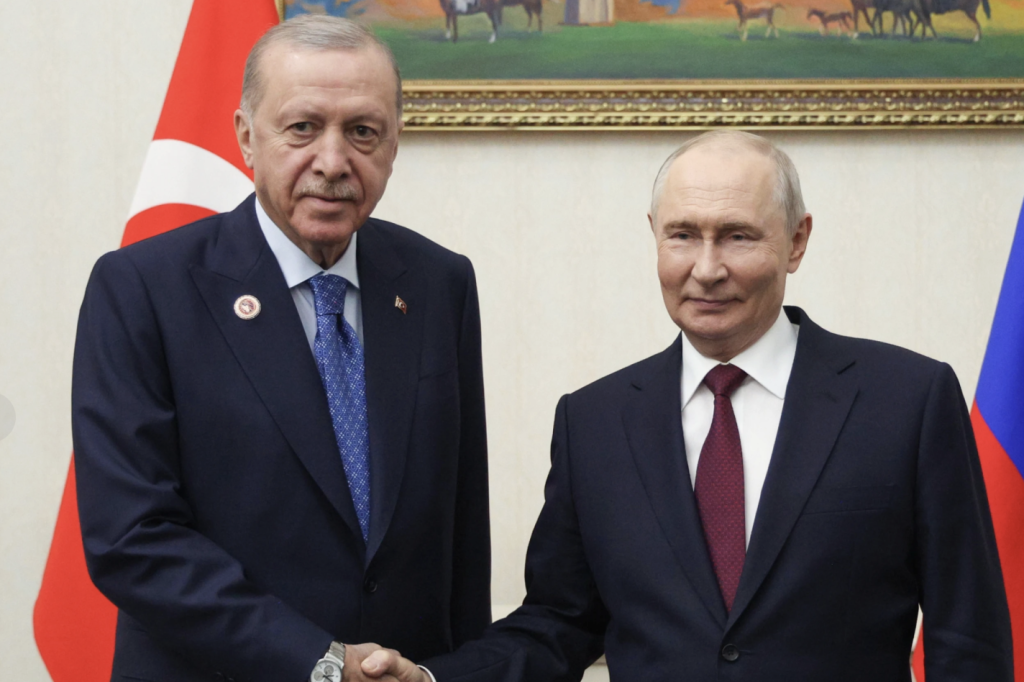
When President Recep Tayyip Erdoğan sat beside Russian President Vladimir Putin this month and spoke of building additional nuclear power plants together, his words carried significance far beyond the construction site at Akkuyu.
Türkiye’s first nuclear power plant, rising on the Mediterranean coast in Mersin Province, represents a long-held national ambition. Once all four reactors are operating, the facility is expected to generate roughly 10 percent of the country’s electricity. For a nation that imports most of its energy, that is not a marginal achievement. It could reduce exposure to volatile fossil-fuel prices, provide continuous low-carbon electricity and help support growing industrial demand. But Akkuyu is also an unusual experiment in sovereignty. Russia’s state-owned nuclear corporation, Rosatom, is not merely supplying the reactors. Under the project’s build-own-operate model, it is financing, constructing, owning and preparing to operate the plant. Türkiye will host the facility and purchase its electricity, but the project’s financing, technology, fuel supply and much of its operating expertise remain closely tied to Moscow.
That tension—between generating electricity at home and depending on a foreign power to do it—should be at the center of the public debate.
A strategic project with a troubled timetable
Türkiye and Russia signed the Akkuyu agreement in 2010. Construction of the first of four Russian-designed VVER-1200 reactors began in 2018. The original timetable envisioned the first unit operating in 2023, the centennial of the Turkish Republic. That deadline passed. The delays have had several causes. German-made electrical equipment was withheld under export restrictions, prompting Rosatom to seek replacement components from China. Financial transfers were also complicated by Western sanctions and compliance concerns arising from Russia’s invasion of Ukraine. Reuters reported in April that approximately $2 billion intended for the project had been frozen in a JPMorgan account.
Moscow subsequently provided approximately $9 billion in additional financing, according to Türkiye’s energy minister. Turkish officials now say they expect the first electricity from Akkuyu in 2026, while the broader project will require additional time.
The plant is nevertheless approaching a consequential threshold. Nuclear fuel arrived at the site in 2023, giving Türkiye the formal status of a country with a nuclear installation. The International Atomic Energy Agency has reviewed elements of Türkiye’s regulatory framework, site design and preparedness. Yet the true test will come when construction gives way to sustained operation—an undertaking that requires an independent regulator, a strong safety culture, trained personnel, transparent incident reporting, cybersecurity and credible long-term plans for spent fuel and radioactive waste.
Energy independence—or a new dependency?
The case for nuclear power in Türkiye is substantial. Nuclear reactors can operate around the clock and complement the country’s rapidly expanding wind and solar capacity. Akkuyu can also reduce the amount of imported natural gas burned to produce electricity. In an era of wars, sanctions and disrupted shipping routes, a more diverse energy system is a national-security asset. Yet diversification is not achieved simply by replacing imported Russian gas with a Russian-owned nuclear plant.
Rosatom’s model concentrates several relationships in one supplier: ownership, financing, reactor technology, fuel, specialized maintenance and workforce training. Nuclear plants commonly operate for 60 years, and sometimes longer. A decision made today may therefore shape Türkiye’s strategic options well into the next century.
This does not mean Türkiye should abandon Akkuyu or refuse all cooperation with Russia. It means future nuclear agreements should be judged by stricter standards. Who owns the asset? Who controls operational decisions? Can fuel be sourced from more than one supplier? What happens if sanctions interrupt payments or replacement parts? How much technology and expertise will actually be transferred to Turkish institutions? Who bears the financial burden of delays, decommissioning and waste disposal? And does the regulator have enough independence and authority to act without political or commercial pressure?
These are not anti-Russian questions. They are pro-Türkiye questions.
A test for Türkiye’s relationship with the West
Erdoğan’s suggestion that Türkiye and Russia could develop additional nuclear plants will receive close attention in Washington and other NATO capitals. Türkiye has tried to preserve working relationships with both Moscow and Kyiv, while serving as a NATO ally and an important regional power. That balancing strategy has sometimes produced diplomatic leverage. It has also created mistrust.
The United States and Türkiye have already discussed cooperation on large reactors and small modular reactors. Those talks offer a practical alternative to a false choice between Russian technology and no nuclear development at all. South Korean, European and potentially other suppliers could also help Türkiye build a more competitive portfolio.
The strongest policy would be a diversified one: complete Akkuyu safely, increase Turkish participation and oversight, and require meaningful competition for future projects in Sinop, Thrace and elsewhere. Türkiye should not allow any single foreign government—Russian, American, Chinese or otherwise—to dominate its nuclear future.
Washington, for its part, should avoid treating Türkiye’s energy needs only as a geopolitical problem. If the United States wants Ankara to reduce its dependence on Rosatom, it must offer credible financing, technology, fuel security, workforce partnerships and commercially realistic timelines. Criticism without an alternative will not change Türkiye’s calculations.
What this means for Turkish Americans
For Turkish Americans, Akkuyu is not a distant technical matter. It sits at the intersection of U.S.–Türkiye relations, NATO cohesion, energy security, climate policy, sanctions and regional stability. Poorly informed debate in Washington could reduce a complex issue to a slogan: either Türkiye is “turning toward Russia,” or every concern about Russian dependence is an attack on Türkiye. Neither frame is adequate.
Turkish Americans can make a more valuable contribution by insisting on two principles at once:
Türkiye has a legitimate need to diversify its energy supplies and develop peaceful nuclear power.
Türkiye’s long-term sovereignty is better protected through transparent contracts, independent regulation, multiple suppliers and stronger cooperation with allied countries.
Effective advocacy should not defend every decision made in Ankara. Nor should it accept one-sided narratives that ignore Türkiye’s energy vulnerability. Credibility comes from presenting facts, acknowledging risks and proposing workable alternatives.
For PACs
Support candidates on a bipartisan basis who favor a strong U.S.–Türkiye relationship, NATO cooperation and realistic energy-security policies.
Ask candidates and officeholders to support expanded U.S.–Türkiye civil nuclear cooperation, including feasibility work on small modular reactors, workforce training, safety regulation and nonproliferation.
Encourage congressional oversight that distinguishes legitimate nuclear safety and sanctions concerns from broad measures that could unintentionally weaken Türkiye or drive it toward greater dependence on Russia.
Maintain rigorous compliance procedures. Under federal law, foreign nationals may not make U.S. political contributions or participate in contribution decisions; lawful permanent residents are treated differently under the relevant FEC rule. Organizations should obtain qualified campaign-finance counsel rather than relying on informal guidance.
For individuals
Write to your senators and representative as an American constituent. Keep the message brief, factual and specific.
Ask Congress to encourage competitive U.S. and allied bids for Türkiye’s future nuclear projects—not simply to criticize Ankara’s cooperation with Moscow.
Request stronger U.S.–Türkiye partnerships in nuclear education, emergency preparedness, cybersecurity, regulatory capacity and clean-energy investment.
Attend town halls and ask a focused question: “What will you do to help Türkiye, a NATO ally, diversify its nuclear technology and fuel supply while maintaining the highest safety and nonproliferation standards?”
Share verified sources instead of inflammatory social-media claims. Public credibility is an advocacy asset, and once lost it is difficult to recover.
The message Washington should hear
A constructive Turkish American message would be direct:
Türkiye’s pursuit of nuclear energy is legitimate and strategically important. Akkuyu should be completed and operated safely, transparently and under effective Turkish regulation. Future projects should strengthen—not narrow—Türkiye’s sovereignty through competition, allied investment, technology transfer and diversified fuel and supply chains. The United States should give Türkiye credible alternatives rather than ultimatums.
Akkuyu may soon begin producing electricity. The more important question is what kind of power relationship it will produce. Türkiye should use the project as the beginning of a nuclear-energy strategy—not as a template that leaves the country dependent on a single external partner for generations.
Sources:
Associated Press, “Turkey’s Erdogan signals further nuclear projects with Russia”, Sept. 1, 2026.
Republic of Türkiye Ministry of Energy and Natural Resources, “Akkuyu NGS, a Historic Turning Point”, Oct. 30, 2025.
Republic of Türkiye Ministry of Energy and Natural Resources, “Vision of 2026 in Energy”, Dec. 26, 2025.
International Atomic Energy Agency, “Türkiye Starts Construction of its First Nuclear Power Plant”, Apr. 5, 2018.
International Atomic Energy Agency, “IAEA Chief Highlights Sustainable Energy as First Nuclear Fuel Arrives in Türkiye”, Apr. 28, 2023.
Reuters, “Turkish nuclear plant delayed by withheld Siemens parts, China to supply”, Sept. 11, 2024.
Reuters, “Turkey says Russia gave it $9 billion in new financing for Akkuyu nuclear plant”, Dec. 26, 2025.
Reuters, “Russia’s Rosatom in talks with Turkish firms on Akkuyu nuclear plant stakes”, Apr. 21, 2026.
Reuters, “Turkey and U.S. in talks on nuclear plant projects, Turkish official says”, July 2, 2024.
World Nuclear Association, “Nuclear Power in Türkiye”, updated Dec. 4, 2025.
Federal Election Commission, “Who can and can’t contribute”.