
The F-35 Talks Resume, but the S-400 Still Controls the Outcome
President Recep Tayyip Erdoğan’s statement that negotiations with Washington over Türkiye’s return to the F-35 program are continuing is important. It is not, however, a breakthrough. The talks have moved from a period of near-total political estrangement into a more serious bargaining phase, but the decisive obstacle is no longer simply whether the American and Turkish presidents want an agreement. It is whether Ankara can satisfy a legal test written by Congress after Türkiye acquired Russia’s S-400 air-defense system.
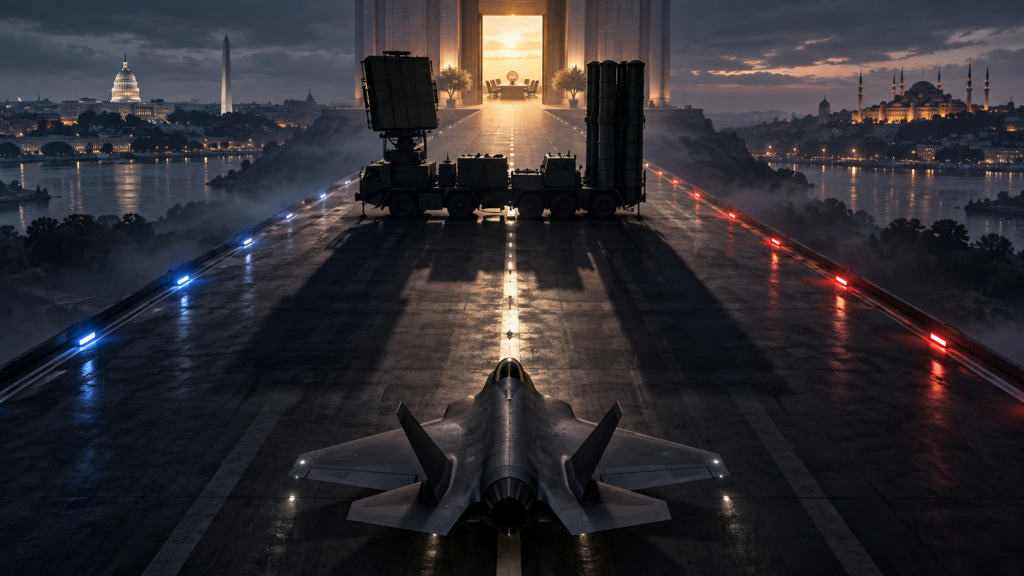
That distinction should guide Turkish-American advocacy. The strongest case for Türkiye is not that Washington should forget the S-400 dispute, or that a NATO ally is automatically entitled to the alliance’s most sensitive aircraft. It is that the United States and Türkiye should negotiate a verifiable, lawful settlement that protects F-35 technology, restores defense-industrial cooperation and prevents a strategic disagreement with Russia from becoming a permanent rupture between allies.
Erdoğan said on Sept. 2 that talks on the F-35 were continuing and expressed confidence that the matter would eventually be resolved. He also stressed that Türkiye would not abandon KAAN, its domestically developed combat-aircraft program. That combination—continued pursuit of the F-35 and continued investment in KAAN—is not contradictory. It reflects Ankara’s desire to close a damaging chapter with Washington without surrendering the strategic autonomy it has pursued since its removal from the F-35 consortium in 2019.
The political climate is more favorable than it was a year ago. At the July NATO summit in Ankara, President Donald Trump said his administration would take the CAATSA sanctions off Türkiye and would consider an F-35 sale. Turkish Foreign Minister Hakan Fidan subsequently said the two countries were closer to resolving the dispute and described the remaining obstacles as legal.
But a presidential announcement is not the same thing as completed sanctions relief, an approved arms sale or delivery of aircraft. As of mid-September, public reporting and the governing statutes still point to an unresolved process. The administration can influence every stage, but it cannot make the S-400 disappear through rhetoric.
The legal lock
Türkiye was an original partner in the F-35 program and Turkish companies manufactured components for the aircraft. The Pentagon began removing Türkiye from the consortium in July 2019, saying that operating the S-400 alongside the F-35 could allow Russia to obtain intelligence about the aircraft’s stealth capabilities. Ankara was not only deprived of future aircraft; it lost industrial participation and remained in dispute with Washington over the approximately $1.4 billion it had paid into the program.
Congress then created a barrier separate from the CAATSA sanctions. Section 1245 of the fiscal 2020 National Defense Authorization Act prohibits transferring F-35s to Türkiye. The executive branch may waive that prohibition only after certifying that Türkiye no longer possesses the S-400 and related items, has credibly promised not to reacquire them and has not acquired other Russian equipment that would endanger the F-35. The waiver becomes available 90 days after that certification.
This language matters. Storage, non-activation or a promise not to integrate the system may reduce the security risk, but the statute says Türkiye must “no longer possess” the S-400. Any reported compromise built around declaring the batteries inoperable would therefore need an unusually strong legal explanation—or new legislation—to survive scrutiny in Congress.
CAATSA is a second, related track. In December 2020, the first Trump administration sanctioned Türkiye’s Presidency of Defense Industries, or SSB, and four officials under Section 231 of the Countering America’s Adversaries Through Sanctions Act. The measures included restrictions on U.S. export licenses and financing, plus asset and visa restrictions on designated officials. CAATSA contains presidential waiver and termination authorities, but some routes require certifications and a congressional review period. The Congressional Research Service has noted that Congress can also try to block sanctions relief or an arms sale.
In practical terms, there are at least four decisions, not one: resolving the physical and legal status of the S-400; changing or ending the CAATSA measures; obtaining executive approval for an F-35 sale; and navigating congressional review. A resolution in one lane does not automatically clear the others.
Why Washington is listening again
Türkiye’s strategic value did not begin in 2026, but several developments have made it harder for Washington to treat the alliance as expendable. Türkiye controls access between the Black Sea and the Mediterranean, possesses NATO’s second-largest military, supports Ukraine while maintaining channels to Moscow, and holds influence in Syria, the Caucasus and the Middle East. Its defense industry has also become a significant producer of drones, missiles, warships and armored systems.
The American interest is not sentimental. Restoring a disciplined defense relationship could improve NATO interoperability, generate business for U.S. manufacturers and reduce incentives for Ankara to deepen its reliance on non-Western suppliers. Türkiye has sought 40 F-35s, while also proceeding with advanced F-16s and developing KAAN.Those alternatives give Ankara options, but they do not make the F-35 strategically irrelevant.
There are also serious objections in Washington. Some lawmakers emphasize the S-400 technology risk; others cite Türkiye’s regional disputes with Israel, Greece and Cyprus or Ankara’s domestic human-rights record. Greek and Israeli concerns have become part of the congressional environment surrounding any prospective sale. Those arguments will not be neutralized by repeating that Türkiye is an indispensable ally. An effective campaign must answer them.
The most persuasive response is a conditional one: the United States should be prepared to restore Türkiye’s place in advanced allied air power if Türkiye accepts a verifiable S-400 disposition that meets American law; Washington should provide a clear road map rather than an endlessly moving set of demands; and both countries should couple the agreement with operational safeguards, sustained military consultation and an enforceable commitment against future acquisitions that could compromise allied systems.
What this means for Turkish Americans
For Turkish Americans, the F-35 dispute is a test of whether diaspora advocacy can mature beyond slogans. Seven Turkish-American organizations wrote to Congress in August supporting an F-35 sale and the removal of CAATSA sanctions. That coalition-building is valuable. The next stage must be more specific.
Advocates should acknowledge at the outset that Congress has a legitimate interest in protecting classified aircraft technology. Doing so is not conceding the argument; it establishes credibility. The request should be for a lawful solution with measurable conditions, not an exception based only on friendship between presidents.
The community should focus on five priorities.
First, ask the administration and Congress to publish a joint road map. It should define the required disposition of the S-400, the verification mechanism, the sequence for CAATSA relief, the process for a possible F-35 notification and how Türkiye’s earlier financial contribution will be credited or otherwise resolved. Strategic ambiguity may help early diplomacy, but it is a poor foundation for congressional approval.
Second, advocate for reciprocity. Türkiye should take verifiable steps on the S-400; Washington should commit in advance to corresponding steps and deadlines. A settlement cannot work if Ankara fears that complying on the Russian system will simply reveal a new, unrelated condition.
Third, build a coalition wider than Turkish-American organizations. Veterans, former diplomats, defense-industry workers, NATO specialists, Ukrainian-American security advocates and businesses in states that benefit from F-35 production can speak to American interests. The argument should be made in Michigan, Texas, Connecticut and other aerospace states as well as in Washington.
Fourth, engage skeptics directly. Offices concerned about Greece, Cyprus, Israel, Syria or democratic governance should receive tailored briefings. Turkish-American advocates do not need to accept every criticism, but they should explain how an F-35 agreement can include deconfliction, end-use monitoring and regular allied consultation. A respectful answer to a hard question is more effective than treating every objection as anti-Türkiye bias.
Fifth, protect KAAN from being framed as a threat to the United States. A capable Turkish defense industry can strengthen NATO if its supply chains and security standards remain connected to the alliance. The recent debate over U.S.-origin F110 engines for KAAN illustrates both the opportunity and the congressional resistance. The case should be that F-35 participation, F-16 modernization and KAAN development can form complementary layers of allied air power.
A practical advocacy agenda
Grassroots organizations should prepare a two-page, sourced briefing built around the statutory pathway. Meetings should target members and staff of the House Foreign Affairs and Armed Services Committees and the Senate Foreign Relations and Armed Services Committees, especially offices with aerospace employment or NATO portfolios. Every meeting should end with a concrete request: support a lawful, verified road map; request an administration briefing; or oppose adding unrelated conditions after Türkiye meets the agreed security test.
PACs should evaluate candidates and officeholders on consistent criteria: support for NATO, willingness to consult allies before punitive action, protection of sensitive U.S. technology, and readiness to provide an achievable path for sanctions relief when behavior changes. Contributions and independent expenditures must follow federal election law, including the rules barring foreign-national participation in election-related decisions.
Individuals can write or call their representatives, attend district events and submit local opinion pieces. The message should be concise: Türkiye’s S-400 purchase created a real problem; permanent exclusion also carries costs; Congress should support a verifiable solution that restores interoperability and keeps Türkiye anchored in the transatlantic defense system.
Turkish-American engineers and defense professionals can be especially useful, but they should respect employer, export-control and security obligations. Their public role is to explain general technical concepts—why co-location creates risk, how verification can work and why trusted supply chains matter—not to disclose controlled information.
The F-35 negotiations are therefore neither theater nor a nearly completed deal. They are an opening. Erdoğan and Trump can provide political direction, but Türkiye’s path back runs through a Russian weapons system, American statutes and a Congress that expects proof. Turkish Americans can help most by turning a relationship-centered appeal into a security-centered, legally credible agreem
Türkiye Helped Build the F-35—Why That Still Matters
Türkiye was not merely a prospective F-35 customer; it helped build the aircraft. In 2019, the Pentagon said 10 Turkish suppliers were producing more than 900 parts and had been assigned more than $1 billion in industrial participation. The work included components used across the multinational fleet, and Türkiye was expected to receive more than $9 billion in projected workshare over the program’s life. Pentagon officials also estimated that shifting the supply chain would require $500 million to $600 million in nonrecurring U.S. engineering costs. A 2023 Government Accountability Office review later put the number at 1,005 Turkish-made parts and reported that the prime contractors had contracted with alternative suppliers. The supply chain was ultimately restructured, but doing so consumed time, money and engineering effort while eliminating skilled Turkish capacity from a program Ankara had supported from its early years.
That history makes permanent exclusion a strategic risk, although not for the simplistic reason that Türkiye once manufactured parts and therefore poses no security concern. Turkish industrial participation gave the alliance trained engineers, qualified factories and a shared economic stake in Western defense technology; leaving that capacity outside the program weakens mutual dependence and may encourage Ankara to build deeper defense relationships elsewhere. At the same time, former participation does not answer Washington’s concern that operating an S-400 near the F-35 could expose sensitive aircraft data. The sound policy is therefore not automatic readmission, but a verified S-400 resolution followed by a phased restoration of Turkish participation under current security, export-control and supply-chain standards. That approach would protect the aircraft while recovering part of the industrial and strategic value the alliance discarded in 2019.
Sources:
- Daily Sabah — “Erdoğan warns Greece to stop arming islands”, September 2, 2026.
- Al-Monitor — “Trump says U.S. will lift CAATSA sanctions on Türkiye”, July 7, 2026.
- Türkiye Today — “Türkiye, U.S. closer to resolving CAATSA, F-35 dispute”, July 10, 2026.
- U.S. Department of Defense — Türkiye’s removal from the F-35 program, July 17, 2019.
- Congressional Research Service — “Türkiye: Possible F-35 Sale and Sanctions Relief”, July 14, 2026.
- American Enterprise Institute — Proposed arrangement for Türkiye’s possible F-35 return, July 2026.
- U.S. Department of State archive — CAATSA sanctions against Türkiye, December 14, 2020.
- Anadolu Agency — Turkish-American organizations urge Congress to support an F-35 sale, August 19, 2026.
- Federal Election Commission — Rules governing political contributions.
- Pentagon briefing — Türkiye manufactured more than 900 F-35 parts through 10 suppliers, July 17, 2019. The Pentagon also reported more than $1 billion in assigned industrial participation, over $9 billion in projected workshare and an estimated $500–$600 million cost to shift the supply chain.
- U.S. Government Accountability Office — F-35 program review, May 30, 2023. The GAO identified 1,005 Turkish-made parts and reported that alternative suppliers had been contracted.