
Canada Looks Beyond America—and Finds a Partner in Türkiye
A new trade and defense partnership could open doors for Turkish American businesses. But the real test is what follows the handshake.
Canada’s search for more business partners has brought it to Türkiye—and given Turkish Americans a development worth watching just across the U.S. border. Canadian Prime Minister Mark Carney and Turkish President Recep Tayyip Erdoğa launched a strategic partnership in Ankara on October 22, seeking closer ties in trade, defense, energy and travel. For Canada, the goal is to reduce its heavy dependence on the United States. For Türkiye, the opening offers a chance to attract investment and build new markets for its companies. For Turkish Americans, the agreement raises a practical question: Could stronger ties between Ottawa and Ankara create opportunities for people who already work between North America and Türkiye? Possibly. But a diplomatic opening is not the same as a business contract—and neither is a promise of free trade
A Partnership With Washington in the Background
Carney’s visit was the first dedicated bilateral trip to Türkiye by a Canadian prime minister. It came as U.S. tariffs and President Donald Trump’s statements questioning Canadian sovereignty pushed Ottawa to seek a wider circle of economic partners, according to Reuters’ reporting, republished by Al-Monitor. The challenge is large. Canada still sends nearly 70 percent of its exports to the United States, Reuters reported. Türkiye cannot replace that market. But it can help Canada build alternatives. The two countries already have a growing commercial relationship. Their merchandise trade reached approximately C$4.3 billion in 2025, including C$1.1 billion in Canadian exports and C$3.2 billion in imports from Türkiye, according to the Canadian prime minister’s office.
The new partnership gives that relationship a three-year action plan. Its reach extends beyond buying and selling goods: the governments want their companies to work together on energy, defense and projects in other countries. “Our goal is not self-sufficiency, it is collective resilience,” Carney said in his official remarks in Ankara. In plain terms, Canada wants more options—and sees Türkiye as one of them.
What Was Agreed—and What Was Not
The most important next step is still ahead.
The first round of negotiations toward a Canada–Türkiye free-trade agreement is scheduled for November 30 through December 4, 2026, in Ankara, according to Canada’s October 23 announcement. That distinction matters. The leaders did not announce a completed free-trade agreement. Businesses should not mistake the new partnership for immediate tariff cuts or automatic access to either market. Other steps are more concrete:
Business cooperation: Export Development Canada and Türk Eximbank signed an agreement to support Canadian and Turkish companies working together on projects in third countries.
Defense: A new industry partnership framework aims to connect companies from the two NATO allies.
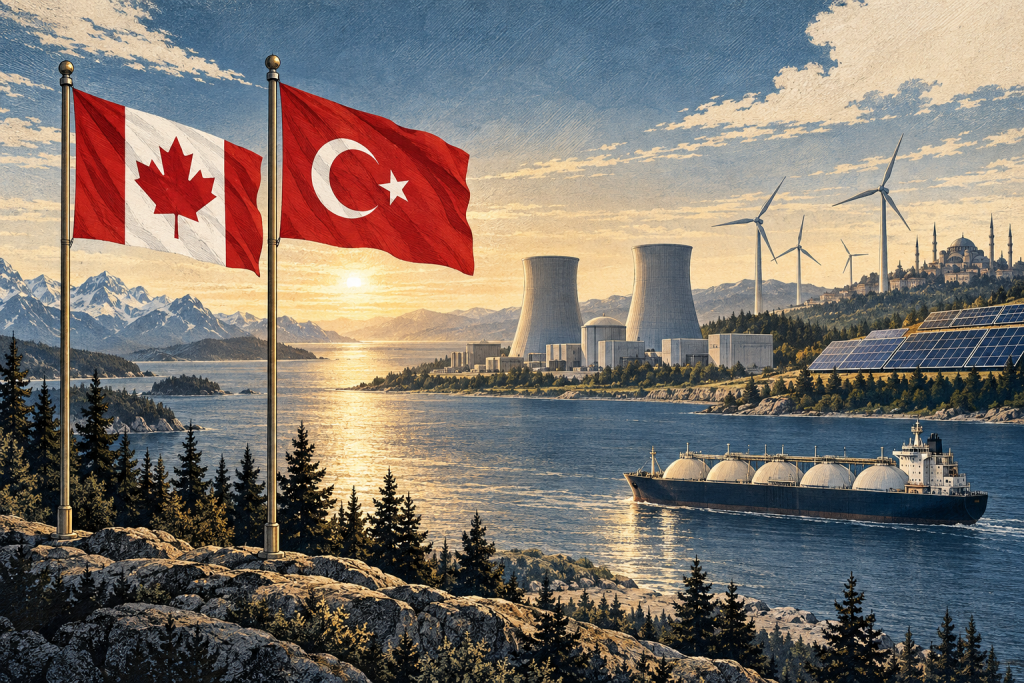
Energy: The countries agreed to strengthen cooperation in liquefied natural gas, civilian nuclear power, renewable energy and critical minerals.
Travel and shipping: An expanded air agreement permits up to 21 weekly passenger-combination flights per country, up from 12, and unlimited all-cargo flights.
Follow-up: Canada announced a trade mission to Türkiye in 2027.
These measures appear in Canada’s official account of the completed visit. They establish a path for more activity; they do not guarantee new airline routes, lower ticket prices or major industrial contracts.
The Biggest Ambitions Come With the Hardest Questions
Energy and defense could become the partnership’s most valuable—and politically sensitive—areas. Türkiye has been discussing potential nuclear projects with Canada’s AtkinsRéalis, as well as companies from other countries. Reuters reported that nuclear power, LNG and critical minerals were central to the visit. But those discussions should not be confused with an awarded Canadian nuclear construction contract. Defense cooperation also carries history. Canada lifted restrictions on certain military exports to Türkiye in 2024 after years of strained relations over the use of Canadian technology in Turkish-made equipment, according to AP’s reporting, published by The Independent. Human rights remain another point of tension. Reuters and CBC reported criticism of Türkiye’s treatment of political opponents and LGBTQ+ communities. Ankara rejects allegations that its courts act for political reasons.
The Canadian Press reported that Canada’s foreign minister raised human rights with her Turkish counterpart during the visit. The economic opening is real. So are the political disagreements that could complicate it.
What This Could Mean for Turkish Americans
The following implications are analysis based on the announced measures, not benefits promised to U.S. residents. For Turkish American business owners and professionals, the most useful way to read this agreement is as a possible expansion of the market—not as a sudden change in the rules. A wider business network.
Turkish Americans with established relationships in Türkiye and North America could be well placed to identify potential suppliers, customers or partners. Engineering, logistics, energy services and industrial supply are areas worth watching because they connect to the sectors named in the partnership. But Turkish heritage, language skills or U.S. business experience alone do not establish eligibility for Canadian financing, contracts or trade programs. Those details must be checked program by program. More competition, too.
A future trade agreement could make Canadian and Turkish firms more competitive in each other’s markets. Turkish American businesses should watch not only for partnership opportunities, but also for changes in how customers choose suppliers. Possible travel options—not promised savings.
More permitted Canada–Türkiye flights could eventually give some U.S.-based travelers additional itinerary choices. However, airline schedules, fares and entry or transit requirements still determine whether a Canadian connection makes sense. The agreement itself does not guarantee cheaper travel. A new subject for community advocacy.
For TCUSAPAC readers, the partnership offers a concrete case study in how Türkiye’s NATO role connects with trade and industrial policy. Community discussions can focus on specific questions: Which projects will move forward? How will governments address security concerns? What safeguards and oversight will accompany closer cooperation?
The strongest argument will be based on results—not simply on warmer diplomatic language.
What Turkish Americans Should Watch Next
1. The opening trade talks.
Watch the November 30–December 4 negotiating round for details about the goods, services and barriers under discussion. A negotiating schedule is progress, but it is not a finished deal.
2. Contracts rather than announcements.
In energy and defense, look for named buyers, financing, procurement notices and signed commercial agreements. Cooperation frameworks are an early step.
3. The 2027 Canadian trade mission.
Its participating companies and sector priorities could show where the governments expect the most business activity.
4. Actual airline schedules.
Expanded traffic rights allow airlines to add service; they do not require them to do so.
5. Claims of an easy shortcut into North America.
Nothing in the reviewed announcements creates a blanket exemption from U.S. tariffs, export controls or other requirements. A Canada–Türkiye partnership should not be marketed as an automatic route around U.S. rules. For now, the clearest message is not that Canada is leaving the United States behind. It is that Ottawa wants more room to maneuver—and Ankara wants a larger role in that future. For Turkish Americans, that could mean new connections and new competition. The smart move is to follow the details before following the excitement.
Source:
Reuters, republished by Al-Monitor, October 22, 2026 — Partnership announcement, U.S. trade context, energy discussions and political concerns.
Prime Minister of Canada, October 23, 2026 — Negotiating dates, trade figures, aviation provisions and signed cooperation measures.
Joint statement by Carney and Erdoğan, October 22, 2026 — Three-year action plan and partnership commitments.
CBC News, October 22, 2026 — Defense cooperation and human rights scrutiny.
The Canadian Press, published by Winnipeg Free Press, October 22, 2026 — Diplomatic context, aviation limits and Canadian officials’ account of human rights discussions.