
Silence Has a Cost: Why Turkish Americans Must Act on H.R. 2585
Turkish Americans: Your Voice Is Needed Now
H.R. 2585, titled the Armenian Genocide Education Act, is before the United States House of Representatives. If enacted, it would direct the Library of Congress to create and distribute educational materials presenting an official interpretation of the tragic events of 1915–1923.
The bill describes Ottoman Turkey as having carried out a “systematic and deliberate state-sponsored mass murder.” It defines claims that the genocide did not take place as “denial” and certain efforts to excuse or minimize it as “distortion.” It would support teacher training, online educational materials and efforts encouraging state and local schools to adopt these resources. It would also authorize $2 million annually for five years—potentially $10 million in federal funding.
This is not only a symbolic congressional statement. It could help establish a nationwide educational system reaching teachers, schools and students across America.
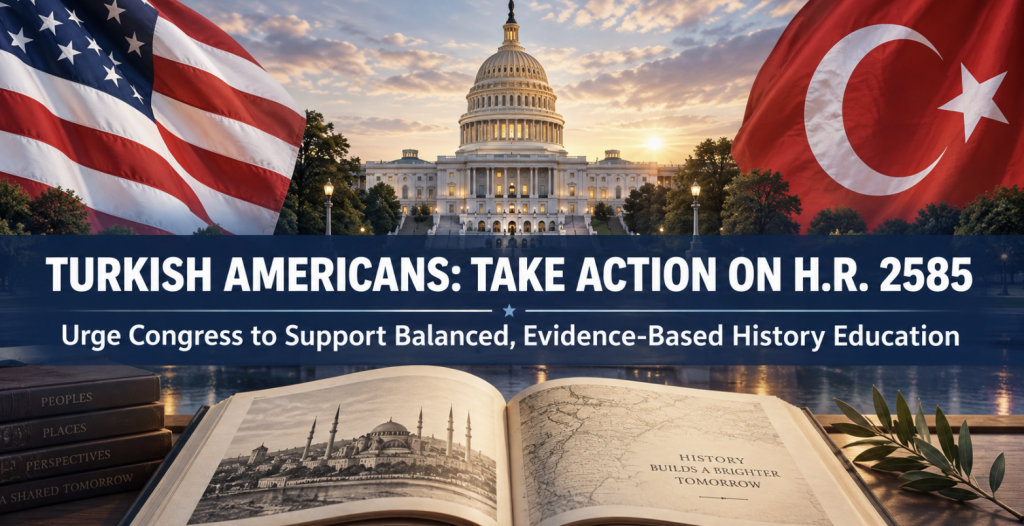
All innocent people who suffered and died during this painful period deserve dignity and remembrance. Opposing H.R. 2585 does not mean attacking Armenian Americans, denying Armenian suffering or asking schools to ignore history. It means insisting that American students receive complete historical context and that complicated historical questions remain open to evidence, scholarship and responsible discussion.
The First World War and the collapse of the Ottoman Empire brought deportation, massacres, famine, disease, forced migration and death to Armenians and to many Ottoman Muslims—including Turks, Kurds and Arabs—as well as Assyrians, Greeks and other communities. These experiences were not identical, but none should simply disappear from the classroom.
For Turkish Americans, the consequences of silence could last for generations. Our children may encounter Ottoman history, Türkiye and their Turkish heritage only through accusations. Students who ask questions or introduce additional historical evidence could fear being labeled as deniers. One-sided teaching could also encourage prejudice against Turkish-American children and make honest dialogue between communities more difficult.
We deserve better than this—and so do American students.
H.R. 2585 has not passed the House. Turkish-American citizens and other constituents who support balanced education still have time to be heard.
Take action today
Visit the campaign page below and send the prepared letter to the member of Congress representing your district:
Tell Congress to oppose H.R. 2585 and support balanced, historically accurate education
Please personalize the letter with two or three sentences about yourself. Say that you are a constituent. If you are a parent, teacher, student, professor, physician, engineer, business owner or community volunteer, explain why accurate education matters to you. A personal message is more powerful than an anonymous form letter.
Then take one more step: send the campaign link to your family, friends and Turkish-American networks. Share it through email, WhatsApp, social media and community organizations. Ask each eligible American constituent to contact their own representative. One letter can be overlooked; hundreds or thousands of constituent letters create a visible movement.
Silence can be interpreted as agreement. Turkish Americans cannot wait for someone else to protect our children’s right to a complete education. We must speak respectfully, clearly and together.
Tell Congress: Vote NO on H.R. 2585 in its current form and support balanced, evidence-based history education.
But one letter campaign is only the beginning. Lasting influence requires year-round participation—in state legislatures, county governments, schools, libraries, cultural institutions and local media.
2026: what happened, where and when
“Accepted” can conceal important differences. A governor’s proclamation, one-house resolution, concurrent resolution and statute are not interchangeable. Most remembrance resolutions are nonbinding and apply to one year; a curriculum mandate may have continuing legal force.
California — SR 87: Introduced March 10, 2026, and adopted by the Senate April 20. It commemorated April 24 and the 111th anniversary. Governor Gavin Newsom separately issued an April 24 proclamation.
Michigan — HR 293: Declared April 24, 2026, Armenian Genocide Remembrance Day. Governor Whitmer separately issued an April 24 proclamation.
New York — J01905: Memorialized Governor Kathy Hochul to proclaim April 24, 2026, Armenian Genocide Remembrance Day.
Rhode Island — H 8424 and S 3207: Companion resolutions proclaimed April 9, 2026, Armenian Genocide Remembrance Day and honored Armenian Americans.
New Jersey — ACR 33: Pre-filed for 2026, but the published official text still said “Introduced Pending Technical Review by Legislative Counsel.” It should not be called adopted. It would recognize the Armenian genocide, condemn Azerbaijan, endorse Artsakh’s self-determination and connect those contemporary claims to Türkiye.
Congress — H.R. 2585: Introduced April 1, 2025, the Armenian Genocide Education Act remained a proposal, not enacted law. It would direct the Library of Congress to develop educational programs about the genocide and American relief.
Congress — H.R. 10008 and S. 5205: Introduced July 30, 2026, the Turkey Human Rights Promotion Act is a separate foreign-policy initiative involving reporting, sanctions and present-day human-rights allegations.
This is a verified breakout of the measures discussed here, not a claim that no other local or state proclamation was issued.
How a remembrance day becomes official
There is no single national process. A community can request a mayoral or gubernatorial proclamation, persuade a legislator to sponsor a resolution, seek a permanent statute, or ask a school board to add an observance. The usual path is:
Constituents draft language and recruit a sponsor.
Legislative counsel prepares text and assigns a number.
The measure is introduced and may go to committee.
One or both chambers vote, depending on its form.
The clerk, secretary or governor publishes the adopted measure.
Community groups organize programming and renew the recognition annually.
The last step matters most. A proclamation may disappear into an archive. A recurring festival, school lesson, library exhibit and public ceremony can become part of a state’s civic identity.
How many states teach the Armenian genocide?
No federal database shows what is actually taught in every classroom, and published counts use different definitions. In 2022, the Armenian National Institute identified 10 states with genocide-education mandates that included or supported Armenian-genocide instruction: California, Connecticut, Illinois, Massachusetts, Michigan, Nevada, New Jersey, New York, Ohio and Rhode Island. A separate Genocide Education Project tally reported that 14 state standards referenced the Armenian genocide as a principal example by 2021.
One count measures mandates; the other includes standards. Neither proves that every teacher provides the same lesson. California standards explicitly call for discussion of Ottoman actions against Armenian citizens. Michigan requires age-appropriate genocide instruction, while New Jersey requires instruction on the Holocaust and genocides.
Parents should inspect the state standard, district curriculum and assigned material. They should not demand removal of Armenian history. They can request sound sourcing, age-appropriate language, clear distinctions between historical conclusions and court rulings, wider late-Ottoman context, and protection of Turkish or Muslim students from stereotyping.
Historical context that students should also receive
Nothing in a balanced curriculum should question whether the final Ottoman years produced terrible human suffering. The empire was declining, the First World War brought foreign invasion and internal conflict, and civilians across Anatolia endured forced migration, famine, disease, massacres and death. Ottoman Armenians suffered devastating deportations, dispossession and loss of life. Ottoman Muslims—including Turks, Kurds and Arabs—as well as Greeks, Assyrians and other communities also suffered on a vast scale.
The military context belongs in the classroom as well. Armenian revolutionary organizations and volunteer formations cooperated with the Russian Empire, and some Ottoman Armenians joined or assisted forces fighting the Ottoman army, particularly in eastern Anatolia. This contributed to genuine Ottoman security fears. It does not follow that the entire Armenian civilian population participated, however, or that the conduct of armed groups automatically justified every action taken against civilians. A serious history curriculum must be capable of presenting both facts at the same time.
Türkiye’s official position rejects the genocide characterization and argues that the events must be understood within this wider context of imperial collapse, war, rebellion, foreign intervention and losses among multiple Ottoman populations. Many governments and scholars take a different position. Precisely because the classification remains politically and historically contested, American education should distinguish among documented events, scholarly interpretation, legislative declarations and binding judicial decisions.
The 1921 British diplomatic record connected to the Ottoman detainees held in Malta is relevant. After reviewing American records, the British Embassy reported that the material contained extensive accounts of atrocities but did not supply concrete evidence sufficient to prosecute the particular detainees under consideration. No completed international trial or conviction followed. This was a significant failure to establish individual criminal cases; it was not a formal acquittal after a full trial or a comprehensive judicial finding about every event of the war.
The historical American record has also changed over time. A note published with “Armenian Terrorism: A Profile” in the August 1982 U.S. Department of State Bulletin described the record of the 1915 events as ambiguous and stated that the department did not endorse allegations that the Turkish government committed genocide. Congress adopted a different political position in 2019, and President Biden used the term genocide in 2021. Students should be shown this evolution rather than being told that the American government’s position has always been uniform.
The international legal record: no binding genocide judgment
This distinction must be stated clearly: no international court has issued a binding judgment legally recognizing the events of 1915–1923 as genocide or finding the Republic of Türkiye responsible for genocide. Political declarations by presidents and legislatures are not international-court judgments, and they should not be presented to American students as though a court examined the complete historical record and reached a binding verdict.
In Perinçek v. Switzerland (2015), the European Court of Human Rights did not approve or judicially confirm the genocide characterization. It ruled that Switzerland violated Doğu Perinçek’s freedom of expression by criminally punishing his statements. The case concerned free speech, context, incitement and proportionality. The court expressly stated that it was neither required nor authorized to make a legally binding determination about whether the massacres and deportations beginning in 1915 constituted genocide.
The International Court of Justice has likewise never issued a judgment declaring these events genocide or assigning genocide responsibility to the Ottoman Empire or the Republic of Türkiye under the 1948 Genocide Convention. Therefore, there is no international judicial ruling establishing the genocide allegation as a matter of adjudicated international law.
The wording still requires care. It would go too far to claim that an international court conducted a full trial and affirmatively ruled that “there was no genocide.” The courts did not reach that merits determination either. The accurate conclusion is that the claim has received political recognition from many governments and legislatures, but it has not received a binding merits judgment from an international court.
American cases do not supply such a judgment. Movsesian v. Victoria Versicherung invalidated a California insurance statute on federal foreign-affairs grounds. Bakalian v. Central Bank of the Republic of Turkey held property claims time-barred. Neither case judicially established the genocide characterization.
An independent memorandum prepared for the Turkish Armenian Reconciliation Commission concluded that the events collectively could be said to contain the Genocide Convention’s elements. However, it also concluded that the convention could not impose retroactive legal, financial or territorial liability on the Republic of Türkiye. The International Center for Transitional Justice is not a court, and its memorandum is not an international judicial judgment.
This legal distinction matters for H.R. 2585. Congress may express a political view, but education materials should not imply that the terminology was conclusively adjudicated by an international tribunal. Students deserve to know the difference among legislative recognition, historical scholarship, legal analysis and a binding court decision.
Why are many Turkish Americans quiet?
No explanation applies to an entire community, and it would be unfair to declare that Turkish Americans are ashamed or do not care. Still, several barriers deserve discussion.
Many immigrants arrived as engineers, doctors, teachers, professors, entrepreneurs and scientists. Professional achievement did not automatically train them in grassroots politics. Türkiye’s public life is comparatively national, centralized and party-centered. American civic power is dispersed among school boards, parent associations, cities, counties, statehouses and congressional district offices.
Someone accustomed to politics flowing from Ankara may wait for an embassy, national association or prominent leader. In America, a parent who knows a principal or a constituent who meets a state representative can have more immediate influence.
Other barriers may include limited time, language insecurity, unfamiliarity with public-comment rules, fear of social or professional backlash, divisions over politics in Türkiye, weak knowledge of late-Ottoman history and discomfort discussing it in English. These are possibilities, not proven motives. The answer is civic training, historical education and an invitation to participate—not accusation.
Make Turkish Heritage Month an affirmative project
Turkish Heritage Month should never be presented as a counter-event to Armenian Remembrance Day. It should stand on its own as an American celebration of Turkish-American people, culture and contributions.
Washington State organizations have built recurring October programming around Turkfest, and Washington, D.C., issued mayoral recognition of October as Turkish Heritage Month in 2022. These examples show a possible path, not a Michigan or nationwide observance.
Every Turkish-American nonprofit should adopt an annual heritage-month resolution, request recognition from its governor or legislature and publish the observance every year. Programs can include:
Turkish music, dance, art, literature and film;
regional food traditions and Turkish-language activities;
Turkish-American migration stories and oral histories;
contributions by Turkish-American physicians, engineers, educators and entrepreneurs;
the Ottoman Empire, independence struggle and Republic taught through credible sources;
shared Anatolian histories, including Armenian, Greek, Jewish, Kurdish, Arab and Assyrian experiences;
a local service project linking heritage to community life today.
Americans are often eager to encounter unfamiliar food, music and family stories. A welcoming annual celebration gives local newspapers and television a reason to cover it. Invite mayors, school-board members, legislators and members of Congress—not just for a photograph, but to meet constituents and hear their priorities.
A parent’s ten-step plan
Audit the calendar. Obtain the district calendar, curriculum and observance policy. Note which recognitions appear and who approved them.
Build a team. Bring together parents, students, Turkish-American educators and a local nonprofit.
Choose the month carefully. In Michigan, first coordinate a common proposal among Turkish-American organizations and seek formal state or local recognition. Elsewhere, document any existing official observance before asking schools to list it.
Meet first. Speak with the principal, curriculum director and superintendent before the school-board meeting.
Bring a one-page proposal. Include learning goals, a sample event, credible resources and volunteer names.
Offer resources. Recruit vetted speakers and performers; address cost, accessibility, food allergies, security and religious neutrality.
Request a recurring entry. Ask for the same annual treatment given to comparable heritage observances.
Invite everyone. Keep events open, educational, welcoming and nonpartisan.
Contact media and officials. Send a factual advisory several weeks ahead and include students and local voices.
Document and repeat. Save attendance, coverage, feedback and materials; begin next year’s planning immediately.
A concise request might read: “Our Turkish-American families ask the district to recognize Turkish Heritage Month on its annual calendar and host an inclusive educational program about Turkish-American culture, history and contributions. We will provide vetted resources and volunteers and follow the standards used for comparable heritage observances.”