
One Envoy, Three Capitals: Tom Barrack’s Expanded Role Places Türkiye at the Center of Washington’s Middle East Strategy
The American ambassador in Ankara now carries responsibility for Syria and Iraq as well—an unusual concentration of diplomatic authority that could strengthen Türkiye’s regional influence or expose it to new political and security risks.
By TC-USA PAC | July 2026
WASHINGTON — President Donald Trump’s decision to appoint Tom Barrack as special presidential envoy to both Syria and Iraq, while keeping him as the United States ambassador to Türkiye, gives one diplomat an extraordinary portfolio spanning three of the most consequential countries in the region.
Trump announced the expanded assignment on May 31, saying Barrack would work with the governments of Syria and Iraq while continuing to lead the American Embassy in Ankara. Secretary of State Marco Rubio had previously indicated that Barrack’s original Syria mandate was expiring, but that he would remain a central figure in Washington’s regional policy.
The appointment is not merely administrative. It signals that the Trump administration increasingly views Türkiye, Syria and Iraq as interconnected parts of a single strategic landscape—one shaped by terrorism, Kurdish political and military movements, Iranian influence, energy routes, refugees and the future distribution of regional power.
Barrack has described the three countries as a strategic center of gravity for Middle Eastern stability and argued that Washington needs a consistent point of contact across them. That language suggests the administration wants decisions involving Ankara, Damascus and Baghdad coordinated through one senior official with direct access to Trump.
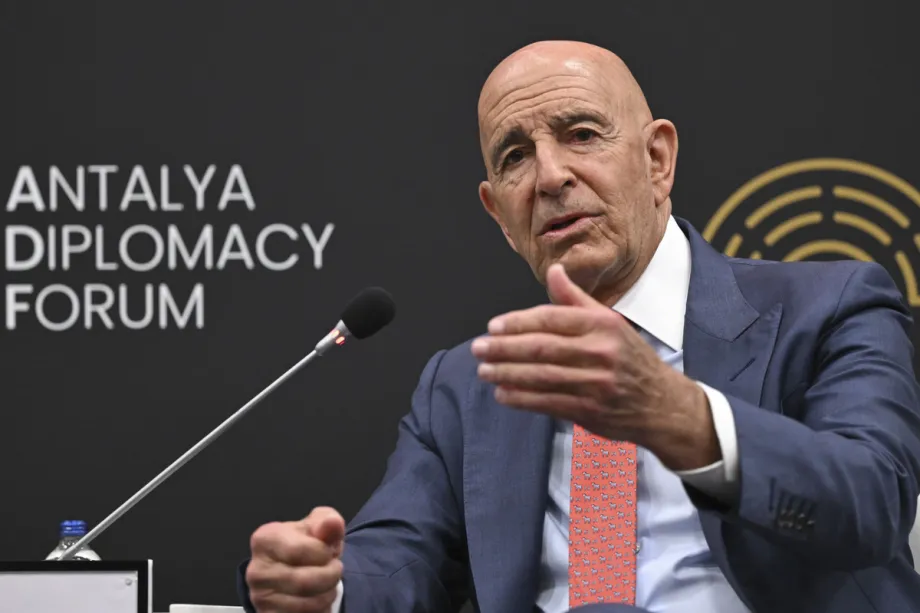
For Türkiye, that arrangement could bring greater influence in Washington. It could also mean that American expectations of Ankara will expand far beyond the traditional bilateral relationship.
An Ambassador With a Regional Mission
Barrack’s new responsibilities were quickly put into practice. Turkish Foreign Minister Hakan Fidan received him in Ankara on June 12 in his combined capacity as ambassador and special envoy for Syria and Iraq. Four days later, Barrack met Iraqi Prime Minister Ali al-Zaidi in Baghdad. This structure gives Ankara unusually direct access to the official helping shape American policy in both neighboring countries. Türkiye’s security concerns in Syria and Iraq—particularly those involving the Kurdistan Workers’ Party, or PKK, and affiliated or related armed organizations—can now be presented to a diplomat who is involved in all three capitals.
But the arrangement should not automatically be interpreted as an American endorsement of every Turkish policy. Barrack is not representing Türkiye in Washington. He is representing American interests across a broad region, and the word leverage has appeared prominently in descriptions of his mission.
Türkiye may therefore gain access and influence, while simultaneously facing pressure to help Washington achieve outcomes in Syria and Iraq.
Syria Will Be the First Major Test
In Syria, Barrack has been closely involved in negotiations between the government of President Ahmed al-Sharaa and the Kurdish-led Syrian Democratic Forces, or SDF.
A January agreement established a ceasefire and a process for integrating SDF fighters and governing institutions into the Syrian state. The agreement was intended to avoid a major military confrontation, but important questions remained unresolved, including command structures, weapons, border crossings, Kurdish political rights and the practical limits of local authority.
Türkiye views the SDF as closely connected to the YPG and PKK and opposes the creation of a separate armed or autonomous structure along its southern border. Barrack has publicly argued that the SDF’s original role as America’s principal local partner against the Islamic State has largely run its course and that Kurdish communities should pursue their future within a unified Syrian state.
That position is closer to Ankara’s approach than earlier American policy, which relied heavily on the SDF during the campaign against ISIS.
Yet the transition carries serious risks. Kurdish communities will need credible protection against retaliation, forced displacement and political exclusion. Damascus must demonstrate that integration means citizenship and participation—not simply disarmament followed by central domination.
At the same time, the transfer of responsibility for ISIS prisoners and detention facilities from Kurdish-led forces to Syrian or Iraqi authorities creates an immediate security challenge. Thousands of suspected ISIS members have been moved or considered for transfer from northeastern Syria to Iraq amid concerns that instability could produce prison breaks or a renewed insurgency.
The Trump administration is also planning for the possible reopening of the American Embassy in Damascus, closed since 2012. Barrack has advocated lifting sanctions and gradually reintegrating Syria into regional and international institutions.
If that effort succeeds, Türkiye could benefit from a more stable neighbor, expanded trade routes, reduced refugee pressure and fewer opportunities for terrorist organizations to operate along the border.
If it fails, Türkiye could face renewed violence, additional displacement and pressure to intervene militarily.
Iraq Brings a Different Set of Risks
Barrack’s Iraq assignment places him at the center of Washington’s campaign to reduce Iranian influence over Iraqi political parties, financial institutions and armed groups.
The United States has warned Iraqi political leaders that governments incorporating Iran-linked militias could face severe financial consequences. Washington possesses exceptional leverage because Iraqi oil revenues are processed through arrangements involving the Federal Reserve Bank of New York.
The administration is also seeking greater American participation in Iraq’s energy sector and infrastructure development. Iraq’s government has pursued new oil, natural gas and electricity investments while attempting to maintain relations with both Washington and Tehran.
For Türkiye, developments in Iraq affect border security, PKK operations in northern Iraq, energy pipelines, water policy, trade and the status of the Iraqi Turkmen community.
A stronger and more sovereign Iraqi state could become a reliable commercial and security partner. But aggressive American pressure on Baghdad could also provoke instability, empower nationalist opposition or turn Iraq into another arena for confrontation between Washington and Tehran.
Barrack will therefore be required to reconcile priorities that do not always align: American pressure against Iranian influence, Iraqi demands for sovereignty, Türkiye’s campaign against the PKK, Kurdish regional interests and the need to prevent ISIS from rebuilding.
Why the Appointment Is Significant for Turkish Americans
For Turkish Americans, Barrack’s expanded role presents a genuine opportunity—but it should not be mistaken for a guaranteed diplomatic victory.
Türkiye now has an ambassador in Ankara who also sits near the center of American decision-making on its two southern neighbors. That can produce faster communication and a more realistic understanding of Türkiye’s security concerns.
It also creates a risk that all disagreements involving Syria, Iraq, Kurdish groups, refugees or Iran will be folded into the U.S.–Türkiye relationship. A crisis in Damascus or Baghdad could quickly become a problem between Ankara and Washington.
Some Turkish political figures have already objected to language portraying Türkiye, Syria and Iraq as countries to be “balanced” through a single American official. Critics argue that such framing can appear to place Türkiye—a NATO ally and sovereign state—in the same category as countries undergoing fragile political transitions.
Turkish-American advocacy should therefore welcome constructive engagement without treating personalities or diplomatic access as substitutes for durable policy.
The Best-Case Scenario
In the strongest possible outcome, Barrack uses his access in Ankara, Damascus, Baghdad and Washington to create a coherent regional strategy.
The Syrian government peacefully integrates Kurdish forces while guaranteeing cultural, political and citizenship rights. PKK-linked foreign fighters leave Syria, ISIS detainees remain secure, and American-Turkish disagreements over the SDF gradually diminish.
Syria becomes sufficiently stable for refugees to return voluntarily and safely. Sanctions relief encourages reconstruction, Turkish companies participate in legitimate rebuilding projects, and new transportation and energy corridors connect Türkiye with Syria, Iraq and the Gulf.
In Iraq, Baghdad strengthens state institutions, limits unauthorized armed groups and expands economic cooperation with both Türkiye and the United States. Iraqi Turkmen and other minorities receive meaningful protection and representation.
Under this scenario, Barrack becomes a bridge between three governments, and Türkiye emerges as a principal security, commercial and diplomatic partner in the reconstruction of the region.
The Worst-Case Scenario
In the most dangerous outcome, the concentration of authority produces overconfidence and policy mistakes.
Washington pressures the SDF to disarm without securing enforceable protections for Syrian Kurds. Damascus fails to govern inclusively, violence returns and ISIS exploits the resulting vacuum.
Türkiye becomes associated with decisions made by Damascus even when it does not control them. New refugee flows move toward the Turkish border, while disputes between Türkiye and Israel over Syria intensify.
In Iraq, excessive American financial pressure destabilizes the government or drives factions closer to Iran. Iran-backed groups respond with attacks against American, Turkish or regional interests. The PKK gains new room to maneuver in the confusion.
Barrack’s overlapping responsibilities could also create conflicts between his role as ambassador to Türkiye and his obligation to pressure Ankara when American objectives differ from Turkish priorities.
The greatest institutional risk is that regional policy becomes dependent on one envoy’s personal access rather than formal agreements supported by Congress, the State Department and future administrations. Analysts have already noted the Trump administration’s preference for personal envoys and informal diplomacy, an approach that can move quickly but may create uncertainty and limited transparency.
The Most Realistic Alternative
The likeliest outcome lies between those extremes.
Barrack may achieve partial agreements: gradual Syrian normalization, limited SDF integration, closer Turkish-American security coordination and new economic projects in Iraq. But major disputes are unlikely to disappear completely.
Türkiye and the United States may cooperate against ISIS while continuing to disagree over particular Kurdish organizations. Washington may support Syrian territorial unity while demanding stronger minority protections. Iraq may reduce some Iranian influence without fully removing Iran-linked parties and militias from its political system.
This middle path would not amount to a dramatic regional settlement. It would be a continuing process of negotiation, crisis management and transactional agreements.
What Turkish Americans Should Watch Closely
First, watch implementation—not announcements. The decisive question is whether agreements on the SDF, ISIS detainees, sanctions and reconstruction are actually carried out.
Second, watch Congress. A policy supported only by the president and a personal envoy can be reversed. Durable progress requires congressional understanding and bipartisan institutional support.
Third, watch the language used about Türkiye. Türkiye should be recognized as a NATO ally and regional partner, not merely as an instrument of American leverage over Syria and Iraq.
Fourth, watch minority protections. Turkish-American organizations can defend Türkiye’s security concerns while also supporting the legitimate rights and safety of Kurds, Turkmen, Arabs, Christians, Yazidis and other communities.
Finally, watch commercial opportunities carefully. Reconstruction, energy and infrastructure could create opportunities for Turkish and Turkish-American businesses, but sanctions rules, export controls and political instability will require strict legal compliance.
Barrack’s appointment places Türkiye closer to the center of American Middle East policy than it has been in years. That can produce influence, but it also brings responsibility and exposure.
For Turkish Americans, the appropriate response is neither celebration nor alarm. It is sustained engagement: with Congress, the administration, policy institutions and the broader American public.
Sources:
- Middle East Monitor’s report on the May 31 appointment.
- Türkiye’s Ministry of Foreign Affairs on Barrack’s June meeting with Hakan Fidan.
- Reuters reporting on the Syrian government-SDF integration agreement.
- Reuters reporting on American financial pressure concerning Iranian influence in Iraq.
- Associated Press reporting on plans for the possible reopening of the U.S. Embassy in Damascus.
- Reuters documentation of Barrack’s June meeting with Iraq’s prime minister.
- Financial Times analysis of the administration’s reliance on personal envoys and informal diplomacy.