
Trump’s Ankara Visit Signals a Potential Reset in U.S.–Türkiye Relations
WASHINGTON — What began as a reported promise during a telephone conversation became a closely watched diplomatic visit with potentially significant consequences for the future of U.S.–Türkiye relations.
President Donald Trump traveled to Ankara on July 7 for the NATO Leaders’ Summit hosted by Turkish President Recep Tayyip Erdoğan. The visit marked the first trip to Türkiye by a sitting American president since Barack Obama and placed Türkiye at the center of discussions about NATO’s future, regional security and the alliance’s rapidly expanding defense industry.
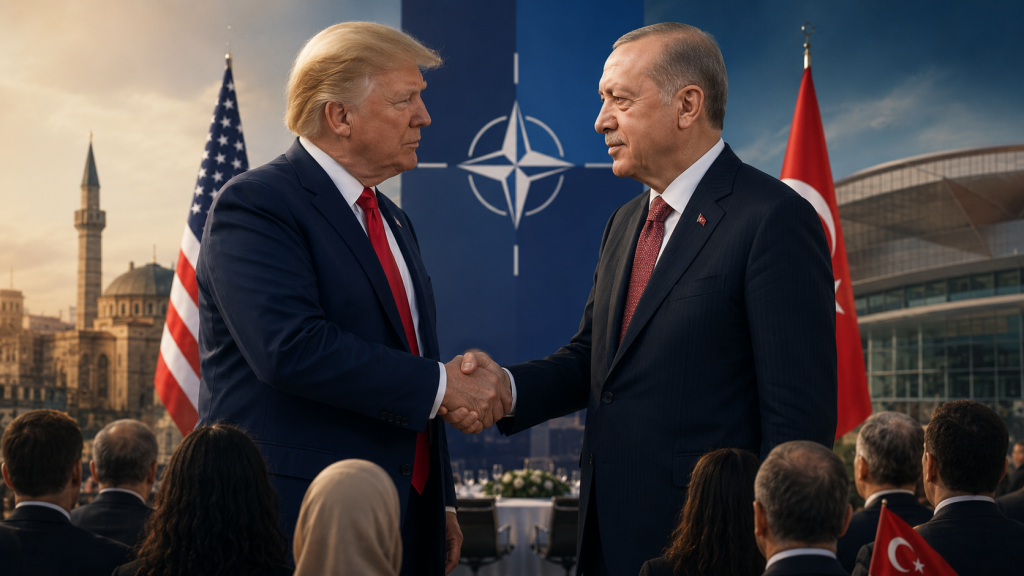
The ceremonial welcome was unmistakably warm. Trump repeatedly described Erdoğan as a friend and said his relationship with the Turkish president influenced his decision to attend the summit. Erdoğan, in turn, emphasized the importance of their personal relationship and thanked Trump publicly as the meetings concluded.
But the visit was about more than personal diplomacy.
During their bilateral discussions, Trump said his administration would move to lift sanctions imposed on Türkiye following Ankara’s purchase of Russia’s S-400 air-defense system. He also expressed openness to selling Türkiye F-35 fighter aircraft, although he later acknowledged that a final decision had not been made. For Ankara, these statements represented progress on two of the most difficult issues in its relationship with Washington. Türkiye was removed from the F-35 program after acquiring the S-400 system, and U.S. sanctions imposed in 2020 became a lasting symbol of the deterioration in bilateral relations.
Still, Trump’s statements should not be confused with a completed agreement. Existing American law, the continuing presence of the S-400 system and likely resistance from members of Congress could complicate or delay any effort to restore Türkiye’s participation in the F-35 program. The diplomatic opening is real, but the legal and political obstacles remain substantial.
Türkiye’s Expanding Role Inside NATO
The Ankara summit demonstrated Türkiye’s growing strategic importance to the alliance. NATO leaders reaffirmed their commitment to collective defense under Article 5, announced more than $50 billion in new defense procurements and pledged €70 billion in military equipment, training and assistance for Ukraine during 2026, with commitments to sustain comparable support in 2027.
The summit also placed unusual emphasis on defense manufacturing, artificial intelligence, drones, missile defense, energy security and reducing trade barriers among allied defense industries. Those priorities align closely with areas in which Türkiye has developed significant manufacturing and technological capacity.
Hosting the summit allowed Türkiye to present itself not simply as NATO’s southeastern security partner, but as a defense producer, regional diplomatic power and essential participant in the alliance’s plans for Europe, the Black Sea and the Middle East.
The warmer atmosphere does not eliminate the disagreements between Washington and Ankara. The two countries continue to have differences involving Russia, Syria, Israel, regional Kurdish groups, democratic governance and the future of the S-400 system. Western governments have also faced criticism for placing less public emphasis on democratic rights in Türkiye as its military importance has increased.
The central question is therefore not whether the Trump-Erdoğan relationship has improved. It clearly has. The question is whether that relationship can be converted into durable cooperation supported by the United States Congress, American institutions and future administrations.
What This Means for Turkish Americans
For Turkish Americans, the Ankara summit creates both an opportunity and a responsibility.
The renewed diplomatic engagement gives the community a stronger platform from which to explain Türkiye’s contributions to NATO, regional security, energy corridors, defense manufacturing and humanitarian diplomacy. However, successful advocacy cannot rely exclusively on the personal relationship between two presidents.
Turkish Americans must continue building long-term relationships with members of Congress from both political parties, federal agencies, policy organizations, state governments and American business leaders. A sustainable U.S.–Türkiye partnership must be institutional rather than dependent on any one administration.
The summit may also create opportunities for Turkish-American professionals and businesses working in aerospace, cybersecurity, artificial intelligence, logistics, manufacturing and energy. NATO’s announced procurement and infrastructure investments could encourage new partnerships, although sanctions, export controls and security regulations will continue to require careful compliance.
Most importantly, Turkish Americans are uniquely positioned to serve as a bridge between two countries whose relationship is frequently misunderstood. Community organizations can help ensure that Türkiye is evaluated through accurate information and direct engagement rather than outdated assumptions or one-sided political narratives.
President Trump’s Ankara visit has opened a door. Whether that opening produces a true strategic reset will depend on what follows: formal agreements, congressional action, resolution of the S-400 dispute and sustained diplomatic engagement.
For Turkish Americans, this is a moment to become more organized, more visible and more active in the American political process.