
Turkey’s F-35 Question Returns to Washington as Israel Raises Objections and Congress Holds the Key
President Donald Trump has said the United States will “consider” a sale of F-35 fighter jets to Türkiye. But no decision has been announced, Israel is pushing back publicly, and Congress remains a decisive gatekeeper.
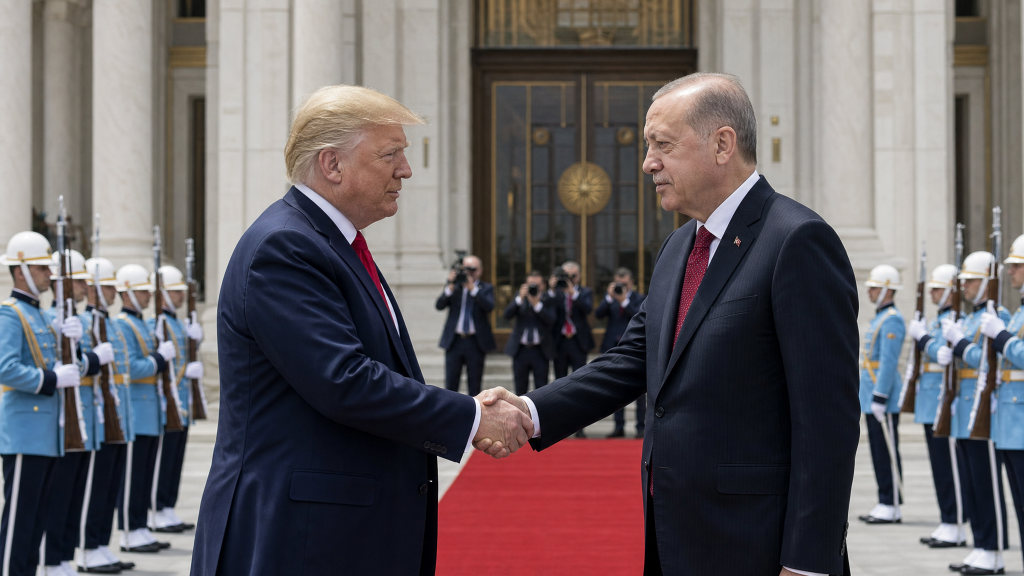
WASHINGTON — A possible U.S. sale of F-35 stealth fighter jets to Türkiye has moved back to the center of U.S.-Türkiye relations after President Donald Trump indicated during the NATO summit in Ankara that his administration would consider Ankara’s request. The remarks opened a consequential debate that goes beyond aircraft. Any move toward restoring Türkiye’s access to the F-35 program would test the future of the U.S.-Türkiye strategic relationship, intensify discussions in Congress, and sharpen regional concerns — especially in Israel. Trump praised President Recep Tayyip Erdoğan during the Ankara summit but did not announce an agreement. As reported by The Washington Post, the president said the United States would “consider” the fighter-jet sale, even as congressional opposition remains significant.
Türkiye was removed from the multinational F-35 program in 2019 after acquiring Russia’s S-400 air-defense system. That decision also triggered U.S. sanctions under the Countering America’s Adversaries Through Sanctions Act, commonly known as CAATSA. Any renewed path to the aircraft would therefore require more than positive presidential rhetoric: it would require a workable policy arrangement on the S-400 issue, an interagency decision in Washington, formal congressional notification, and the ability to withstand political scrutiny on Capitol Hill.
The issue gained further urgency after reports that Defense Secretary Pete Hegseth was expected to discuss the question with Israeli leaders during a planned visit to Israel. Reuters reported that the anticipated meetings were to include the F-35 issue and Iran, though the visit was later canceled amid escalating U.S.-Iran tensions.
Israel has made its opposition clear. Prime Minister Benjamin Netanyahu has argued that providing the fifth-generation fighter to Türkiye could alter the regional military balance. In remarks reported by CNN, Netanyahu said he urged Trump not to approve the transfer and warned of what he described as Türkiye’s growing regional ambitions.
Israel is currently the only Middle Eastern operator of the F-35. The concerns voiced by Israeli leaders reflect the broader U.S. policy of preserving Israel’s qualitative military edge, a longstanding factor in American arms-transfer decisions in the region.
For Ankara, however, the question is fundamentally about alliance credibility and military readiness. Türkiye is NATO’s second-largest military power and occupies a strategically vital position linking Europe, the Black Sea, the Caucasus, the Middle East, and the Eastern Mediterranean. Turkish officials and supporters of a renewed F-35 arrangement argue that excluding Türkiye from the program weakens NATO interoperability and pushes an important ally toward more independent defense choices.
The debate is also unfolding in a more complicated regional environment. Türkiye and Israel remain sharply divided over Gaza, Syria, and wider regional security policy. At the same time, Washington is balancing the NATO alliance, the security of Israel, escalating tensions with Iran, and congressional concerns over U.S. defense technology.
At this stage, the most important fact is also the simplest: there is no announced F-35 deal with Türkiye. Trump’s comments indicate political openness, not a completed transaction. Any final decision would face a long and politically difficult process in Washington.
What this means
The F-35 discussion is not merely about a fighter aircraft. It is a major test of whether Washington and Ankara can rebuild a durable strategic understanding after years of friction. A positive decision could:
1) Strengthen U.S.-Türkiye defense cooperation and NATO interoperability.
2) Reopen discussion of Türkiye’s role in advanced Western defense-industrial programs.
3)Improve the broader atmosphere for cooperation on Black Sea security, Ukraine, Syria, energy routes, counterterrorism, and regional stability.
4)Signal that Washington sees Türkiye as a long-term strategic ally rather than only a transactional partner.
But a path forward would also require difficult answers:
How will the S-400 dispute be addressed in a way that satisfies U.S. security concerns?
Can Congress be persuaded that a sale serves U.S. national-security interests?
How would Washington address Israeli concerns about the regional military balance?
Can U.S.-Türkiye relations withstand disagreements over Gaza, Syria, sanctions, and human-rights concerns while still advancing practical security cooperation?
What Turkish Americans can do
Turkish Americans have a legitimate and constructive role in this public-policy debate. The most effective approach is organized, informed, and civic-minded engagement.
Contact elected representatives.
Turkish Americans should communicate respectfully with their members of Congress and senators, especially those serving on foreign-affairs, armed-services, appropriations, and defense-related committees. The message should focus on U.S. national interests, NATO cohesion, security cooperation, and the importance of a strong U.S.-Türkiye alliance.Make the case in American terms.
Advocacy is most effective when it explains how a stable U.S.-Türkiye relationship benefits the United States: NATO readiness, deterrence in the Black Sea region, strategic access, energy security, and the prevention of further defense fragmentation among allies.Separate facts from rhetoric.
The F-35 issue is highly political and often discussed through slogans. Community leaders, organizations, and voters should rely on verifiable reporting and official statements — and avoid treating preliminary comments as a finalized agreement.Build coalitions.
Turkish-American organizations can engage with veterans, NATO-security experts, business groups, academic institutions, and other diaspora communities that support strong transatlantic ties. Broad coalitions carry more influence than isolated advocacy.Encourage dialogue, not hostility.
Turkish Americans can support Türkiye’s national-security interests while rejecting anti-American, anti-Israeli, anti-Greek, or anti-Armenian rhetoric. A credible civic voice advances U.S.-Türkiye cooperation through democratic participation, not polarization.Stay engaged beyond one arms-sale debate.
The F-35 issue is part of a larger relationship. Turkish-American advocacy should also prioritize educational exchanges, trade, technology partnerships, cultural understanding, democratic participation, and long-term people-to-people ties.
Editorial analysis
Washington now has an opportunity to move the conversation from speculation to a serious strategic framework. That does not mean the United States should disregard technical-security concerns, congressional oversight, or regional consequences. It means those issues should be addressed through sustained diplomacy rather than allowed to define the alliance indefinitely.
Türkiye’s return to the F-35 conversation would be politically difficult, but its very return to the agenda demonstrates that the relationship remains strategically important. The next steps will be determined not by summit praise alone, but by decisions in the White House, Pentagon, State Department, Congress, and Ankara.
For Turkish Americans, this is a moment to be informed, visible, and constructive — advocating for an alliance that is stronger, more predictable, and better aligned with the interests of both countries.
Source notes
This original article is based on reporting from: