
A Historic Turning Point: Trump, Türkiye, and the F-35 — What It Means for Turkish Americans
The Big Picture: Something Shifted at NATO’s Ankara Summit
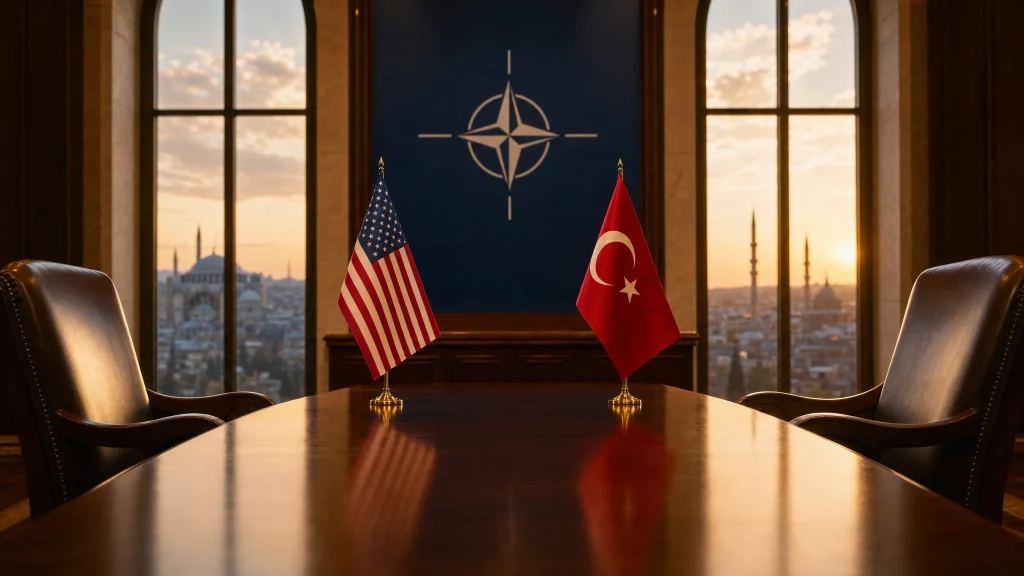
For the first time in years, something real is happening between the United States and Türkiye — and Turkish Americans need to pay close attention. This past week, President Donald Trump traveled to Ankara for the annual NATO summit. It wasn’t just another diplomatic meeting. Trump sat down with Turkish President Recep Tayyip Erdoğan, and the signals coming out of that meeting were unlike anything we’ve seen in nearly a decade. Trump publicly stated his desire to lift U.S. sanctions against Türkiye’s defense industry and hinted at reopening the door for Türkiye to rejoin the F-35 fighter jet program — a program Türkiye was kicked out of back in 2019. This is a big deal. And if Turkish Americans want to see it through, now is the time to get involved.
What Is the F-35, and Why Does It Matter?
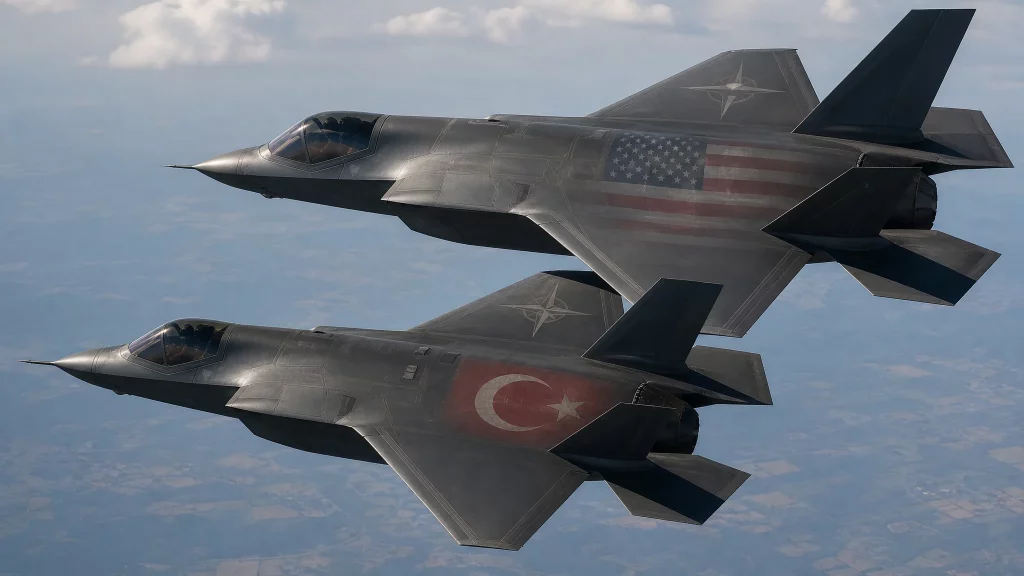
Let’s start simple. The F-35 Lightning II is one of the most advanced fighter jets in the world. It’s made by the U.S. company Lockheed Martin and is used by many NATO allies. Türkiye was part of this program for years — Turkish companies helped manufacture parts for the jet and were set to buy over 100 of them for their own air force. Then, in 2019, Türkiye bought the Russian-made S-400 air defense system. The United States said this was a serious problem. Why? Because the S-400 is designed to track and shoot down stealth aircraft like the F-35. If Türkiye had both, there was a real risk that Russia could learn secrets about the F-35 through the S-400’s radar systems. So the U.S. kicked Türkiye out of the F-35 program and later slapped sanctions on Türkiye’s defense procurement agency under a law called CAATSA (Countering America’s Adversaries Through Sanctions Act).
That decision hurt Türkiye’s military industry and strained the relationship between two NATO allies for years. But now, things may be changing.
The Trump-Erdoğan Connection: A Relationship That Actually Works
One of the most important things to understand is the personal bond between Trump and Erdoğan. Politico described Erdoğan as “NATO’s Trump Whisperer” — and that’s not just a catchy headline. These two leaders genuinely seem to get along. Trump has called Erdoğan “strong” and praised his leadership. In turn, Erdoğan has shown he knows how to work with Trump — quietly, behind the scenes, without drama. According to people who have watched both men closely, Erdoğan has managed to get things from Trump that other NATO leaders couldn’t. As one diplomatic source put it: “Everything I’ve ever asked him for, he’s done.” This personal relationship matters enormously. Trump does not operate like a traditional president who follows policy playbooks. He responds to loyalty and personal connection. And right now, Erdoğan has both.
At the Ankara NATO summit, the two leaders met privately. The atmosphere was warm. Trump praised the summit and the progress made. And crucially, Trump announced his intention to lift the CAATSA sanctions — a major win for Türkiye if it goes through. But here’s the catch: Trump can talk, but Congress still controls the law.
What Has Actually Improved in the Last Five Years?
It’s important to understand how far this relationship has come since 2021. Five years ago, the U.S.-Türkiye relationship was in serious trouble. There were tensions over Türkiye’s purchase of the S-400, a lack of coordination on Syria, disagreements over human rights, and little trust between Washington and Ankara. Here is what has genuinely improved since then:
Strategic cooperation on Syria: In early 2026, both countries aligned on a plan to reintegrate northeast Syria with the new Syrian transitional government. This was a major breakthrough. Türkiye and the U.S. now largely agree on what a stable Syria should look like.
Trade ambitions: Both governments have set a goal of increasing bilateral trade from roughly $35 billion to $100 billion. This would mean more jobs, more business connections, and more economic ties between the two countries.
Türkiye’s NATO value on full display: When the U.S. and Israel conducted military operations against Iran earlier this year, Türkiye — though not directly involved — provided critical diplomatic buffer and allowed NATO to deploy Patriot air defense systems inside its borders. Türkiye’s geography is simply irreplaceable. It sits at the crossroads of Europe, Asia, and the Middle East, sharing borders with eight countries and controlling the straits connecting the Black Sea to the Mediterranean.
Türkiye’s military strength is a real asset: Türkiye has the second-largest military in NATO, with over 355,000 active personnel. Its homegrown defense industry — including Bayraktar drones that have been used effectively in Ukraine, Libya, and Azerbaijan — has proven itself on the world stage. The U.S. knows that a fully aligned Türkiye is a powerful ally. A disconnected Türkiye is a strategic problem.
Türkiye is moving away from Russia — in real ways: Forbes reported this week that Türkiye has excluded the S-400 from its national air defense system entirely. The system sits in storage and has never been activated. Türkiye is now actively shopping for Western alternatives — the U.S.-made Patriot or the Franco-Italian SAMP/T — and is developing its own advanced “Steel Dome” missile defense architecture. Last December, President Erdoğan reportedly asked Vladimir Putin to take back the S-400 systems. That is a remarkable reversal.
The Obstacles: What’s Standing in the Way?
Even with Trump’s goodwill and Erdoğan’s maneuvering, there are serious roadblocks.
The law says no — for now. Section 1245 of the National Defense Authorization Act (NDAA) for fiscal year 2020 explicitly bans F-35 sales to Türkiye as long as it “possesses” the S-400 system. This is not just a policy preference — it is written into federal law. For the ban to be lifted, either Türkiye must fully remove the S-400 from its territory, or Congress must change the law.
Congress is pushing back — hard. A bipartisan group of 10 House lawmakers — including both Republicans and Democrats — wrote a formal letter to Trump opposing any F-35 sale or sanctions relief for Türkiye. Another group of 18 House Democrats urged leadership to block the move through a “Joint Resolution of Disapproval.” Senator John Cornyn (R-TX) publicly reminded the White House that the NDAA restrictions cannot be bypassed by executive action alone.
Israel is loudly opposed. Israeli Prime Minister Benjamin Netanyahu appeared on television this week and urged Trump directly not to give Türkiye the F-35. He accused Türkiye’s government of being hostile to Israel and warned the jets could “upset the power balance in the Middle East.” Netanyahu’s warnings carry weight in Congress, where many members have strong pro-Israel constituencies.
Some Republicans are more open. Congressman Darrell Issa (R-CA) argued the opposite: if the U.S. doesn’t supply Türkiye with advanced Western weapons, Türkiye will turn to Russia or China — which would be far worse for American security. This is a reasonable argument, and it’s gaining some traction.
Will Trump Actually Deliver?
This is the most important question — and the honest answer is: not automatically, and not quickly. Trump has signaled positive intent. But signaling is not the same as doing. The NATO summit ended without a formal F-35 agreement. Türkiye did not re-enter the program. What was announced is a willingness to explore a pathway — not a done deal. The administration is reportedly working to find a creative legal interpretation of what it means for Türkiye to “no longer possess” the S-400. Ideas floated include “boxing up” the systems or placing them under international inspection. But legal analysts and congressional critics say these workarounds do not satisfy the law as written.
Here is the realistic timeline: Trump can move to lift the CAATSA sanctions through executive action, but he must first submit a report to Congress. Congress then has a review period during which it can pass a resolution of disapproval. Trump could veto that resolution — but Congress could override his veto with a two-thirds majority. That’s difficult but not impossible. In short: Trump has opened a door. Whether Türkiye walks through it depends heavily on Congress, the S-400 question, and the lobbying power of the Turkish American community.
What This Means for You — Turkish Americans, This Is Your Moment
Here is what we at TCUSAPAC need you to understand: elections matter, relationships matter, and phone calls matter. Turkish Americans are citizens and residents of this country. You pay taxes. You vote. Your children serve in the U.S. military. Your businesses contribute to local economies across the United States. And you have every right — and every reason — to make your voice heard on issues that affect the relationship between your two countries.
Here is what you can do right now:
Call or write your members of Congress. Find your Representative and two U.S. Senators at www.congress.gov. Tell them you support restoring Türkiye’s place in the F-35 program. Tell them you support lifting the CAATSA sanctions. Tell them that Türkiye is a vital NATO ally with the second-largest military in the alliance, and that pushing Türkiye away is a mistake that benefits Russia and China, not America. Be polite, be clear, and be persistent.
Contact the House Foreign Affairs Committee and Senate Foreign Relations Committee. These are the committees that will most directly handle any legislation related to the F-35 deal or sanctions waiver. A message to their offices carries extra weight.
Engage your local Turkish American associations. Organizations like TCUSAPAC exist to amplify your voice. Join, donate, volunteer, and share our content. The more organized we are, the more seriously Congress takes us.
Educate your neighbors and friends. Many Americans don’t know much about Türkiye. They may have heard only negative stories. When you explain that Türkiye controls the Bosphorus Strait — the gateway between two seas — that Türkiye hosts one of NATO’s largest military bases (İncirlik), that Türkiye’s Bayraktar drones helped defend Ukraine, and that Türkiye is working to abandon the Russian S-400, you change the conversation.
Watch the following closely in the coming weeks and months:
The administration’s formal CAATSA waiver submission to Congress. Any Joint Resolution of Disapproval introduced in the House or Senate. The fate of Türkiye’s alternative purchase — the F110 engine deal for the homegrown KAAN fighter jet — which is currently moving forward. Any vote on the defense spending bill (NDAA) for fiscal year 2027, which could include new language on Türkiye. And Türkiye’s next formal announcement on the S-400 — the key that unlocks everything.
The Bottom Line
Something real is happening. After years of tension, the U.S.-Türkiye relationship is warming in ways that matter. Trump and Erdoğan have a personal bond that no previous U.S. president and Turkish leader have shared in recent memory. Türkiye is moving away from Russia and toward the West — in its air defense choices, in its diplomacy, and in its strategic posture. But good intentions at the top are not enough. The legal and political obstacles are real. Congressional opposition is organized and bipartisan. Israel is lobbying hard in the other direction.
What tips the balance is pressure from people like you — Turkish Americans who believe that a strong U.S.-Türkiye partnership is good for both countries, and who are willing to say so out loud, to their elected officials, in their communities, and in the public square.
Türkiye is not just a country on a map. It is a democracy of 85 million people. It is the guardian of one of the world’s most strategically important pieces of geography. It has one of the most powerful armies on the planet. It is a NATO ally that has stood with the West through wars, crises, and decades of Cold War. It deserves to be treated like one — with respect, with partnership, and with the tools to defend itself and its allies.
Now is the time to make that case. Make some noise. Make some calls. Make a difference.
Sources
Politico, “Everything I’ve Ever Asked Him For, He’s Done: How Erdoğan Became NATO’s Trump Whisperer,” July 7, 2026. https://www.politico.com/news/2026/07/07/everything-ive-ever-asked-him-for-hes-done-how-erdogan-became-natos-trump-whisperer-00987685
Middle East Eye, “NATO Ankara Summit: What to Expect from Trump’s Meetings with Erdoğan and Sharaa,” July 7, 2026. https://www.middleeasteye.net/news/nato-ankara-summit-what-expect-trump-meetings-erdogan-and-sharaa
The New York Times, “Trump Announces Revised F-35 Export Policy Regarding Turkey,” July 6, 2026. https://www.nytimes.com/2026/07/06/us/politics/trump-turkey-f35.html
Forbes, “Turkey’s Air Defense Future Takes Shape With No Role for Russian S-400,” Paul Iddon, July 6, 2026. https://www.forbes.com/sites/pauliddon/2026/07/06/turkeys-air-defense-future-takes-shape-with-no-role-for-russian-s-400/
Fox News, “Netanyahu Warns Türkiye Should Not Get F-35s, Citing Erdoğan Hostility Toward NATO Allies,” July 2026. https://www.foxnews.com/media/netanyahu-warns-turkey-should-not-get-f-35s-citing-erdogan-hostility-toward-nato-allies
Al Jazeera, “Five Key Takeaways from the NATO Summit in Ankara,” July 8, 2026. https://www.aljazeera.com/news/2026/7/8/five-key-takeaways-from-the-nato-summit-in-ankara
Washington Post, “Trump Praises Turkish Leader, Stops Short of Approving Fighter Jet Sale,” July 7, 2026. https://www.washingtonpost.com/politics/2026/07/07/trump-praises-turkish-leader-stops-short-approving-fighter-jet-sale/
Politico National Security Daily, “Will Trump Deliver F-35s to Turkey Over Congress?” July 7, 2026. https://www.politico.com/newsletters/national-security-daily/2026/07/07/will-trump-deliver-f-35s-to-turkey-over-congress-00988954
JINSA, “After Ankara: Lifting CAATSA Doesn’t Unlock the F-35 for Turkey,” July 2026. https://jinsa.org/jinsa_report/after-ankara-lifting-caatsa-doesnt-unlock-the-f-35-for-turkey/
The New Republic, “Trump’s Plan to Sell F-35s to Turkey, Lift Sanctions,” July 2026. https://newrepublic.com/post/212760/trump-plan-sell-f-35s-turkey-lift-sanctions
Atlantic Council, “Navigating Change: U.S.-Turkish Defense Relations in 2026.” https://www.atlanticcouncil.org/content-series/ac-turkey-defense-journal/navigating-change-us-turkish-defense-relations-in-2026/
Foreign Policy, “NATO, Trump, Europe Summit Ankara: Alliance, Russia, Defense, Geopolitics,” July 13, 2026. https://foreignpolicy.com/2026/07/13/nato-trump-europe-summit-ankara-alliance-russia-defense-geopolitics/
Fox News, “Trump’s Turkey Arms Sale Proposal Sparks Congressional Questions Before NATO Summit,” July 2026. https://www.foxnews.com/world/trumps-turkey-arms-sale-proposal-sparks-congressional-questions-before-nato-summit