
Turkic Identity and Minority Status in the U.S.: Why Being Counted Changes What We Can Build
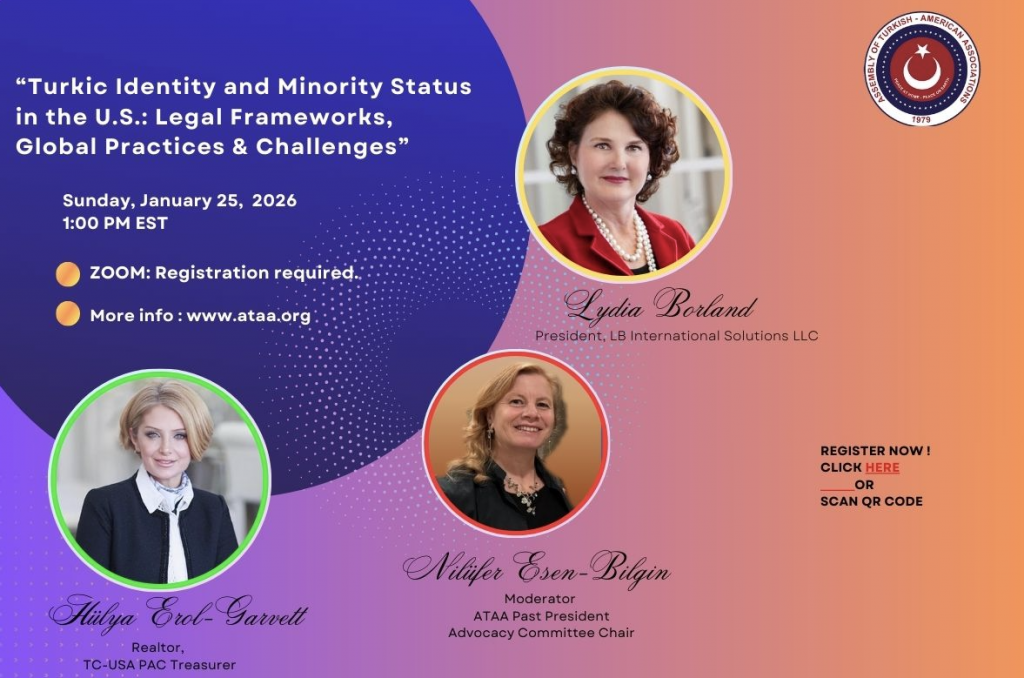
On January 25, 2026, the Assembly of Turkish American Associations (ATAA) hosted a timely and thought‑provoking webinar titled “Turkic Identity and Minority Status in the U.S.: Legal Frameworks, Global Practices & Challenges.” The event brought together community leaders and policy experts to examine how Turkic Americans are categorized within the American legal system—and why that categorization has real-world consequences.
The program was moderated by Nilüfer Esen‑Bilgin, ATAA Past President and Advocacy Committee Chair. Featured speakers included Hülya Erol‑Garvett, a civic advocate and community leader, and Lydia Borland, President of LB International Solutions LLC, who has extensive experience in government relations and policy analysis. Together, they unpacked a complex but crucial topic: how identity categories in the United States shape access to rights, resources, and representation.
At its core, the discussion explored how the United States defines and measures minority status—and how that differs from approaches in other parts of the world.
The speakers explained that in many European and international contexts, minority recognition often centers on language, culture, and religion, with a focus on protecting collective identity. The U.S. system, however, is largely structured around a civil-rights framework, where racial and ethnic categories are used to measure discrimination and disparities in areas such as housing, employment, education, healthcare, and political participation.
In the American context, being included in official data categories—especially those tied to the Census and federal standards—can determine whether a community’s challenges are documented and addressed. If a group is not clearly visible in those data systems, it may struggle to demonstrate need or advocate effectively.
The speakers highlighted how Turkic Americans often experience what they described as a form of “statistical fragmentation.” Members of the community may be categorized under broad classifications that do not fully capture their distinct identity. As a result, community-specific concerns may not be systematically tracked or measured.
A central theme of the webinar was the concept of invisibility—not as a symbolic issue, but as a structural one.
The discussion emphasized that invisibility in official data systems can carry tangible consequences:
Civil Rights Protection: If incidents of discrimination or bias affecting Turkic Americans are not consistently documented within recognized categories, it becomes more difficult to establish patterns and pursue remedies.
Education and Language Support: Public schools often rely on demographic data to justify heritage-language programs, culturally responsive services, and additional support resources. Without clear data, it can be challenging to demonstrate need.
Public Health and Social Services: Health programs and outreach initiatives are frequently designed based on measurable disparities. If a community is not visible in the data, its specific health needs may remain underexamined.
Funding for Nonprofits: Community organizations often depend on demographic evidence to compete for grants and public funding. Limited data can weaken applications and restrict growth.
Political Representation: Policymakers frequently rely on measurable population data when setting priorities. Communities that are difficult to count may also be easier to overlook.
The speakers stressed that in the American system, data drives decision-making. Being counted is not about seeking preferential treatment; it is about ensuring equal access to the protections and opportunities already embedded in the system.
Why This Matters for Turkish Americans
For Turkish Americans and the broader Turkic diaspora, the conversation comes at a pivotal time. Debates surrounding immigration, identity, and representation continue to shape national discourse. In this environment, understanding how identity is formally recognized—or not recognized—becomes an essential part of civic engagement.
The webinar underscored that recognition is not an abstract academic discussion. It affects whether communities can:
- Advocate effectively for their needs
- Preserve language and culture across generations
- Secure resources for educational and cultural institutions
- Participate fully and visibly in American civic life
Importantly, the speakers framed the issue not as one of separation, but of full participation with clarity of identity. The goal, they suggested, is not to distance Turkic Americans from broader society, but to ensure they are accurately represented within it.
The event also highlighted the importance of long-term civic engagement. Recognition within U.S. federal data systems is a complex process that requires advocacy, research, coalition-building, and sustained effort. Community organization, institutional development, and proactive engagement with policymakers were presented as essential components of building visibility.
Ultimately, the webinar delivered a clear message: in the United States, visibility in data often translates into visibility in policy. For Turkish Americans, understanding this framework is the first step toward ensuring that their community is not only culturally vibrant, but structurally recognized.
The cost of invisibility, as discussed during the program, is neither theoretical nor symbolic. It can shape access to rights, resources, and representation for years to come. By fostering informed dialogue on these issues, ATAA’s webinar contributed to a broader conversation about how Turkic Americans can navigate—and strengthen—their place within America’s diverse civic landscape.