
The Jets Washington Won't Sell, the Ally It Can't Afford to Lose, and What Every Turkish American Needs to Understand
Behind the F-16 talks quietly resumed between Ankara and Washington lies a combustible mix of Russian missiles, Greek lobbying, Israeli airstrikes in Syria, and a Congress that does not fully trust its own NATO ally. This is not just a defense story — it is the defining story of where Türkiye stands with America right now.
By the TCUSPAC Editorial Board | October 15, 2026
WASHINGTON — At a heavily secured NATO air base in Ramstein, Germany, on a September morning that drew almost no press coverage, Turkish and American air force officers sat across a conference table and resumed a conversation that has, in various forms, shadowed the alliance for nearly a decade.
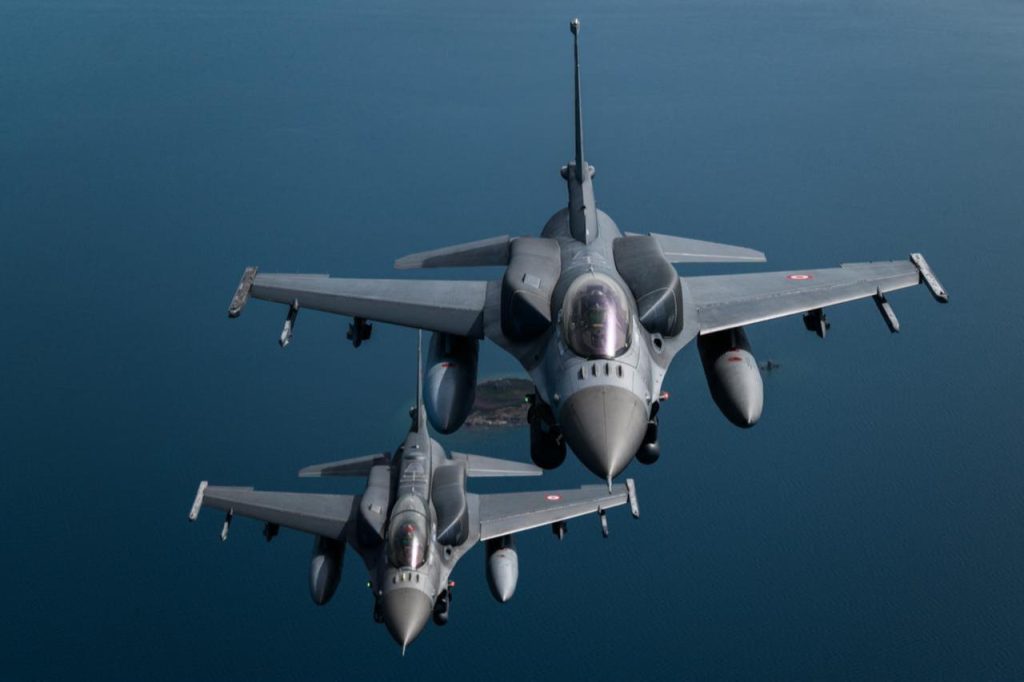
The subject was fighter jets — specifically, forty new F-16 Block 70 aircraft that Türkiye wants, has already paid roughly $1.5 billion to reserve, and has yet to receive. The meeting, confirmed by Türkiye’s Defense Ministry, was quiet by design. But the silence around it should not be confused with simplicity. The F-16 talks now sit at the intersection of the most consequential tensions defining U.S.-Türkiye relations: a Russian missile system Ankara refuses to give up, a Congress that remains deeply skeptical, a neighbor in Greece that is lobbying furiously to block the deal, and an Israel now striking sites in Syria where Turkish forces are quietly building influence.
To understand what happened at Ramstein — and why it matters far beyond the tarmacs of Turkish air bases — you have to understand all the moving pieces at once.
The Jet Türkiye Has and the Jet It Cannot Have
Start with the aircraft itself.
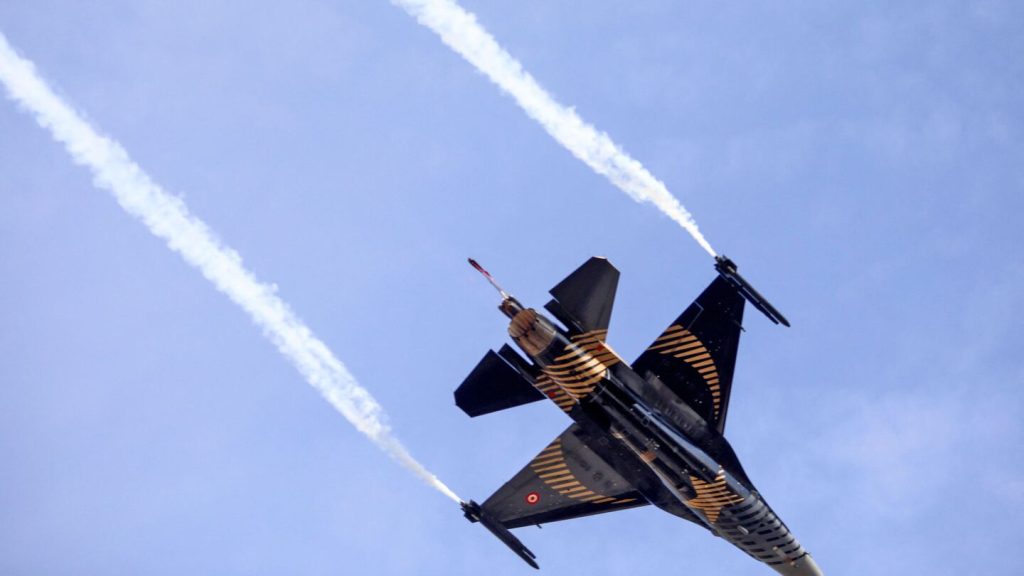
Türkiye’s air force today relies on a fleet of aging F-16 Fighting Falcons, some of them three decades old, and an even older cohort of F-4E Phantom jets now approaching retirement. For years, Ankara assumed it would bridge this generation gap with the F-35 Joint Strike Fighter — the United States’ crown jewel of fifth-generation stealth aviation. Türkiye was, in fact, a manufacturing partner in the F-35 program, with Turkish defense contractors producing components that went into every jet built anywhere in the world.
Then came the S-400.
In 2019, facing what officials in Ankara described as a refusal by Western governments to provide equivalent air defense systems at reasonable terms, Türkiye purchased the Russian-made S-400 missile defense system. Washington’s response was swift and punishing: Türkiye was expelled from the F-35 program entirely. Six F-35A jets already manufactured and bearing Turkish serial numbers were quietly transferred to storage at Edwards Air Force Base in California, where they remain today — a physical embodiment of an alliance stuck in place. In December 2020, the Trump administration imposed CAATSA sanctions on Türkiye’s Presidency of Defense Industries, the SSB, limiting the agency’s access to U.S. export licenses and certain financial services. As of this October, nothing fundamental has changed.
On July 22, the U.S. State Department formally notified Congress in writing that Türkiye has not met the legal conditions required to rejoin the F-35 program. On October 8, Secretary of State Marco Rubio reaffirmed the position: the legal barrier remains intact, and no transfer can occur while the S-400 remains in Turkish possession. The relevant statute, Section 1245 of the Fiscal Year 2020 National Defense Authorization Act, does not bend to diplomatic goodwill — it requires Türkiye to cease possession of the system. Turkish officials, for their part, have acknowledged exploring “creative ideas,” including the possibility of transferring the S-400 batteries to a third country — a concept that would require Russian consent and has produced no finalized agreement. This is the cage Ankara finds itself in. And the F-16 talks at Ramstein were, in large part, the most practical exit it can engineer right now.
The F-16 as a Bridge, Not a Consolation Prize
Viewed from Ankara, the forty new F-16 Block 70 aircraft are not a consolation prize for losing the F-35. They are a strategic bridge — the most ready-made solution available to prevent a dangerous gap in Türkiye’s air power before its next generation of aircraft arrives. The timeline makes the urgency plain. Türkiye’s indigenous fifth-generation fighter, the KAAN — a sleek twin-engine jet developed by Turkish Aerospace Industries that performed its maiden flight in 2024 — signed its first procurement contract in May 2026, covering an initial batch of 20 aircraft. But serial deliveries to the Turkish Air Force are not expected until the 2030s, with the first Block 1 aircraft targeted around 2028–2029. The Eurofighter Typhoons Türkiye contracted in October 2025 — twenty Tranche 4 aircraft — are similarly not expected before 2030. That leaves a window. An aging fleet, a growing gap, and a region in which the air power calculus is shifting rapidly around Türkiye.
The F-16 Block 70 fills that window. And Türkiye has made clear it is not merely window-shopping: the advance payment of approximately $1.5 billion has already been rendered. The complication, according to defense analyst Arda Mevlutoglu, is that the U.S. Department of Defense has not yet signed a formal production contract with Lockheed Martin for these 40 aircraft. Payment has been made. The jets have not been authorized into production. “Ankara expects concrete action,” a Turkish Cabinet source told reporters in late September. The patience in the room at Ramstein, it seems, is finite.
Greece: The NATO Ally Lobbying to Leave Türkiye Defenseless
Here is where the story takes a turn that every Turkish American should understand clearly. Türkiye’s air power deficit is not happening in a vacuum. It is happening as a fellow NATO member — Greece — is actively working in Washington to ensure that deficit deepens. Greece, which signed a contract to receive F-35 jets, has mounted an intense, multi-front diplomatic campaign to prevent Türkiye from receiving either F-35s or the advanced engines Türkiye needs for the KAAN fighter. Greek Defense Minister Nikos Dendias has stated publicly that Athens “would not welcome” the provision of advanced U.S. platforms to Ankara, arguing that Türkiye’s past military posturing in the Aegean — including a formal “casus belli” stance on Greek territorial waters — makes it an unreliable recipient.
Greece is building what it calls the “Achilles Shield,” a €3.5 billion integrated air defense network developed in partnership with Israeli defense technology. And in Washington, the lobbying infrastructure supporting this effort is formidable. Three prominent Greek-American advocacy organizations — the Hellenic American Leadership Council, the American Hellenic Institute, and the American Hellenic Educational Progressive Association — have coordinated with pro-Israel circles and members of the Hellenic Caucus in Congress to argue that transferring advanced aircraft to Türkiye would destabilize the Eastern Mediterranean and Aegean. This lobbying is not hypothetical. It is organized, well-funded and directed specifically at bipartisan members of Congress who hold sway over arms sales.
Türkiye, for its part, has responded. In August 2026, the Turkish Ministry of National Defense signed a one-year, $2.4 million annual contract with Ballard Partners, a Washington lobbying firm with close ties to the Trump administration, to advocate for Türkiye’s defense interests in Washington. The registered team includes prominent figures in Republican circles. The mandate, per the Foreign Agents Registration Act filing, covers the “wider” U.S.-Türkiye defense relationship. The lobbying battle over Türkiye’s air force is being fought on American soil, in American corridors of power, by American advocates — and right now, the Greek-American side has been in this game longer.
Israel: The Qualitative Edge and the Syrian Flash Point
The regional dimension complicates this further. Israel operates the F-35I Adir — the only variant of the F-35 permitted to integrate domestically developed avionics and electronic warfare systems. It is arguably the most technologically advanced combat aircraft in the Middle East. While Türkiye’s overall fleet is numerically larger, the Israeli Air Force holds a widely recognized qualitative edge in stealth capability, precision-strike reach, and long-range intelligence and targeting infrastructure. That gap matters more now because the two countries’ forces are operating in dangerously close proximity. In August 2026, Israeli aircraft struck the Abu al-Duhur airbase in Syria — a facility that Türkiye had identified as a site for building post-Assad security stabilization capacity. Israeli officials characterized the strikes as necessary to prevent the development of a military infrastructure they considered threatening. Turkish officials characterized them as an intrusion into a legitimate stabilization effort.
The incident did not escalate to direct confrontation. But the shrinking of buffer zones in post-Assad Syria — where both Israeli and Turkish military assets now operate closer to each other than at any point in recent memory — has raised the baseline risk of miscalculation. Israeli lobbying against Türkiye’s F-35 reinstatement mirrors Greece’s campaign: both governments argue that providing Türkiye with advanced fifth-generation aircraft would disturb a regional balance that currently favors their security posture. President Erdoğan has dismissed these objections directly. “These concerns have no place in this matter,” he said in a July press appearance. “Türkiye’s defense needs are sovereign decisions, and we will pursue them accordingly.” What he cannot dismiss is the reality that both Greece and Israel have influence in Washington — and that Türkiye, despite the Ballard Partners contract, is playing catch-up.
The Trump Factor: Personal Chemistry Is Not Policy
One element cuts through all of this in ways that are simultaneously promising and precarious. President Donald Trump, who met President Recep Tayyip Erdoğan on July 7 in Ankara before the NATO summit, has been consistently warmer toward Türkiye than Congress and much of the permanent national security establishment. “Good chemistry” and “a very special relationship” were his words at the joint appearance. He suggested the United States should not “sanction friends” and signaled willingness to revisit the S-400 restrictions. Trump attended the NATO summit, he said, partly because of his relationship with Erdoğan. Analysts noted this as a meaningful gesture of political investment. Yet Trump’s July meeting produced rhetoric, not resolution. The legal barriers — the NDAA provision, the active CAATSA sanctions on SSB, the State Department’s formal notification to Congress — remained in place in the weeks that followed. The president can express a preference; overturning a statutory prohibition requires an act of Congress or, at minimum, a formal presidential certification that the relevant conditions have been met. Congress remains unconvinced. By July, the Washington Post reported that Trump praised Erdoğa but stopped short of formally approving the fighter jet sale. Congressional opposition, particularly among members with close ties to Greek-American and pro-Israel constituencies, persists.
Al-Monitor’s October 4 analysis noted that the resumed F-16 talks appear timed, in part, around an expected next meeting between the two presidents. The hope in Ankara is that Trump’s personal engagement will provide the political cover to push the production contract through — or to accelerate movement on the S-400 impasse in a way that unlocks the F-35 path simultaneously. Personal relationships between presidents, however, are not alliances. They are variables.
What This Means for Turkish Americans: The Honest Assessment
For the Turkish American community, this story lands differently than it does for defense analysts or diplomatic correspondents. Let us be direct about what it does and does not mean. Your economic interests in defense are indirectly affected. The CAATSA sanctions on SSB limit the agency’s ability to receive U.S. export licenses and engage certain financial services. This does not automatically affect Turkish American individuals or businesses unconnected to SSB. But it does restrict joint ventures, technology transfers, and co-production arrangements in the defense sector between U.S. and Turkish entities at the governmental level. Turkish American entrepreneurs or professionals in aerospace, defense manufacturing, or dual-use technology should monitor how the sanctions landscape evolves.
The lobbying asymmetry is real and consequential. Greek-American advocacy organizations have been active in Congress for decades on precisely these issues. Their infrastructure, relationships and institutional memory are formidable. The Turkish Ministry of Defense’s new $2.4 million lobbying contract reflects a recognition that Türkiye has under-invested in Washington advocacy. Turkish Americans should understand that this fight is being waged by professional lobbyists on both sides — not by diplomats alone — and that community engagement with elected representatives matters.
The KAAN’s engine dependency creates a leverage point. In June 2026, the U.S. approved the export of General Electric F110-GE-129 engines for the KAAN Block 10 variant, a deal valued at approximately $705 million. This means Türkiye’s flagship independent defense program relies, in its early production phase, on American engines. That is a point of cooperation — but also a point of vulnerability. Should the political relationship deteriorate significantly, engine exports could be restricted. Turkish Americans who follow industrial policy should track this dependency.
The Syria situation warrants specific attention. The August Israeli strikes on an airbase in Syria that Türkiye was developing for stabilization purposes is not a distant geopolitical abstraction. If incidents like this escalate — if Turkish and Israeli forces come into more direct contact in Syrian airspace — the diplomatic temperature in Washington will rise rapidly. Members of Congress will be asked to take sides. Turkish Americans should monitor this trajectory and be prepared to engage their representatives with factual, grounded perspectives.
Do not confuse the president’s warmth with resolved policy. Trump’s personal rapport with Erdoğan is real and may ultimately prove useful. But it has not yet unlocked F-35 reinstatement, produced a production contract for the F-16 Block 70s, or lifted CAATSA sanctions. Track decisions, not declarations.
What Turkish Americans Should Do: A Grassroots Watch List
The following are specific, actionable developments that community organizations and engaged citizens should monitor and respond to:
1. Watch for a production contract announcement. The critical missing step in the F-16 Block 70 deal is a formal Department of Defense contract with Lockheed Martin. An announcement of that contract would represent the first concrete deliverable from the Ramstein talks. Its absence means the deal remains in pre-production limbo regardless of political signals.
2. Track Congressional notifications. Under U.S. law, proposed arms sales above specified thresholds trigger a formal notification to Congress that opens a 30-day window for members to file a resolution of disapproval. When — and if — a formal F-16 sale or F-35 transfer is proposed, that notification will trigger organized opposition. This is when community engagement with individual members of Congress carries the most direct influence.
3. Monitor the S-400 impasse for genuine movement. Discussions about transferring the S-400 to a third country require Russian consent and have not produced a finalized arrangement. If a credible resolution package emerges, it will likely require a new statutory certification by the executive branch and could face a congressional vote. That moment will be a decisive turning point.
4. Follow the Greek and Israeli lobbying filings. Foreign agent registrations and lobbying disclosure reports are public documents. HALC, AHI and AHEPA are active, visible organizations whose congressional outreach can be tracked. Understanding their arguments and counterarguing on the record with your own representatives is legitimate civic engagement — and it is underutilized.
5. Distinguish the KAAN engine deal from the F-16 and F-35 debates. The approved export of GE engines for the KAAN represents functioning U.S.-Türkiye defense industrial cooperation. This cooperation has beneficiaries on both sides — including American manufacturers and workers. It can be cited as evidence of the relationship’s constructive potential in conversations with policymakers who may be skeptical.
6. Do not assign Turkish Americans collective responsibility for Ankara’s decisions. Türkiye’s purchase of the S-400, its Syria policy, and its military posture toward Greece and Israel are decisions made by a government — not by a diaspora. Turkish Americans span a wide range of political perspectives, hold American citizenship, and are entitled to engage American politics on their own terms and in their own interests. No one should accept the premise that community members must answer for, defend or apologize for every decision made in Ankara.
The Bottom Line
The quiet meeting at Ramstein in September was about fighter jets. But the forty aircraft being discussed represent something much larger: whether the United States and Türkiye, despite years of friction, sanctions, Russian missiles, Greek lobbying and Syrian complications, can still find a functional working relationship — one rooted in durable institutions rather than the personal warmth of two leaders.
The F-16 Block 70 is Türkiye’s most immediate ask. The S-400’s disposal is Washington’s most immediate requirement. Greece and Israel will continue pushing to prevent both from moving forward. Congress will not simply defer to executive enthusiasm. And the KAAN fighter, the platform that was supposed to make Türkiye strategically self-sufficient, will not be ready for serial delivery for years.
In the space between these timelines, between the Ramstein conference table and the Capitol hearing rooms and the lobbying offices along K Street, decisions will be made that shape both the alliance and the community.
Turkish Americans who understand this space — who can speak to it clearly, advocate in it credibly, and engage it as the informed citizens they are — will be far better positioned than those who simply watch from the sidelines.
The jets are not just a story about aircraft. They are a story about whether Türkiye and America can get their relationship right. And that story has not yet reached its final chapter.
Sources
This article is based on reporting, official documents, and analysis reviewed through October 15, 2026. All factual claims are attributed to published sources below. The editorial analysis and watch points represent the independent judgment of TCUSPAC’s editorial board.
Al-Monitor — Barin Kayaoglu, October 4, 2026: “Turkey revives F-16 talks with US amid Israel, Greece deterrence concerns.” The foundational report on the Ramstein talks, aging fleet pressures, and the deterrence context.
Türkiye Today, September 27, 2026: “Türkiye presses Washington for action on delayed F-16 deliveries.” Details on the ~$1.5 billion advance payment and Ankara’s demand for “concrete action.”
MigFlug/Afterburner — August 20, 2026: “Turkey’s F-35 Return Still Frozen: S-400 and CAATSA in 2026.”Comprehensive analysis of CAATSA sanctions, the six stored F-35s at Edwards AFB, and legal barriers.
U.S. State Department / ekathimerini — July 22, 2026: “Turkey doesn’t meet legal conditions to rejoin F-35 program, State Dept. tells Congress.” The formal congressional notification.
Envantermedya — October 14, 2026: “Rubio: U.S. conditions on Türkiye’s six stored F-35s.” Secretary Rubio’s October 8 statement affirming the unchanged legal position.
TRT World — July 24, 2026: “Greece’s F-35 campaign against Türkiye.” Detailed account of Greek diplomatic efforts and Greek-American lobbying organizations opposing the deal.
Jerusalem Post — July 7 & 9, 2026: “Greece’s Achilles Shield and F-35 opposition to Türkiye.” Israeli and Greek perspectives on the deterrence balance.
Washington Post — July 9, 2026: “Trump praises Turkish leader, stops short of approving fighter jet sale.”Coverage of the Trump-Erdoğan July 7 bilateral and Congressional resistance.
Bosphorus News — August 27, 2026: “Türkiye Defense Ministry hires Ballard Partners for U.S. defense lobbying.” The $2.4 million FARA-registered lobbying contract.
Breaking Defense — May 8, 2026: “Turkish Air Force contracts its first batch of indigenous KAAN jets.” The May 2026 procurement contract for 20 KAAN aircraft and delivery timeline.
War on the Rocks — September 7, 2026: “Shrinking Buffers: Why Türkiye and Israel Are on a Collision Course.” Analysis of the Abu al-Duhur airbase strikes and escalation risks in Syria.
Eurasian Times — August 20, 2026: “Turkey a serious air power despite aging F-16s: Israeli analyst after near-clash over Syrian airbase.” Post-incident analysis of the Türkiye-Israel air power dynamics.
Al Jazeera — July 7, 2026: “NATO’s Türkiye Summit live: Trump and leaders meet in Ankara.” Live coverage of the NATO summit and Trump-Erdoğan bilateral.